
 E-Paper



Operation Abhyaas fails to make an impact in Gurugram
Gurugram deputy commissioner Ajay Kumar, who led the initiative, monitored the entire drill from a central control room set up at the Mini Secretariat.

 Prefer HTon Google


Gurugram: ‘Operation Abhyaas’, aimed at observing a symbolic blackout to honour the armed forces, failed to garner significant participation in Gurugram on Tuesday night. Despite appeals for a citywide lights-out from 7:50pm to 8:00pm, most residential societies did not comply, and traffic continued to move as usual. Several residents said they were unaware of the exact timings or purpose of the blackout, while others questioned the effectiveness of such symbolic gestures.
In multiple sectors, streetlights and common area lighting remained operational, and there was no visible reduction in electricity consumption. “There was no clear communication. We only heard about it through forwards on WhatsApp, and there was no official circular,” said Kusum Sharma, a resident of Suncity Township of Sector 54. The lack of coordination and communication from the authorities appears to have contributed to the overall failure of the campaign in the city.
Lack of clarity and information made the blackout in Gurugram and Faridabad, a sheer failure.
To start with local authorities failed to sort things out at their level-- all street lights, park lights etc were fully functional. A majority of these are solar powered so they remained lit. Not only this-- restaurants, malls, clubs all public places and individual homes failed to abide by the blackout instructions. While some blamed poor volume of sirens for this other said that they were not properly informed.
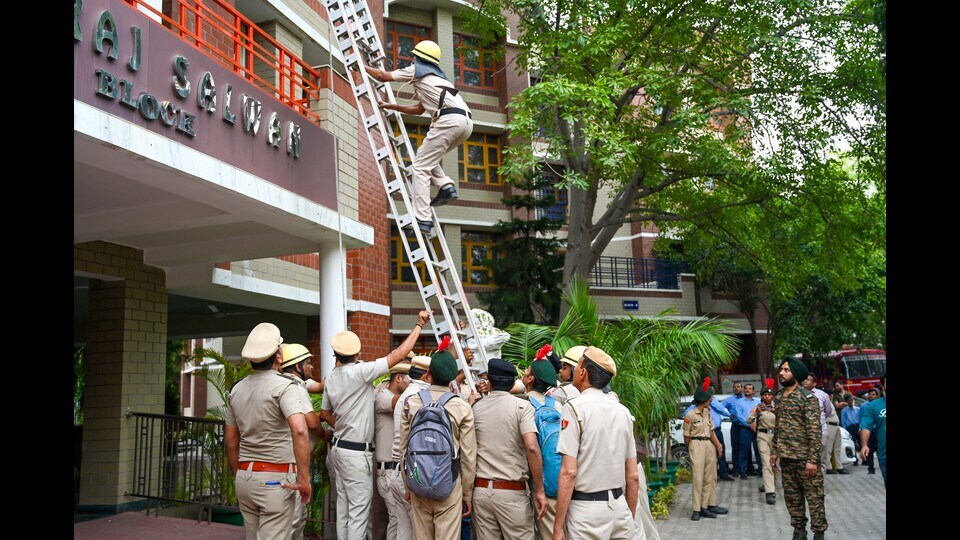
A large-scale civil defence drill was conducted across Gurugram on Wednesday, to raise public awareness and test emergency preparedness in case of an air raid. At exactly 4pm, a siren echoed through the city, signalling the start of the exercise. People across five key locations—Ambience Mall, Sector 4/7 Government School, Salwan Public School in Sector 15 Part 2, Hero MotoCorp at Hero Honda Chowk, and the Power Grid in Garhi Bajidpur— responded to the simulated alert with coordinated efforts.
Gurugram deputy commissioner Ajay Kumar, who led the initiative, monitored the entire drill from a central control room set up at the Mini Secretariat. The Tau Devi Lal Stadium served as the command staging area, from where five task forces led by senior officers were deployed. Each team carried out rescue operations, coordinated with police, civil defence, and fire services and simulated real-time evacuation and medical aid. At many sites, civilians trapped on upper floors were successfully rescued using mock emergency protocols.
Named Operation Abhyas, Kumar said that the exercise, conducted under the Ministry of Home Affairs’ nationwide civil defence directive, aimed to test and strengthen Gurugram’s emergency response system. “This drill teaches citizens how to act swiftly and responsibly during an air raid. Knowing where to shelter, how to blackout a home, and how to assist others can save lives,” he said.
Officials reiterated that the drill was not only a test of infrastructure but also a means to mentally and physically prepare citizens for real emergencies. The DC urged the public to report any suspicious activities and reminded them that the state government has officially implemented the Incident Response System (IRS) under the Disaster Management Act, 2005 to streamline emergency protocols.
The evening concluded with a review meeting at Tau Devi Lal Stadium, where task force leaders briefed the DC and the police chief on the drill’s outcomes, successes, and areas of improvement.


