
 E-Paper



Traffic police adopt ‘minimal’ checks to detect GRAP-II violations; BS-IV entry allowed
As per CAQM’s recent directive, vehicles compliant with BS-III or lower emission norms and all commercial goods vehicles registered outside Delhi will be prohibited from crossing into Delhi’s borders from November 1.

 Prefer HTon Google


Gurugram: Denying reports of polluting commercial vehicles entering Delhi without any checks at Sirhol toll plaza, officials on Saturday said that automated cameras were scanning registration plates to detect violations.
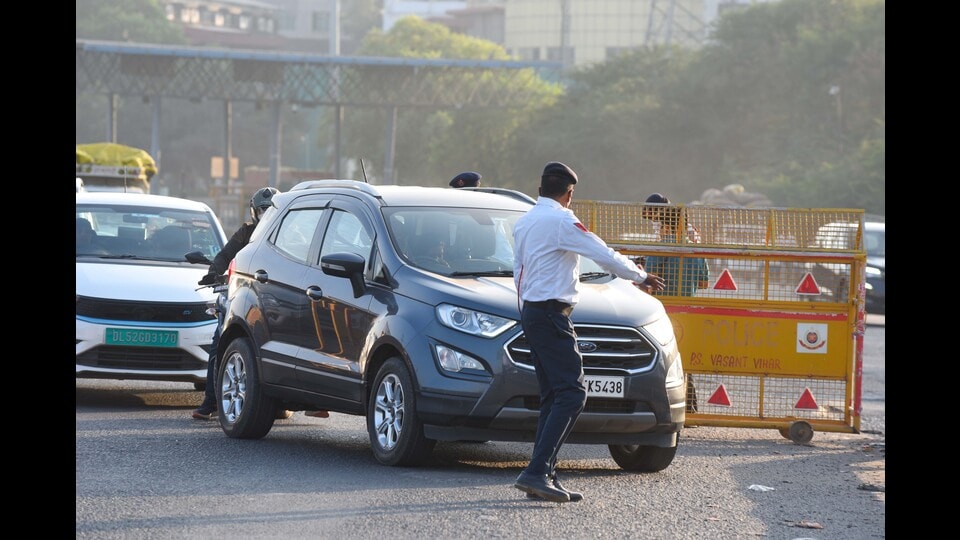
According to officials, around 141 vehicles were stopped for inspections at various checkpoints on the four busiest border points connecting Delhi and Gurugram, including Sirhol Toll Plaza, and on Dwarka Expressway. Of these, 38 were stopped at a checkpoint on the Delhi-Jaipur-Gurugram expressway (NH48), around one km from the Sirhol toll plaza, and three were returned to the city, according to officials.
As per the Commission for Air Quality Management’s (CAQM’s) recent directive, vehicles compliant with BS-III or lower emission norms and all commercial goods vehicles registered outside Delhi will be prohibited from crossing into Delhi’s borders from November 1. Under the transitional arrangement, BS-IV compliant commercial vehicles will still be permitted until 31 October 2026.
Dr Rakesh Mohan, DCP (Traffic), said police relied on both traditional and technological methods to enforce the CAQM order.
“We are relying on automatic registration plate recognition (ANPR) cameras and real-time scanning through in-built platforms to track emission records of vehicles,” DCP Mohal said.
According to officials, a similar arrangement has been made on the Dwarka expressway and the Dhundahera-Kapashera border to track vehicles, along with the help of the department of state transport and the Delhi Police.
Officials blamed possible traffic congestion for not manually checking every motorist on expressways.
“Based on any suspicious movement and old registration plates, our zonal officers at checkpoints also stop large goods and heavy goods vehicles,” a senior official said, requesting anonymity.
The official added that around 120 patrolling officers deployed on all three borders were monitoring vehicles round the clock .
“Once any vehicle not aligned to emission norms is detected at toll plazas, the information is dispatched to zonal officers deployed at nearby checkpoints to stop and challan it,” added the DCP.


