
 E-Paper



72 lives lost in 11 months, citizens demand action after tragic accident
Wagholi stretch of Pune-Ahmednagar highway sees 72 fatalities in 11 months. Citizens demand strict action against reckless heavy vehicle violations.


The Wagholi stretch of the Pune-Ahmednagar highway has become a death trap, with 72 fatalities recorded in the past 11 months. In the wee hours of Monday, yet another horrifying accident claimed three lives and injured six, fuelling citizen outrage over the rampant violations by heavy vehicles. In the latest incident, a dumper driven by an inebriated driver ran over nine people sleeping on the footpath outside the Wagholi police station. Among the deceased were a one-year-old girl, a two-year-old boy, and a 22-year-old man. The driver, identified as Gajanan Shankar Totre, was arrested on the spot.
Following the incident, relatives and others forced to sleep on the footpath staged a protest, blocking the highway for some time in the evening, while demanding action against the driver as well as better traffic movement in the area.
According to police, the victims included siblings Vaibhavi Pawar (1) and Ritesh Pawar (2), along with their relative Vishal Vinod Pawar (22).
“The dumper (MH 12 VF 0437) went out of control and ploughed into the sleeping group at around 1 AM,” said an officer from the Wagholi police station.
This incident is only the latest in a string of fatal accidents caused by heavy vehicles in Wagholi. In October, a 32-year-old woman on a two-wheeler was killed instantly after being hit by a speeding dumper during restricted hours for heavy vehicles. Her husband was severely injured.
Unregulated heavy traffic a major concern
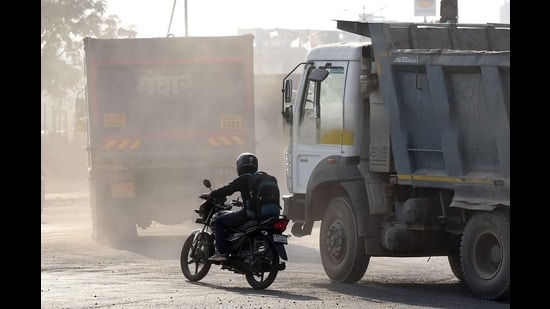
The Wagholi stretch, which serves as a transit route for dumpers carrying construction materials for numerous development projects in the area, is plagued by reckless driving and traffic law violations. Despite a ban on heavy vehicle movement during peak hours, restrictions are rarely enforced.
Anil Kumar Mishra, president of the Wagholi Against Corruption Organisation (WACO), accused the traffic authorities of turning a blind eye to the violations.
“The latest tragedy once again highlights the complete indifference of the administration. Traffic rules are flouted daily, and bribes are taken to allow unauthorised vehicles. This negligence is costing innocent lives,” said Mishra.
Mishra also alleged that corruption is deeply entrenched in the system.
“The administration is enabling illegal transport by accepting bribes. We demand an overhaul of the traffic system in Wagholi within a month. If no action is taken, WACO will organise a large-scale protest against this injustice.”
A deadly toll
Data from Yerawada police indicates that from January to November 2024, 72 people have died on this highway stretch. The lack of proper traffic management and the unchecked movement of heavy vehicles contribute to the alarming frequency of accidents.
“The highway has become a daily risk for commuters. With dumpers and other heavy vehicles operating at high speeds, there is little regard for safety,” said a local activist, who also pointed out the poor state of infrastructure and the absence of pedestrian safety measures.
Demand for accountability
Citizens and organisations have also demanded immediate measures to address the situation.
Deputy Commissioner of Police (Traffic) Sunil Gaikwad acknowledged the issue and said, “We will initiate stricter action against violators and review heavy vehicle movement in the area. Public safety remains our priority.”
However, for residents of Wagholi, assurances are no longer enough. “We need concrete action now. How many more lives need to be lost before the authorities wake up?” asked Mishra, reflecting the sentiment of an outraged community.
As the situation stands, the Wagholi stretch remains perilous, and without immediate intervention, it is only a matter of time before, yet another tragedy unfolds.
Suggestions by citizens to address the situation:
Strict enforcement of traffic rules, especially during restricted hours
Installation of speed cameras and barriers to monitor and control heavy vehicle movement
Regular checks on drivers for compliance with safety standards, including sobriety tests
Development of an alternate route for heavy vehicles to reduce their presence on residential stretches


