
 E-Paper



After GBS-linked death, PMC, PCMC to collect patient data from private hospitals
The exercise is aimed at identifying unusual trends in GBS cases and deaths that may go unreported to civic health departments


Following the death of a 36-year-old teacher from Kalewadi due to Guillain-Barré Syndrome (GBS) at Yashwantrao Chavan Memorial Hospital (YCMH) on November 22, the Pune Municipal Corporation (PMC) and Pimpri-Chinchwad Municipal Corporation (PCMC) will seek details of all GBS patients treated at private hospitals.
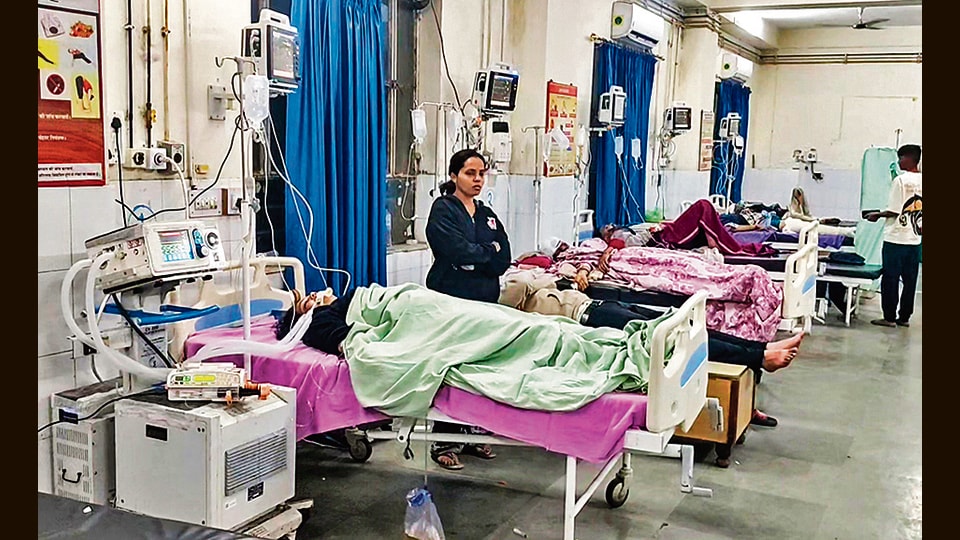
The exercise is aimed at identifying unusual trends in GBS cases and deaths that may go unreported to civic health departments.
According to officials, the woman had approached a private hospital after experiencing weakness in her legs. As her condition worsened, she was admitted to the intensive care unit at the civic-run New Thergaon Hospital before being shifted to YCMH.
“The woman died while undergoing treatment at our hospital. The patient had symptoms of GBS and is clinically a confirmed GBS patient. We are also collecting the numbers of GBS patients who underwent treatment at YCMH in the past three months,” said Dr Rajendra Wabale, dean of YCMH.
PCMC health chief Dr Laxman Gophane said the civic body had asked YCMH doctors to check whether a nerve conduction test had been conducted on the deceased.
“We have asked the YCMH doctors to check if nerve conduction tests were done on the deceased patient. There is a possibility of sporadic cases, but there has been no unusual surge in GBS cases. However, we will issue a letter to all private hospitals to provide details of GBS patients reported at their facilities this year,” Gophane said.
GBS is a rare neurological disorder in which the body’s immune system attacks the peripheral nerves.
Collecting data from private hospitals is particularly important because GBS is not a notifiable disease, meaning hospitals are not routinely required to report every case to the government. This makes independent monitoring difficult.
The PMC reported an unusual surge in GBS cases beginning January 9 last year, particularly in Nande Gaon, Nanded, Dhayari, Kirkitwadi and Khadakwasla. A total of 141 suspected cases were reported, of which 120 were confirmed. This was the largest cluster of GBS cases reported in the country.
Dr Nina Borade, health chief of the PMC, said the earlier outbreak in Pune was waterborne and linked to Norovirus and Campylobacter jejuni. Following the outbreak, the civic body stepped up water-quality monitoring and surveillance of diarrhoea and dysentery cases.
“The GBS outbreak in Pune was waterborne and due to Norovirus and Campylobacter jejuni. Following this, we have started monitoring water samples to maintain water quality. Regular communication and letters are being sent to the civic water department to check water quality and test samples as a special precaution,” Borade said.
She added that the PMC would issue instructions to collect data from private hospitals.
The PMC has also initiated short- and long-term measures to prevent a recurrence of the outbreak. Additional Municipal Commissioner Pavneet Kaur said the chlorination system had been automated as an immediate measure. Earlier, water was chlorinated manually.
As part of its long-term plan, the PMC has secured approval for a separate ₹890-crore water supply project covering 12 villages affected during the GBS outbreak.
The 12 villages are Khadakwasla, Nanded, Nandoshi, Suncity, Kirkitwadi, Dhayari, Narhe, Jambhulwadi, Kolhewadi, Mangadewadi, Nimbalkarwadi and Bhilarewadi.
“Following the GBS outbreak, we have started both short-term and long-term measures to prevent similar outbreaks in the future. As a short-term measure, the chlorination system has been automated. Water samples are tested regularly to check for contamination, and the health team conducts surveillance in the affected villages,” Kaur said.
She said the ₹890-crore project would strengthen water supply infrastructure in the 12 villages and ensure a more reliable supply of clean drinking water.


