
 E-Paper



Committees and plans pile up, but Pune traffic mess continues
The city-level traffic advisory committee will establish 34 committees at the traffic police station-level

 Prefer HTon Google


PUNE: From the Pune unified metropolitan transport authority (PUMTA) and Mission 32 to the city transformation committee, the state’s high-powered Pune traffic committee, and now 34 new traffic police station-level committees; Pune has created/resurrected a string of mechanisms over the years to tackle its traffic problems. However, potholes, illegal parking, encroachments, bottlenecks and chaotic junctions continue to plague motorists, raising questions whether the latest committees will deliver where the earlier ones struggled.
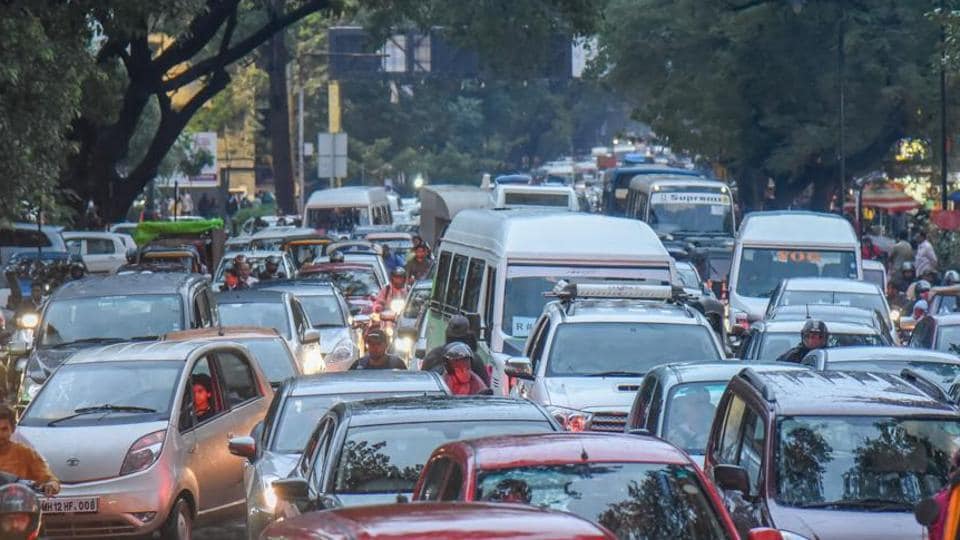
The city-level traffic advisory committee will establish 34 committees at the traffic police station-level. A representative of the main committee will be associated with each local panel that will include local stakeholders and Pune Municipal Corporation (PMC) officials.
These committees will identify and address problems specific to their jurisdictions, including unauthorised or obstructive parking at road corners, blocked footpaths, congestion caused by hawkers, signal synchronisation, free-left turns and poor road conditions.
“The committees will also be expected to take ownership of local problems. For instance, if potholes or other road-related issues are causing traffic obstruction, the concerned committee will coordinate with the civic authorities for their prompt resolution,” said police commissioner Amitesh Kumar.
However, the proliferation of committees is not new. Over the past 15 years, Pune has repeatedly turned to institutional mechanisms to address its traffic and transport problems; be it traffic management committees constituted in 2010 or the city transformation committee and Pune traffic committee established earlier this year or the 34 committees that are now set to take shape.
Traffic expert Ranjit Gadgil said that committees can be useful but only if they are representative and focused on solving problems raised by citizens. “Committees are very important, but overall representation is mandatory. Also, committees should try to solve issues being faced or raised by common people; otherwise, people will start losing interest, and it will remain only on paper,” he said. Gadgil said that the city’s congestion also needs to be addressed by strengthening public transport and restricting the use of private vehicles.
On his part, additional commissioner of police (traffic) Manoj Patil said that the new committees will provide citizens with a platform that was previously unavailable to them. “Earlier, there was no such platform for common people to express themselves. These 34 traffic police station-level committees will provide them with a platform to raise local issues and get them addressed with the help of local police and other authorities,” he said.
Whereas PMC commissioner Naval Kishore Ram said that committees are necessary to coordinate between departments but acknowledged that the focus now has to be on implementation. “Yes, committees are important for coordination among various departments to solve a particular issue. It is true that now we have to focus on groundwork, and PMC is doing the same thing to get desired results,” he said.
Pune district collector Jitendra Dudi said that the state government has constituted two major committees for projects affecting the district’s transport infrastructure — one, dealing with the inner and outer ring roads, underground tunnels and related infrastructure; and the other, focused on issues in the Chakan industrial area. “These are the two main committees handling traffic and various infrastructure-related issues, and you can see results in the near future,” he said.
But the proliferation of committees has also highlighted a larger problem: coordination is often easier to announce than to execute. Pune’s roads fall under multiple agencies, including the PMC, PMRDA, PWD, NHAI, MIDC and traffic police, making responsibility for individual problems diffuse. For the latest committees to make a difference, traffic experts said that each problem will need a clearly identified agency, a deadline, funding where required, and a mechanism to track whether the promised action has actually been completed.
For Pune’s motorists, the test will ultimately be straightforward: not how many committees are formed, but whether potholes disappear, footpaths become usable, junctions work better, illegal parking is controlled, and traffic queues finally begin to shrink.


