
 E-Paper



Monday Musings: India’s first school for girls slowly collapses as restoration plans stay put
For years, politicians from different parties have been using Jyotirao and Savitribai Phule’s names to garner votes, but have failed to rebuild the historic Bhide Wada in Pune

 Prefer HTon Google


It has been 175 years since India’s first school for girls was started by Jyotiba and Savitribai Phule at historic Bhide Wada in Pune on January 1, 1848. The structure is currently in shambles, and unfortunately, even after so many years, the rulers have not been able to redevelop it.
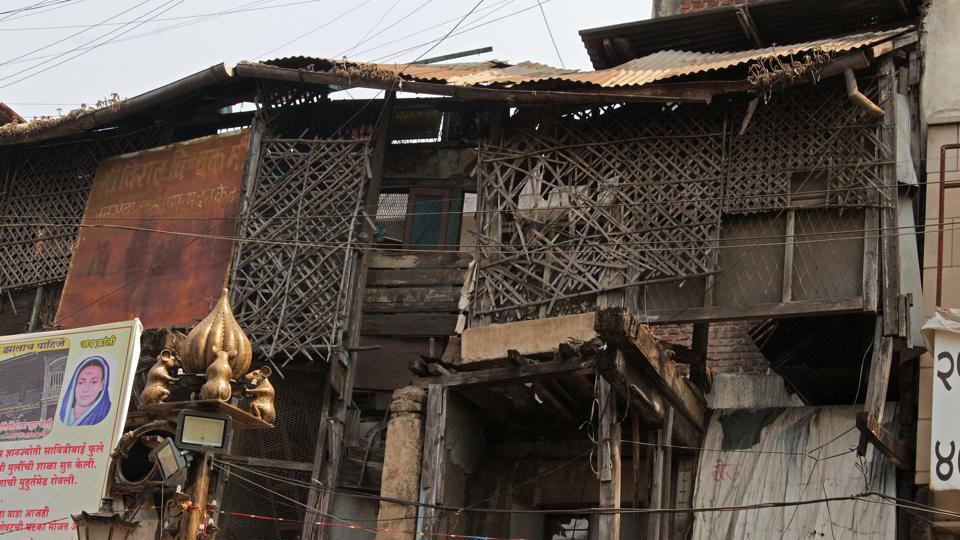
During the recently concluded state assembly session at Nagpur, chief minister Eknath Shinde asked the administration to prepare a report about the redevelopment of Bhide Wada. At present, the structure is in a dilapidated state and the school that used to be held here was shut down almost 16 years ago.
Shinde has directed Pune collector and municipal commissioner to hold a meeting with the tenants of Bhide Wada in Pune and submit the final report. For all these years, politicians have been seeking the redevelopment of the structure and replacing it with a national monument. However, this has not taken off due to issues related to opposition from shop owners, who run their businesses from the premises. There have been litigations involved.
Presently, the wada, the then home of Tatya Saheb Bhide, who was inspired by the Phules’ work, hosts crumbling walls, broken wooden doors and windows, and a nearly completely covered floor with grass.
As per the original plan, the government proposes to build a seven-storey structure that will have five floors reserved for the school. These floors will have all the modern amenities including. The school will be run by Pune Municipal Corporation (PMC), and the basement will house shops, which are already located there.
Earlier in 2021, the Maha Vikas Aghadi (MVA) government also attempted to prepare a plan for redevelopment of the structure. However, the shop owners and residents are not in the mood to leave the place, putting on hold efforts by then ministers Chhagan Bhujbal and Ajit Pawar. Previously too state government and PMC have frequently stated that the crumbling structure will be redeveloped to include a memorial for the school and its founders, but the plans have not materialised.
For years, politicians from different parties have been using Jyotirao and Savitribai Phule’s names to garner votes, but have failed to rebuild the structure. With an eye on votes from other backward communities, the state government under then chief minister Prithviraj Chavan renamed the University of Pune to Savitraibai Phule Pune University.
Sharad Pawar, Nationalist Congress Party (NCP) chief has also attempted to consolidate his OBC vote bank by whipping up sentiments on emotional issues in the past. In 2018, Pawar, at a public meeting had asked party workers to shun the Puneri pagdi (turban) and instead use the Phule pagdi.
In Maharashtra, Puneri pagdi is historically associated with the Peshwas, the Brahmin prime ministers of the Maratha empire. On the other hand, the Phule pagadi is associated with social reformer Mahatma Phule and is seen as a symbol of “bahujans” - a euphemism used for scheduled castes, scheduled tribes and OBCs.
The Bharatiya Janata Party (BJP) too has not been behind and has attempted in its own ways to attract OBCs on its side.
When the Phule couple started teaching at Bhide Wada, the school’s curriculum was different from what was taught by Brahmin teachers in their home schools. It included mathematics, science and social studies instead of Brahmanical texts like Vedas and Shastras.
Within three years, Phule’s school saw around 150 girl students enrolled with the couple running three schools in Pune by 1851. The teaching methods at their schools were believed to be better than government schools and soon the number of girls enrolled in Phule’s schools outnumbered that of the boys in government schools.
If rulers are serious, the least they could do is to bring this structure back to its former splendour.


