
 E-Paper



Startup Mantra: From a hyperloop dream to motors that move factories
For Pune-based Quintrans, the journey from hyperloop research to industrial automation began with a discovery


The ambition of building a train that travels at extraordinary speed brought four engineering students together. But, the business they eventually built took shape around something much smaller — the components that make machines move.
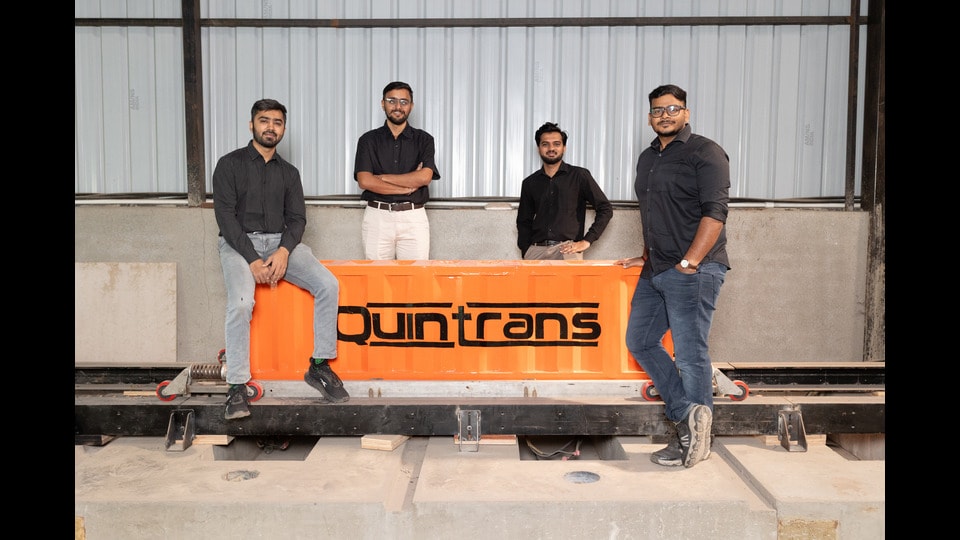
For Pune-based Quintrans, the journey from hyperloop research to industrial automation began with a discovery. The technology developed to propel and levitate a transport pod could also find applications in robotics, warehouses and factories.
Make in India
“It started with hyperloop. In 2021, we set out as a hyperloop startup, growing out of VegaPod Hyperloop, our student research team at MIT WPU,” says Anirudh Atigre, co-founder of Quintrans. “Our dream was simple: build hyperloop technology in India for the world.”
Atigre and his fellow founders, Prasanna Kadambi, Pranay Luniya and Kartik Kulkarni, had been working together since their second year of college in 2018. Their student research laid the foundation for the company, which they established in 2021.
As they explored commercial applications, linear motion emerged as an opportunity. These systems move a load along a straight path and can perform tasks ranging from pressing a keypad to positioning components inside industrial equipment.
The founders saw potential customers across pharmaceuticals, semiconductors, automobiles and factory automation. They also saw an opening for domestic manufacturing.
“Yet nobody in India was making these motors. Everything came from China or Europe. We wanted engineers and manufacturers here to have an Indian option,” says Atigre.
Turning that ambition into a product required money, equipment and repeated experimentation. The founders developed a proof of concept for their actuators over the past year, working through two or three iterations before arriving at a version that helped them raise capital.
First sale
Their first sale offered a practical demonstration of where the technology could fit. A lock automation company needed to test its digital locks. Quintrans supplied micro actuators that automated key pressing during testing.
The order gave the team an application beyond the laboratory and a starting point for reaching other customers.
Today, Quintrans operates across two product lines. Its electromechanical products address customers already purchasing imported equipment. Here, the company’s pitch centres on faster delivery and service from a local manufacturer. Its electromagnetic products, including linear motors and voice coils, represent the next stage of the business. These direct-drive systems use electromagnetic force to produce movement.
Quintrans is approaching potential customers in pharmaceuticals, semiconductors and medical devices while also receiving enquiries from businesses seeking an Indian supplier, says Atigre.
For now, most revenue comes from electromechanical products. Micro actuators sold through Amazon, Robu and Flipkart contribute a smaller share. Larger contributions come from pilot orders with robotics businesses, including Hachidori Robotics and Unbox Robotics, alongside defence applications.
Market launch
The flagship linear motor is still being commercialised, with a market launch expected within the next three months. Funding has come from both the founders and institutional investors. The four founders have collectively invested ₹12–15 lakh of their own money. Quintrans has also raised institutional capital of ₹7 crore from Capital A and other partners.
“Every rupee raised so far has been equity, and the founders hold almost equal stakes,” says Atigre.
The company is now working towards another funding round of roughly $5 million. Discussions remain unconfirmed, but the founders hope to close the round by May–June 2027.
The proposed capital would support the commercialisation and production of a broader electromagnetic portfolio, including linear motors, voice coils and coreless motors. Atigre expects these premium products to attract customers with more demanding applications and offer better margins.
“For the next year, our focus is on setting up the production line for these direct-drive electromagnetic products,” he says.
Over five years, the founders want Quintrans to move beyond supplying individual components and begin building complete systems. That would mean designing assembly lines and machines powered by the company’s own actuators.
International expansion
International expansion is also part of the plan, with Europe, particularly Germany, and China among the markets the team wants to enter.
“Over the next five years, we want to grow from a component player into a systems player,” says Atigre.
The hyperloop ambition gave the founders a reason to begin working together. Their immediate challenge is now to turn that research into products that manufacturers will buy, install and use.


