
 E-Paper



Sutradhara’s Tales: When Pune city became Shaiste Khan’s military camp
Shaiste Khan arrived via the Phaltan-Baramati route and tried to capture fort Purandar. But, Marathas defended the fort and Shaiste Khan had to retreat to Saswad. He eventually came to Pune and took over the entire region from the Marathas

 Prefer HTon Google


When young a Shivaji Raje was sent to Pune along with Jijabai and Dadoji Konddev, Shahaji Raje equipped him with his own Ashta pradhan mandal (ministry of eight). Dadoji Konddev was the “karbhari”- in charge of running the entire jahagir (feudal land grant) from Indapur and Supe, to Baramati and Shirwal, on behalf of Shahaji.
The jahagir also included a region of 12 mavals (sub regions to the west of Pune), which were remote and known for rice cultivation.
Shivaji Raje, essentially an employee of Shahaji Raje, was made “Pot Mokasdar” (sub-letter of land rights), directly in charge of 36 villages in the Karyant maval, stretching from fort Sinhagad to Pune city. By the age of 15-16, Shivaji started actively looking after the entire jahagir. He, along with Dadoji Konddev, managed to subjugate various Deshmukhs of the 12 mavals, including Bandal Deshmukh. He took stringent action against powerful miscreants and sexual offenders such as the Patil of village Ranjhe, which helped with recognition of his power, even at a young age.
Under Adilshahi, the forts were ruled by central powers, while the flat productive lands were part of jahagirs. However, except for fort Sinhagad and Purandar, which were connected to the mainland, remote forts were largely neglected. With his base as Pune, the period between 1645 and 1647 was effectively utilised by Shivaji to conquer various forts in the Maval region of Pune.
Fort Sinhagad was the strategic fort to rule over Pune city. Shivaji took over Kondhana (Sinhagad) by bribing the Adilshahi governor and with help of Honap Deshpande.
In 1645, fort Torna was conquered with help of a small infantry led by Yesaji Kank, Tanaji Malusure and Baji Pasalkar.
Rajgad hill (Murumb Deo Dongar) was taken over and was built into a formidable fortress with treasure found at Torna. Fort Rajgad later went on to become first fort capital of Maratha Empire.
After the death of Dadoji Konddev in 1647, Shivaji consolidated his powers by taking over Supe. He raided Junnar and retrieved a huge treasure and horses. His activities irked the Adlshahi court and Fateh Khan was sent to act against Shivaji.
However, Shivaji managed to defeat Fateh Khan at Khalad-Belsar, but lost his comrades Baji Pasalkar and Godaji Jagtap in the battle.
When Nilkanthrai, the commander of Purandar, died, Shivaji under the pretext of solving a dispute, first arrested, and then recruited the surviving heirs under his independent rule.
Subsequently, forts Rajmachi, Lohagad, and Rohida were included in the newly formed “Swaraj”.
After 1655, Shivaji Maharaj preferred staying at forts Purandar, Sinhagad and Rajgad. The departure of the ruler from Pune affected the morale of local people, there was a lull in city life and the population receded.
The development of Pune, kick-started by the arrival of Shivaji, came to an abrupt halt, and Pune became just another town on the map of the Deccan.
The death of prominent Adilshahi sardar, Afzalkhan at the hands of Shivaji in 1656 was a shocking event and made all of India take note.
After accession to the throne in 1659 after emperor Shahajahan’s death, Aurangzeb took rein over most of India, including the Deccan.
Shivaji Raje’s “swaraj adventures”, by then, had attracted the attention of the Mughal court. Shivaji’s new stature placed him in the way of the southward expansion of the Mughal Empire. He had already earned Aurangzeb’s wrath by pillaging Aurangzeb’s domains.
Without wasting any time, Aurangzeb sent his maternal uncle and trusted commander, Shaiste Khan as subhedar (governor) of Deccan to defeat Shivaji in 1660.
Shaiste Khan arrived via the Phaltan-Baramati route and tried to capture fort Purandar. But, Marathas defended the fort and Shaiste Khan had to retreat to Saswad. He eventually came to Pune and took over the entire region from the Marathas. His commanders captured fort Sangramdurg at Chakan after fierce resistance from Firangoji Narsala for two months.
Shaiste Khan descended into the Deccan with a huge army of 40-50 thousand. And on conquering Pune in May 1660, Shaiste Khan made Lal Mahal, the former residence of Shivaji Maharaj, his base. There was no prominent town in the region of the 12 mavals, except Pune, to accommodate such an army. The city also provided the necessary space along the river banks. The fertile region around Pune was raided for grains and other requirements.
The population of Pune swelled overnight and the entire town was made into a military camp. Krishnaji Kalbhor was given the Deshmukhi of Pune in 1662. The original Kasba peth, Shahapura and Somwar were not enough to accommodate the requirements of the camp. Hence, Shaiste Khan went on to settle a new peth, Shastapura, along the river and beyond the Nagjhari stream, which is the present day Mangalwar peth.
The military also brought in various artisan communities to settle in Pune. Prominent among them were shikalgars (weapon makers) and kagajis. A separate Kagazipura was settled to the east of Kasba for paper making.
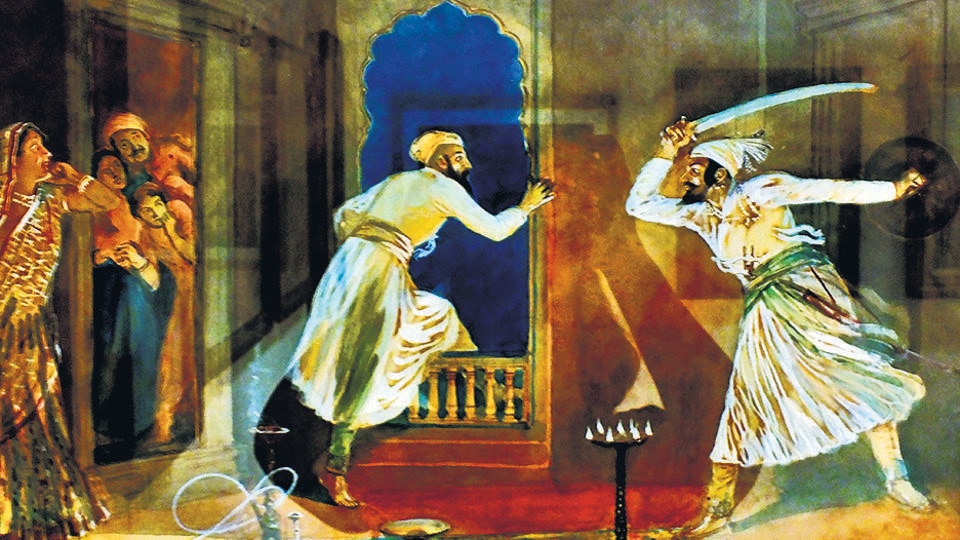
Shivaji Maharaj waited for the right opportunity to reconquer Pune and on April 5, 1663, he secretly attacked the Mughal camp in Pune. Shivaji was at Sinhagad, 20km from Pune, and under the pretext of a marriage procession managed to sneak in 200-300 Maratha soldiers dressed as the marriage party and as labourers, with the help of Pune’s Kotwal.
It was the month of Ramadan, the Muslim month of fasting, and security around Lal Mahal was slack. At midnight Shivaji and his squad of men sneaked into Lal Mahal, which he was intimately familiar with. He led the men towards the cook house next to the women’s quarters and opened up a passage into Khan’s harem. Shivaji Maharaj managed to sever the fingers of a fleeing Shaiste Khan. A general and a number of officers were killed that night and many officers fled through the narrow lanes of the town.
This attack on the heart of a Mughal military camp instilled great terror in the minds of the Mughal soldiers and particularly, Shaiste Khan. Shivaji and his troops swiftly retreated to the nearby Sinhagad and mislead the Mughal troops in the direction of Katraj ghat, to follow bullock carts which were lit-up. This tactic of deflection led to the coining of the phrase “Katraj ghat dakhawane”!
Shaiste Khan left Pune and the Deccan in the next three days to return north, in extreme embarrassment.
Saili Palande-Datar is an indologist, environmentalist, history researcher and farmer. She can be reached @ sailikdatar@gmail.com


