
 E-Paper



Taste of Life: Bonding over food during Christmas
Food had always been an integral part of Christmas festivities. Certain dishes became associated with Christmas, sometimes because they had a symbolic meaning, and sometimes because they were too expensive to be eaten all the time


Enthusiastically promoted by authors like Charles Dickens and Washington Irving in the nineteenth century, Christmas celebrations were revived by the longing on the part of the Victorian middle class for an idealized past comprising familial sentiments and charitable thoughts towards those who were less fortunate.
Food had always been an integral part of Christmas festivities. Certain dishes became associated with Christmas, sometimes because they had a symbolic meaning, and sometimes because they were too expensive to be eaten all the time.
Pork was a favourite Christmas dish in Russia and Europe from Greece to Germany in the nineteenth century. It was one of the most favoured dishes in England too. The boar was sacrificed to the sun at Christmas as late as the early nineteenth century: a boar’s head formed part of a continuing ceremony since at least the fourteenth century held at The Queen’s College, Oxford.
“Janus sits by the fire with double beard,
And drinketh of his bugle horn the wine;
Before him stands the brawn of tusked swine
And “Nowel” crieth every lusty man”
wrote Chaucer highlighting the importance of the boar at Christmas.
Pigs were an important source of meat from the Saxon period and remained so in the medieval period, probably representing the second most important source of meat after cattle. Pork, mutton, and beef were important foods not just because of their nutritional significance, but also because they could be smoked and salted, which preserved the produce for longer. Other parts of the animal were also used, stored or rendered for fats such as cheese and butter. Because of this storage potential, the consumption of meats and types of meat varied seasonally.
The pork was essential as all parts of the pig could be used. Offal and sausages were consumed in late autumn and around Christmas (the season when pigs were slaughtered) because the sides of the beast were sent off for preservation. Suckling pigs provided a tasty meal, but wild boar was appreciated as it was richer in flavour than domestic pork. Brawn was served with vinegar or syrup of wine and honey.
British troops in Poona appreciated having pork for their Christmas dinner. That sold to the army was usually purchased at the canteens in barracks, for as a rule pork was never on sale in most of the native bazaars. Christmas was one occasion where the officers could hunt a wild boar.
In the short story “Jack Vereker’s Ghost” written by Sir Randal H Roberts in the late nineteenth century, the protagonist Albert Forrester, stationed at “Ghoorpoorie lines”, Poona, during Christmas, is lounging in the verandah of the mess room, thinking of the jolly Christmas times he had spent at home – the pheasant shooting, the hunting, the three woodcock he shot in the laurels the day before Christmas one year, the family dinner-party, the servants’ ball, and the decoration of the church. He and his friends then decide to spend Christmas day hunting the wild boar near Poona.
Poona was, in the nineteenth century, a first-class sporting centre, which embraced almost every kind of activity, including hunting, polo, and pig-sticking. The cream of the hog-hunting country lay between Poona and Daund, along the banks of the river Bheema. The Madras and Southern Mahratta Railway, which threaded the jungle between Poona and Daund, was the key to the area. The railway afforded cheap facilities for the transport of men and horses, and the tiny wayside stations formed centrally-placed bases from which to conduct operations against the wild boar.
The wild boar familiarly called the hog, was then so common that hounders had been known to dash through the camp in mid-day. The clearing away of the jungle, the occupation of a large extent of land, and the great industry of European hunters thinned the vicinage of the Poona neighbourhood of its ancient wild inhabitants; but the Deccan still remained very celebrated as a sporting country, and afforded the resident European many an opportunity of whiling away leisure in an exciting and “noble” pastime.
European hunters from Poona claimed that the hog was pursued in India in a much more “manly” way than in any other country in the world. Disdaining the aid of dogs and the use of fire-arms, the Indian hog-hunter saddled his little Arab (horse), and, vaulting into his seat, spear in hand, rode to the cover with a few companions, all equally eager for the honour of inflicting the first wound. Sometimes native men were employed to beat the jungle, the sugarcane plantations, or another haunt of the grizzly boar, and drive him into the plain; but in some places this process was unnecessary, as “the pigs” came out of their own accord, to take the air or wallow in some neighbouring stream. The moment they were seen, the hunters made for them at a killing pace. Away went the boar, over rocky ground, swamps, nullahs, and jungles. The chase would be prolonged, over a wide extent of country, for half an hour or more: sometimes the boar got away; sometimes, driven to his last shifts, he turned about and gallantly charged his foes. Then came the critical moment. If the horse swerved, or the sear was untrue, a fearful gash in the belly or a leg of the horse assured the boar escape, at least from one opponent; if otherwise – if the horse obeyed the bridle, maintained his stand, and enabled the huntsman to deliver his spear just above the shoulder of the boar, the grey monster died, and while his tusks adorned the tent or bungalow of the victor, his fat sides furnished forth a repast with which pork chops in Britain would bore no kind of comparison.
Pork chops were served with winter vegetables. The seeds of European vegetables were sown after the rainy season and came to perfection during the cold weather. Green peas, cauliflowers, and cos lettuce appeared at Christmas, sustaining, without injury, night frosts which would kill them in their native climes; but celery, beetroot, and carrots rarely attained their proper size, and were frequently deficient in flavour.
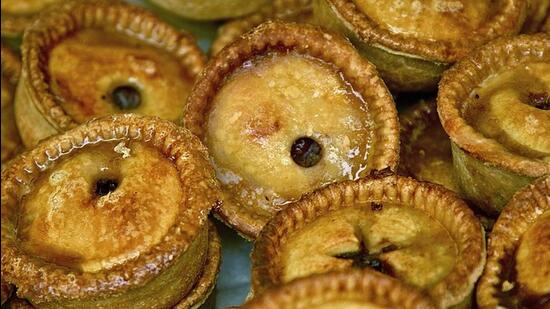
In the twentieth century Poona where acquiring wild boar became difficult, pork pies were made from pigs kept by many families, to provide fresh meat for Christmas and ham for the winter. Like other pies of the season, pork pies were a way of making use of every scrap of meat. Even trotters could be used. They were vital to make the jelly that filled up the pie case. This left the legs to be roasted as joints or cured as hams.
Those who could afford bought turkeys from Bombay and served the bird with pork sausages. Menus featured in novels by Charles Dickens were replicated on Christmas. The “Bombay Gazette” in December 1884 featured a recipe sent by a lady from Poona for a leg of pickled pork and greens and a pair of roast stuffed fowls, as prepared by Mrs Joe Gargery in “Great Expectations”.
Sharing food is a symbol of kindness, generosity, and affection. There is no better time than Christmas to bond with loved ones and create memories over food.


