
 E-Paper



Rapid testing moves out of Covid-19 containment zones to other areas
District administrations have set up testing centres in government schools, dispensaries, community centres as well as in medical vans, senior government officials said on Friday.


All 11 districts in Delhi have started conducting rapid antigen tests beyond the containment zones, as part of the city-state government’s plans to scale up Covid-19 testing across the city.
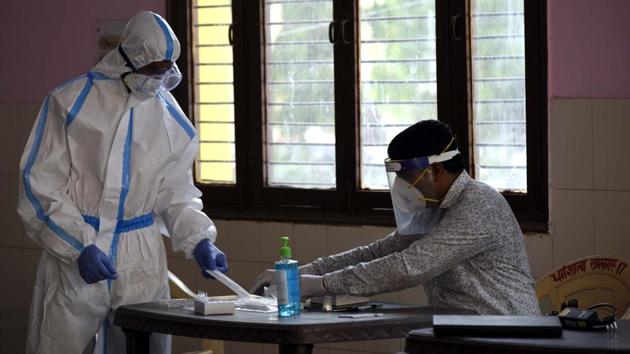
District administrations have set up testing centres in government schools, dispensaries, community centres as well as in medical vans, senior government officials said on Friday.
Delhi government had last month procured 600,000 rapid antigen test kits, which were distributed among all 11 revenue districts in the city, with the foremost priority to test residents in Delhi’s containment zones, a senior government official said.
As of Friday, the national capital had 445 containment zones.
Delhi deputy chief minister Manish Sisodia on Friday told HT, “We have scaled up tests across all districts in the city and rapid antigen tests are a major part of that strategy. Antigen tests help reduce time of the suspect period [the time taken between sample collection and results to arrive] of a person. So, rapid action can be taken in every positive case.”
So far, under the rapid antigen test initiative, district administrations have covered around between 60% and 70% of the containment zones in their jurisdictions, with over 150,000 people tested till Friday.
After the progress in these areas, around 40 antigen test centres were set up on Friday in localities outside containment zones, including in Greater Kailash, Kalkaji, Shahpur Jat, Mehrauli, Saket, Hauz Rani and Rajouri Garden, among others. These exclude the 167 antigen testing centres that were previously operational inside or close to containment zones.
The government is yet to summarise data on the total number of people outside containment zones who went through antigen tests and how many among them tested positive.
According to the Delhi government’s daily health bulletin, 24,165 were tested across the city on Friday, of which 13,588 were tested via the antigen method.
The government earlier this week placed orders for another 500,000 antigen test kits, which are likely to arrive by Monday, following which they will be distributed among all district authorities.
Rapid antigen tests are non-confirmatory tests for the Sars-Cov-2 virus, using a nasal swab, where the results take less than 30 minutes to come. While every positive is considered an accurate positive, individuals with negative results may have to undergo an RT-PCR test for reconfirmation.
Chief secretary Vijay Dev said: “Currently, we are conducting antigen tests both within and outside containment zones, under ICMR protocols. Such tests not only help identify people infected earlier, but also provide a sense of the burden of the disease. It also helps in early detection and surveillance of positive cases which assists in controlling the pandemic.”
WHO CAN GET TESTED
In a standard operating procedure issued last week, the Delhi Disaster Management Authority (DDMA) had given district administrations a free hand to decide who can be tested under the rapid testing initiative.
HT on Friday spoke to several officials and found that three districts have prioritised health care workers, sanitation staff, police personnel, civil defence volunteers and others engaged in the management of containment zones. Another two districts had prepared a list of “high-risk” individuals that mostly comprised fruit and vegetable sellers, milk vendors, grocery shop owners, pharmacists and other essential goods and services providers who worked in full capacity when the city was recording around 3,000 new daily cases of Covid-19 regularly. Most other districts on Friday, however, tested anyone who walked in, on a first-come-first-served basis.
A senior official in the revenue department said a uniform strategy for all districts is likely to be ready by Monday. By then, all districts are also expected to set aside some portion of the test kits in their quota for government hospitals under their jurisdiction.
Jugal Kishore, head of community medicines department in Safdarjung Hospital, said: “It is a good strategy to expand the ambit of the antigen test initiative. When it comes to prioritising, the first category of persons who should be tested is contacts of Covid cases who haven’t got themselves tested so far, health care workers and individuals who interacted directly with covid patients in hospitals, covid centres or their residences.”
“Second should be elderly citizens with severe acute respiratory infections and influenza-like illnesses. The third category should be individuals with ailments related to heart, kidneys, liver, etc. And the fourth category should be people who worked outside when the cases peaked. The last category may include the police, civil defence volunteers, etc.”

Stay updated with all top Cities including, Bengaluru, Delhi, Mumbai and more across India. Stay informed on the latest happenings in World News along with Delhi Election 2025 and Delhi Election Result 2025 Live, New Delhi Election Result Live, Kalkaji Election Result Live at Hindustan Times.


