
 E-Paper



Beijing better than Delhi: Only 7 days of good air in Capital in 2yrs
A HT analysis of pollution data shows Delhi’s air is consistently more toxic than that in Beijing. Rigorous statistical comparison of two years’ worth of data from both cities has shown this for the first time.

 Prefer HTon Google


Delhi’s air is consistently more toxic than that in Beijing, rigorous statistical comparison of two years’ worth of data from both cities has shown for the first time.

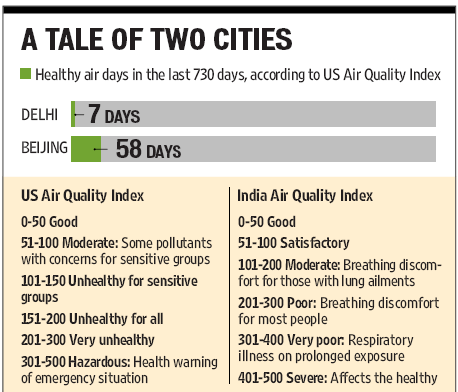
The Indian capital’s air was “healthy”, according to US air quality standards, for just seven days in the last 730, while Beijing hit the mark 58 times.
Delhi has consistently worse conditionsacross the board, according to Professor Douw Steyn of the University of British Columbia, an air pollution expert who performed the analysis for HT, using hourly results from the pollution monitoring station at RK Puram in Delhi and the US embassy in Beijing.
His assessment aims to cut through the debate around seasonal variation on what overall proportion of time both cities spend at each level of pollution, from healthy through hazardous.
“Unpolluted (healthy) conditions were found in Delhi for less than 1% of the time while such conditions exist in Beijing approximately for 8% of the time,” said Steyn, who has done research on air pollution across the world for more than two decades.
The data shows that in Delhi, the level of microfine particles known as PM 2.5, seen as the most dangerous, is above the “hazardous” level 17% of the time, or nearly one day in five. At these levels, according to the US definition, “everyone may experience serious health effects”.
In Beijing, where local authorities have introduced several air pollution control measures in recent years, only 7% of days — or one in 14 — reached this catastrophic level.
The new analysis is important, Steyn argues, because “comparisons based on annual average pollution concentrations, such as presented by the World Health Organization, ignore the fact that the intermittently occurring severe days have strong human health effects. Comparisons based on individual days ignore the effects of different weather conditions in the two cities”.
Gufran Beig of the Indian Institute of Tropical Meteorology (IITM), however, disputed the finding, saying comparing pollution levels at RK Puram with the US embassy in Beijing was not correct because of a huge geographical difference between the two locations.
“The US embassy is outside the polluted zone of Beijing and has a lush green area on one side and a big water body on the other, both contributing to pollution sequestration. RK Puram is middle of Delhi and is next to the congested Ring Road without any sequestration zones,” he said, adding that pollution levels in Delhi are higher than Beijing only during winter months.
Steyn used the more stringent air quality index (AQI) of the United States for a fair comparison and therefore, his results are more alarming than the recently launched Indian air quality index, which had some good air days for Delhi in March.
The US index equates air quality of a city on six parameters — moderate, unhealthy for some, unhealthy, very unhealthy and hazardous — and is much more stringent than the Indian one. Air quality that India’s AQI considers moderate is considered unhealthy in the US.
Steyn’s analysis appears to settle beyond doubt the debate over which city is worse off.
The question for Delhi residents is whether local authorities are committed to resolving the problem.
Anumita Roy Choudhary, associate director general at the Centre for Science and Environment (CSE), said Delhi needs to learn from Beijing on enforcing tough measures to improve air quality. In the Chinese capital, vehicles with even and odd number licence plates are allowed to run on alternate days, heavy-duty diesel vehicles have been retrofitted to reduce emissions, stringent norms have been enforced for all vehicles and polluting industries have been closed.
On the other hand, both governments — the Centre and Delhi — have been dilly-dallying on a plan to reduce air pollution despite a series of orders by the National Green Tribunal in the last six months. Both governments have spoken about piecemeal measures and are opposed to banning vehicles more than 10 years old running on diesel.
“The cost of pollution reduction is far smaller than the costs of pollution damage and simple technological solutions are easily available. What is needed is political will, which can only come from an informed and engaged population,” Steyn said. On this, Beig was in agreement.


