
 E-Paper



Ramjas clash: Is crime branch probe into DU violence an eyewash?
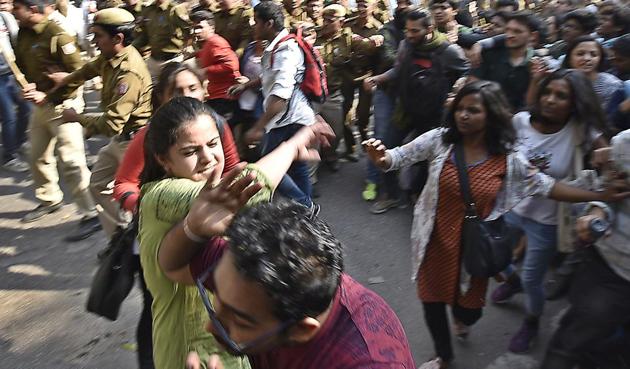
Violence had erupted on the campus when two groups -- one led by Akhil Bharatiya Vidyarthi Parishad (ABVP), student wing of RSS, and the other comprising of Ramjas College students, teachers affiliated with left parties, and other students organisations, clashed on Wednesday.


Soon after fingers of doubt were raised at the police for their inept handling of the violence near Ramjas College this week, the case was transferred to the crime branch for probe.
Contrary to what it may seem and as several past instances have proved, transfer of a case does not mean a quick conclusion of the investigation. Some of the past incidents (some mentioned in the box) show that ‘case transferred to crime branch has been used by the police as a ruse to divert attention from its inaction.
Read: Ramjas clashes: ABVP wary of JNU’s ‘leftist culture’ seeping into DU
The record of some of the most controversial cases that generated large public and media attention, and which were transferred to the crime branch for investigation, shows that it achieved nothing.
Under media pressure and video tapes, that showed police personnel thrashing students and media persons, the Delhi police registered an FIR. When social media was flooded with videos showing cops beating students, three constables were suspended and the case was transferred to the crime branch.
The crime branch is the elite investigating unit of the police. Unlike the local police, officers of the crime branch do not handle regular law and order duties. They are tasked with investigating sensitive cases, which require expertise.
Ramjas violence is not the only case that was transferred to the unit and has not achieved a quick closure.
Read: Ramjas clash: DU turns fortress day after violence, over 500 cops guard campus
More than a year after Gajendra Singh, a farmer from Rajasthan committed suicide by hanging from a tree during an AAP party rally at Jantar Mantar, the probe is yet to make a headway. The FIR registered at the Parliament Street police station names senior leaders of the Aam Aadmi party (AAP). While AAP leaders were summoned for questioning, the police are yet to file a chargesheet or file a closure report in the case. It is mandatory to file a chargesheet within three months of registering a case. Senior crime branch officers say they are ‘still probing the case.’
Similarly, army veteran Ram Kishan Grewal committed suicide by consuming poison outside the Jawahar Bhawan in November last year. Grewal’s suicide triggered a political slugfest, with massive protests by parties across the city, with some voices alleging that Grewal was forced to commit suicide.
Instead of the local police, the crime branch was tasked to look into the case. Crime branch officers have over the last few months questioned Singh’s friends and even taken bank account details but still seem clueless, about his death.
Read: Ramjas clash: Crime branch to probe violence on DU campus, 3 cops suspended
The mysterious disappearance of JNU student Najeeb Ahmed is another one in the series of cases that were given to the crime branch. Despite the fact the police have put a reward of R10 lakh for anyone who will provide clues to his whereabouts, he remains missing. The crime branch team has over the last two months, conducted a two day massive search operation in JNU and Najeeb’s house in Badaun, Uttar Pradesh, but are yet to get a breakthrough.
On record, crime branch officers did not offer any comment.
However, a senior crime branch officer, speaking on the condition of anonymity, said: “It is wrong to say we don’t solve cases. From crime spots, police get evidence in the first 48 hours. Cases are transferred to us after weeks. The most important time in gathering critical clues is gone. Last year, we solved the theft of a golden dagger stolen at Nehru museum within two days.”

Stay updated with all top Cities including, Bengaluru, Delhi, Mumbai and more across India. Stay informed on the latest happenings in World News along with Delhi Election 2025 and Delhi Election Result 2025 Live, New Delhi Election Result Live, Kalkaji Election Result Live at Hindustan Times.


