E-Paper



Amid global churn, Budget faces 'external' challenge | Number Theory
.

 Prefer HTon Google


If the 2026-27 Union Budget were not being presented in an external environment of unprecedented turbulence the economic situation would have been very different. Today, the erstwhile hegemon of the rules-based-order is hell bent on destroying it -- and at a time when the world is bracing for a generational leap in technology thanks to Artificial Intelligence (AI) which, at least for now, seems to have taken financial markets beyond the realm of rational intelligence. As an economy which runs a current account deficit and is, therefore, dependent on capital flows and is looking to attract more FDI to boost manufacturing, economic policy making in India has no choice but to account for these challenges. Here is a brief description of what they are.

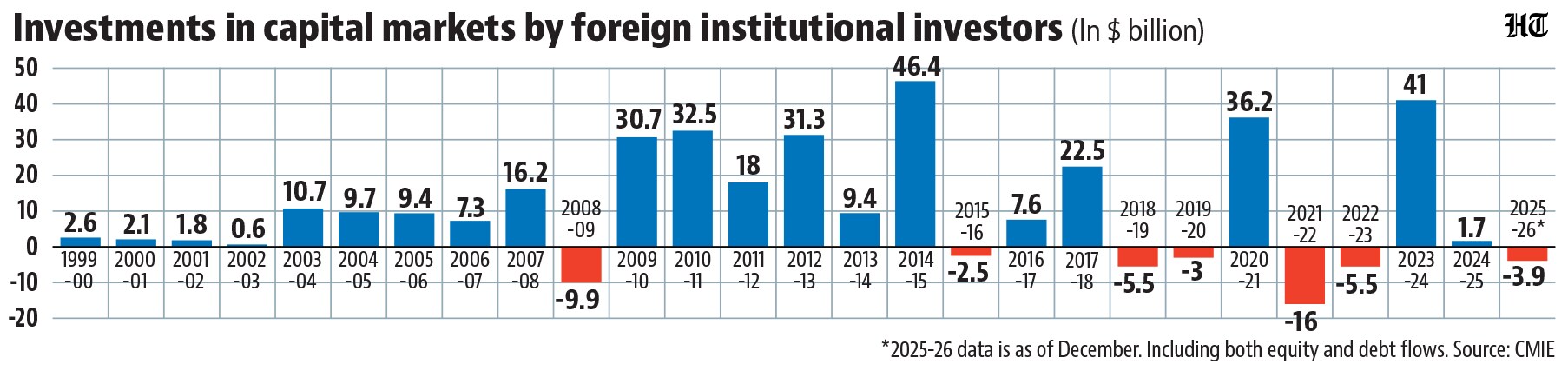
 Portfolio investors leaving has created a bearish sentiment in equity markets ahead of the BudgetIndia’s benchmark equity market index has lost more than 3% of its value since the beginning of the year. India was also the worst performing stock market index last year (among major markets); at a time when global markets were buoyed by a narrow but powerful AI-driven rally in technology stocks, Indian indices struggled to find a similar engine of momentum. Almost all of this can be explained by a large exodus by foreign portfolio investors (FPIs). After net inflows of over $41 billion in 2023–24, total portfolio investment fell to just $1.7 billion in 2024–25 and turned negative in the first nine months of 2025–26. What explains this flight? Many factors are at play. Global uncertainty has triggered a flight of capital to such things as precious metals. Most of the hot money has gone fishing in the pond of AI stocks, triggering a boom in advanced economy markets. That India’s own corporate earnings have been subdued, more because of low inflation than a real slowdown, has also not helped. Explanations aside, FPIs leaving is weighing on the economy.
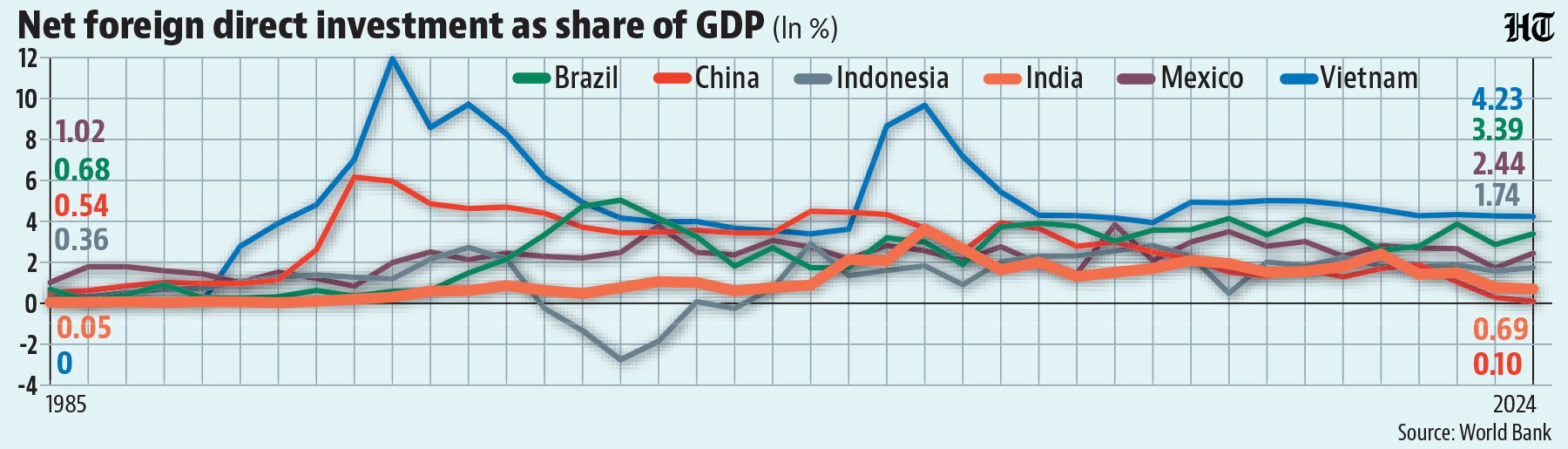
- What is even more worrying is the slowdown in FDIReforms bring in Foreign Direct Investment (FDI), which boosts manufacturing, leads to exports and generates growth is the textbook virtuous cycle for an emerging economy to do well in the period after the Second World War. India has historically struggled to get into this trajectory as well as other emerging market economies. This can be seen in India’s Net-FDI to GDP ratio being relatively lower.
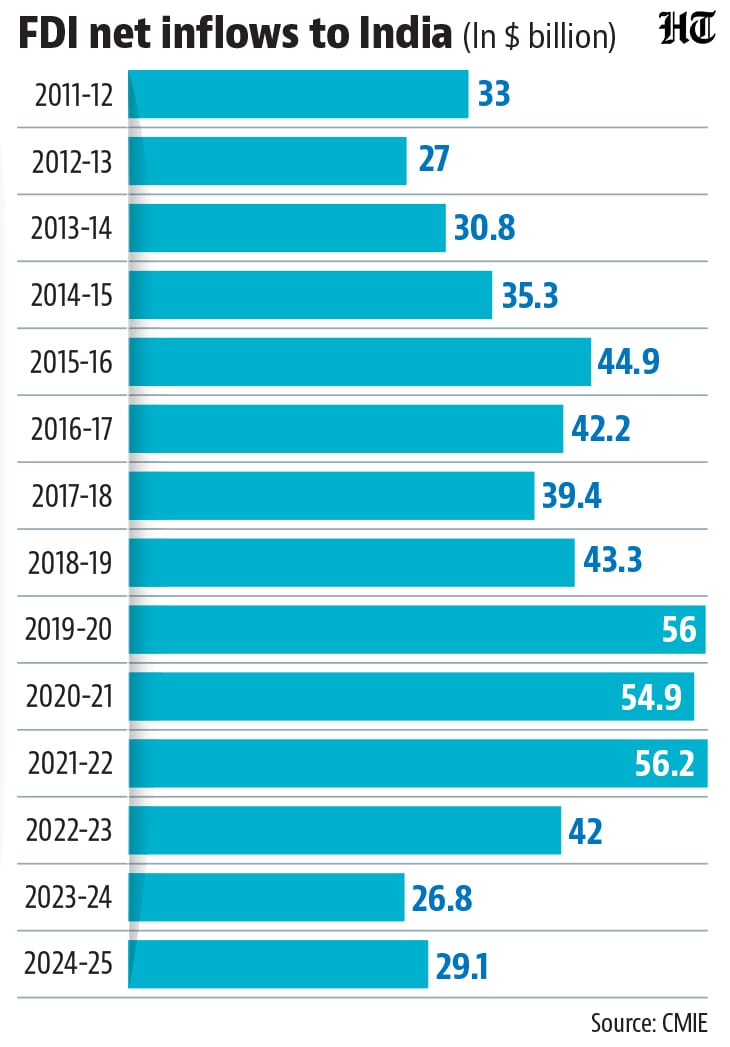
- Cooling inflows and rising outflowsWhile more reforms were expected to solve this problem, things have become worse rather than better in the last couple of years. After rising steadily through the 2010s, FDI net inflows climbed from about $33 billion in 2011-12 to a peak of just over $56 billion in 2019-20 and again in 2021-22, benefiting from abundant global liquidity and strong investor appetite for emerging markets. That phase now appears firmly behind. Net inflows fell sharply to $42 billion in 2022-23, and further to $26.8 billion in 2023-24 before recovering only marginally to $29.1 billion in 2024-25. FDI net inflows were recorded at $25.1 billion between April 2025 and September 2025, the latest period for which we have data for this fiscal. To be sure, the net FDI story is also driven by rising FDI outflows and not just falling FDI inflows. The latter could well be seen as Indian companies finding the confidence to go and explore foreign markets which is not necessarily a bad thing. And to be sure, part of the outward FDI is also on account of investing companies repatriating profits to their own countries. Gross direct investment outflows from India went from $20.3 billion in 2023-24 to $31.7 billion 2024-25. As the latest Economic Survey states, “Companies harvest profits from established operations in India while hesitating to commit fresh capital amid global uncertainty. The solution lies in mobilising new investment through policy stability, aggressive investor engagement, and scaling proven state-level models nationwide.”
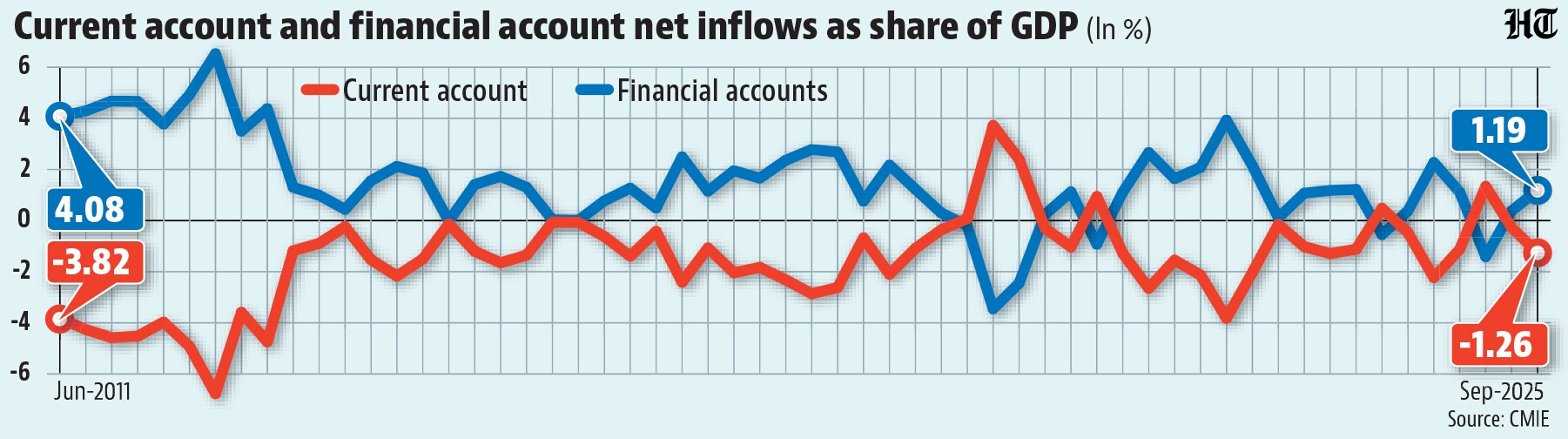
- This is not to say that an external account crisis is on the cardsWhile the reversal in FDI and FPI are a matter of concern and India has to do all it can to aggressively grow both, the Indian economy is not facing any crisis as of now as far as the external account is concerned. This is best seen in the fact that the current account deficit is still not at very high levels. India’s current account deficit (CAD) was 1.3% of GDP in the quarter ending September 2025, the latest period for which we have data on the CMIE website. While the number has fluctuated a bit in the past few quarters, the situation is nowhere comparable to the early 2010s when the CAD was consistently in the ballpark of 5% along with very high inflation and fiscal deficit. It is perhaps this situation which captures the irony facing the government: it has done well to preserve macroeconomic stability but the global markets are distracted in a world which is becoming far more unstable.