E-Paper



Four things to watch out for in Bihar results | Number Theory
.
Updated on: Nov 13, 2025, 23:12:09 IST

 Prefer HTon Google
Share via


Copy link

Counting for the 2025 Bihar assembly elections will take place tomorrow. The key question is whether or not Nitish Kumar’s political juggernaut, which started in October 2005, will continue to roll in Bihar. The answer to this question will depend on the intricate dynamics within the two major alliances, namely the National Democratic Alliance (NDA) and the Mahagathbandhan (MGB). Then, there is the question of the debutant Jan Suraaj Party launched by Prashant Kishor. Here are four key data points which can help us understand these factors.
Will the RJD continue its recovery?
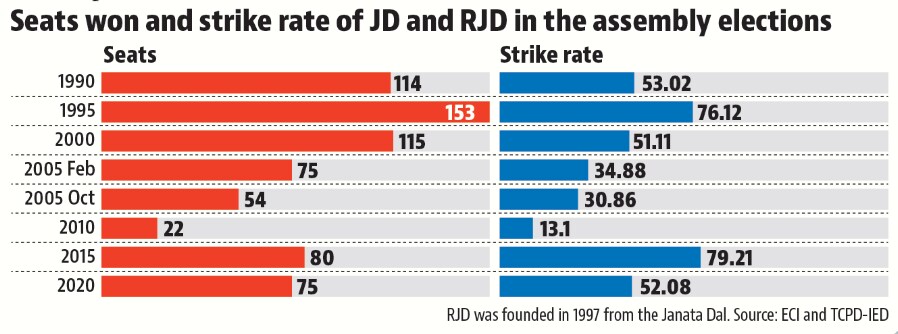
 Will the RJD continue its recovery?Lalu Yadav held power in Bihar for 15 uninterrupted years from 1990-2005. However, the fortunes of his party Rashtriya Janata Dal (RJD) fell sharply thereafter and it plummeted to just 22 MLAs in the 2010 Bihar assembly elections against the NDA, creating an almost existential crisis for the party. Things changed for good in the 2015 elections which the RJD fought with Nitish Kumar’s Janata Dal (United) or JD(U) and the Congress and it won an impressive 80 assembly constituencies (ACs). Even in the 2020 elections, the RJD did well and finished as the single-largest party slightly ahead of the Bharatiya Janata Party (BJP), with 75 ACs. But the 2015 and 2020 assembly elections were not normal as far as Bihar and RJD were concerned. In 2015, the coming together of RJD and JD(U) created a large Mandal consolidation and in 2020, the Lok Janshakti Party (LJP) actively sabotaged the JD(U) with tacit approval from the BJP’s top leadership – the LJP continued to be a part of the NDA at the centre while doing this. With the NDA’s house in order, the RJD enjoys no such tailwinds this time, and a credible performance in 2025 would indicate that it has overcome its 2010 crisis.
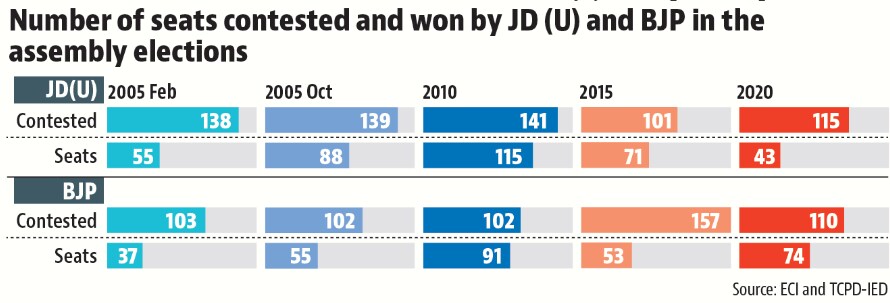
- Will Nitish Kumar regain his mojo?Nitish Kumar’s coronation as chief minister in 2020 was more a sign of weakness than strength for Bihar’s longest serving chief minister. His party JD(U) managed to win only 43 ACs, largely because of sabotage by the LJP and it was the BJP which was the biggest constituent of the NDA in the Bihar assembly. Nitish has also had to offer more room to the BJP in the alliance of late. The number of ACs contested by the JD(U) and the BJP was 141 and 102 in 2010 elections, fell to 115 and 110 in 2020 and is now 101 each in these elections. Unless the JD(U) manages to perform as well as, if not outperform, the BJP in these elections, its control over power in Bihar could very well be ceremonial rather than the dominance which Nitish Kumar used to enjoy in the pre-2014 period.
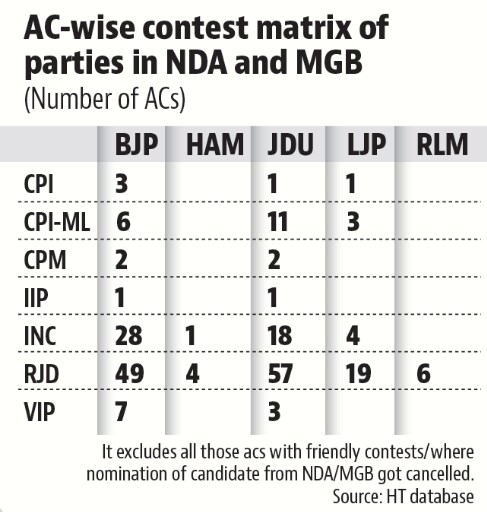
- The bipartisan bet on smaller alliesBoth the MGB and the NDA have ceded more ground to their smaller allies in these elections . The NDA has offered 41 ACs to its smaller, largely caste-based party allies, namely the LJP (28 after the nomination of one canddiate was rejected) and six each to Hindustani Awam Morcha (HAM) and Rashtriya Lok Morcha (RLM). The MGB has a wider ideological gamut of allies ranging from the Congress (61) to the Communists (33) and two smaller caste-based parties, namely, the Vikassheel Insan Party (VIP) and Indian Inclusive Party (IIP) , which are contesting 14 and 3 ACs respectively. The overall fortunes of these smaller allies will be crucial in deciding whether or not the NDA or MGB make it past the halfway mark in the state. A lot of these smaller allies are also pitted against the bigger parties in the state. To be sure, there are 12 ACs where there is an intra-alliance conflict in MGB.
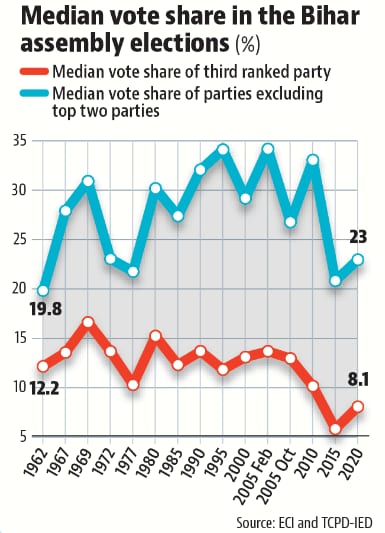
- The Prashant Kishor factorThe 2025 elections have seen both the major formations in Bihar consolidating their alliances by adding newer parties to their fold. Amid this quest to make the polity more bipolar, Prashant Kishor’s Jan Suraaj Party is hoping to open a third front in the state by fielding candidates in almost the entire state (238 out of the 243 ACs). How exactly this debutant impacts the electoral math in these elections will be interesting to watch . While a credible performance by Jan Suraaj will be a statistical outlier, what remains to be seen is whether it does create a consolidation or sorts, by ensuring most of its candidates are placed third .