
 E-Paper



How Emergency brought the opposition together | Number Theory
.
Updated on: Jun 25, 2025, 15:26:20 IST

 Prefer HTon Google
Share via


Copy link

June 25 marks 50 years of the imposition of the Emergency by Indira Gandhi in India. The Emergency is one of the greatest ironies of politics in India. It was imposed to secure Indira Gandhi’s hold on power but ended up catalysing (short-lived) opposition unity which would lead to the Congress losing power for the first time in independent India. In other words, the Congress’s humiliating loss in the 1977 elections was more a result of opposition unity than Congress’s loss of popular support among voters.

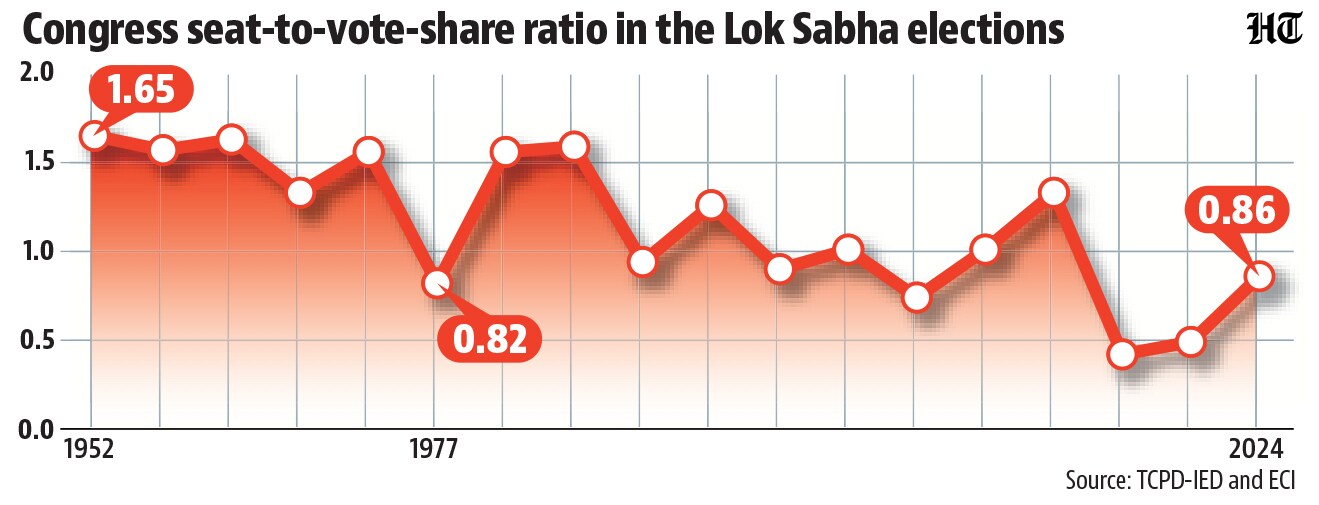
 Congress’s seat share fall in the 1977 elections was disproportionate to its vote share fallCongress’s tally of 154 parliamentary constituencies (PCs) in 1977 was its lowest for that period and would remain to be its worst ever performance until it fell to 140 PCs in the 1996 elections. To be sure, the Congress has fared worse in subsequent elections. Congress’s vote share in the 1977 elections was a sizable 34.5%. To put this in perspective, the Bharatiya Janata Party (BJP) won a Lok Sabha majority in 2014 with just 31% vote share. The best way to understand the Emergency’s political punishment for the Congress is to compare its seat share to vote share ratio – they are the best measure to understand a party’s efficacy or lack of it to convert popular support into seats in a first-past-the-post system – in the post-Emergency elections with all Lok Sabha elections in India. This number is 0.82, the fourth lowest for the Congress in all Lok Sabha elections and its lowest ever between 1952 and 1998. See Chart 1: Congress seat share to vote share ratio in all Lok Sabha elections in India
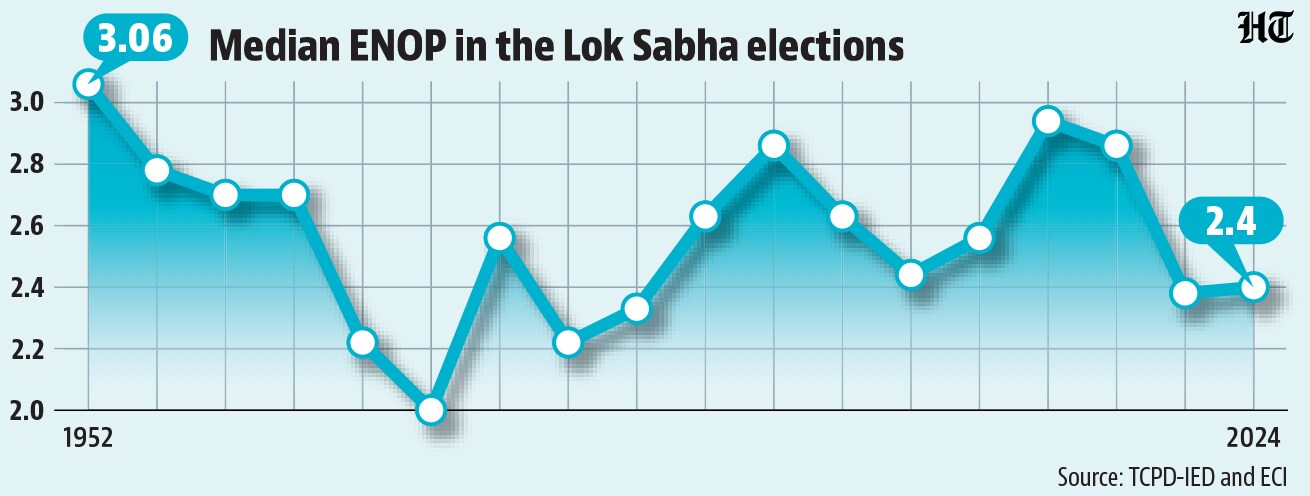
- The post-Emergency election was the most polarised in India’s historyIn a first-past-the-post system, a winning candidate need not get to 50% of the votes to win a constituency as more than one candidate is in the fray. A fragmented opposition will therefore help the stronger party disproportionately. A good way to measure the level of polarization in an election is to compare the median value of the Effective Number of Participants (ENOP) in different elections. ENOP is defined as the reciprocal of the sum of squares of the vote shares of all candidates in a constituency and a higher value indicates greater fragmentation. For instance, four candidates with vote shares of 26%, 25%, 25%, and 24% yield an ENOP of 3.99, while a split of 50%, 45%, 3%, and 2% results in an ENOP of 2.2. Median ENOP in the 1977 elections fell to just 2, the lowest ever value it has ever taken in a Lok Sabha election in India. This was the result of almost the entire opposition (barring the communists in West Bengal and Kerala and the Dravida Munnetra Kazhagam in Tamil Nadu) coming together to form the Janata Party against the Congress. See Chart 2: Median ENOP in all Lok Sabha elections in India
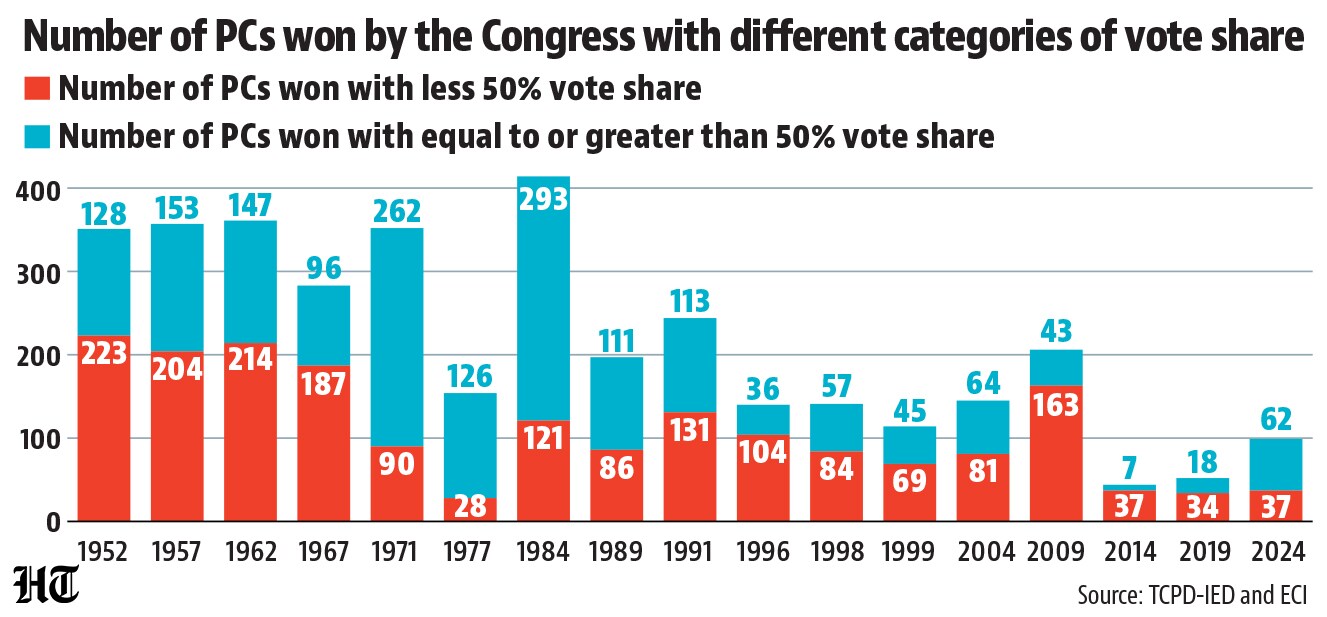
- It was this opposition unity which destroyed the Congress in the 1977 electionsOne can say that a party is benefitting from fragmentation of the opposition vote if it manages to win a constituency without polling 50% of the total votes. An analysis of election data before 1977 shows that the Congress used to gain a lot from a fragmented opposition. The Congress won an average of 340.8 PCs in the Lok Sabha elections held between 1952 and 1971. It won an average of 183.6 and 157.2 PCs with a vote share of less than 50% and 50% or more during this period. The Congress could win just 28 PCs in 1977 where it polled a vote share of less than 50%. This number is the lowest ever number of PCs won by the Congress with a seat share of less than 50% in any election. See Chart 3: Congress seat share won with less than and more than or equal to 50% vote share
- The fact that India has not seen as polarised an election as the post-Emergency one shows that the Emergency did trigger a strong political reaction from both political actors as well as the voters. The latter rallied behind an ideologically fragmented but tactically united opposition to dislodge what they saw as an authoritarian party. It is here that Indira Gandhi made the biggest tactical mistake in proclaiming the Emergency 50 years ago. The strategic implications of the processes which triggered the Emergency and outlived its removal are for more complicated and deserve a separate discussion.



Unlock a world of Benefits with HT! From insightful newsletters to real-time news alerts and a personalized news feed – it's all here, just a click away! -Login Now!


