
 E-Paper



Monsoon may end with July as its inly bright spot | Number Theory
This monsoon season has been near normal in only around one month. This means that around half of country is running very dry and so are its major reservoirs
Updated on: Sep 7, 2026, 06:30:59 IST

 Prefer HTon Google
Share via


Copy link

The June-September monsoon season is now just 10 days away from September 17, the normal date on which the weather system associated with it starts withdrawing from the most north-western corners of Rajasthan. This means that the verdict on the 2026 monsoon is almost written. What does it say? That this monsoon season has been near normal in only around one month. This means that around half of the country is running very dry and so are its major reservoirs. Here are four charts that describe these trends in detail.
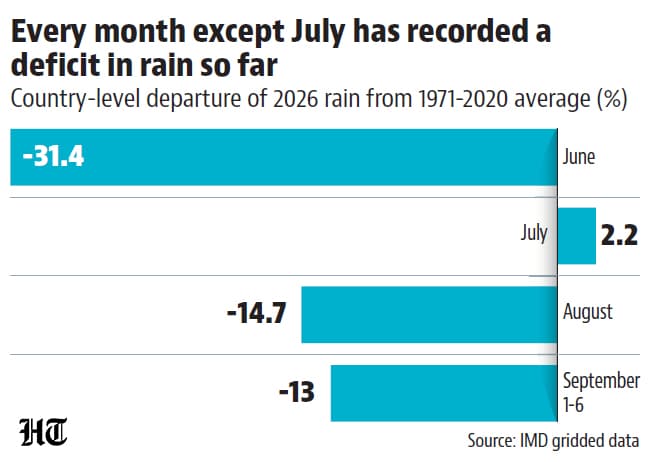
 July is the only satisfactory monsoon month so farAccording to the gridded data of the India Meteorological Department (IMD), India has received 34.6 mm rain in September so far (up to September 6), 13% less than the 1971-2020 average, which the IMD currently considers the Long Period Average (LPA) for tracking rainfall performance. This makes it the 42nd driest September 1-6 period since 1901, the first year for which the IMD has published gridded data. Similarly, August rainfall had a 14.7% deficit. While neither September nor August have a June-like deficit, they leave only July with a surplus.
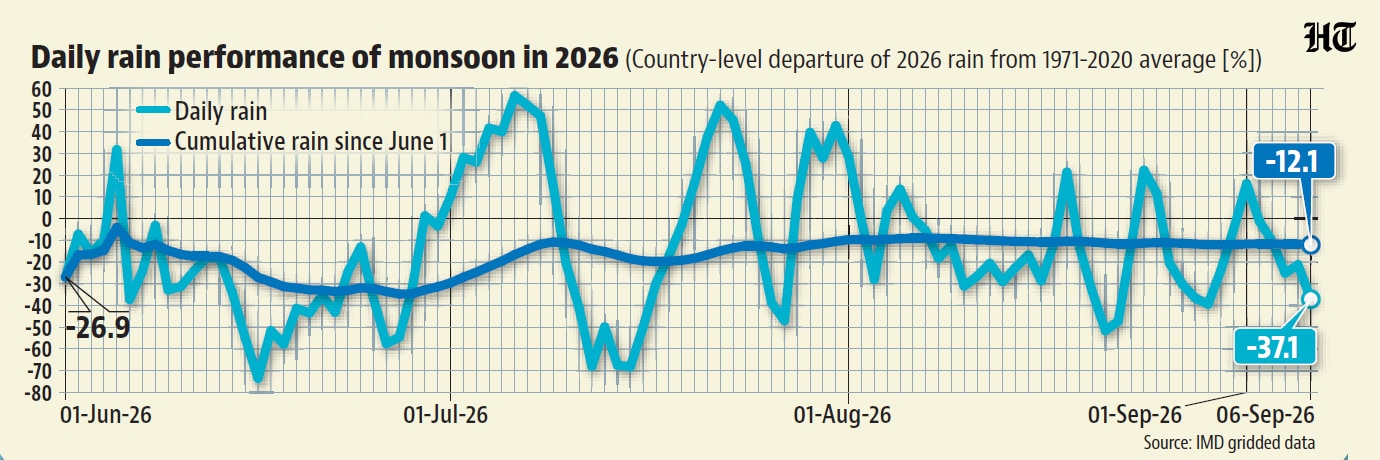
- However, monsoon’s cumulative deficit has not jumped up drastically after JulyThe characterisation above also holds true in daily statistics. June and August had 28 and 24 days of deficient rainfall, respectively, and September has had five, compared with only 13 in July. However, June had 20 days with a deficit of 20% or more, compared with only 10, 15, and three days in July, August, and the September so far, respectively. This has prevented the cumulative deficit from rising drastically after July. It was 10.5% on July 31, 12% on August 31, and 12.1% as of September 6. To be sure, this still makes the monsoon season so far the driest since 2009, and the 15th driest since 1901.
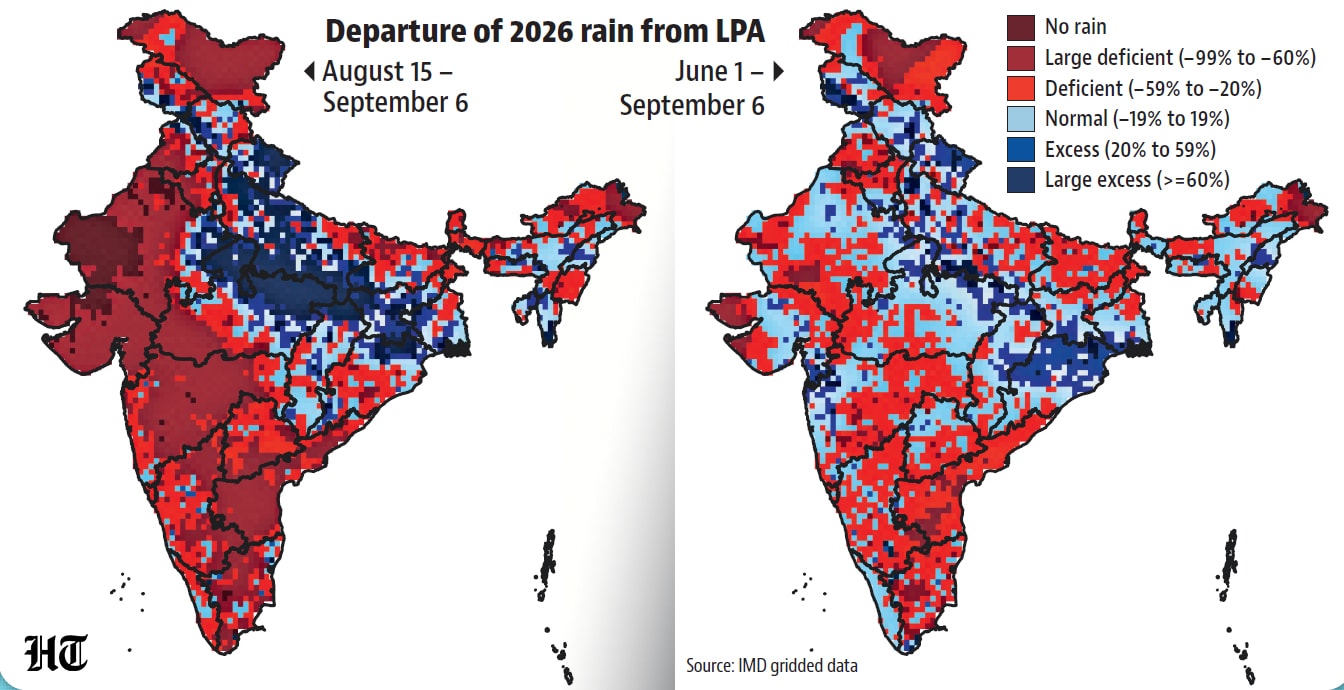
- The IMD classifies a deficit of 20%-60% as “deficient” and that of 60% or more as “large deficient” at the local level. Surpluses of the same degree are termed “excess” and “large excess”, with rainfall within 20% of the LPA classified as normal. As of September 6, 49.9% of the country is in one of the deficient categories, 3.7 percentage points more than on July 31. To be sure, most of this increase has come from a decline in area under excess categories, with the area under normal rain roughly steady at 36.6%. This is because surplus rainfall since the middle of August has shifted to a narrow band running from Uttarakhand to northern Odisha. This has decreased deficient area by over 30 percentage points in Uttar Pradesh and Jharkhand and by 5-10 percentage points in Madhya Pradesh and Bihar between July 31 and September 6, even as such area increased in other states.
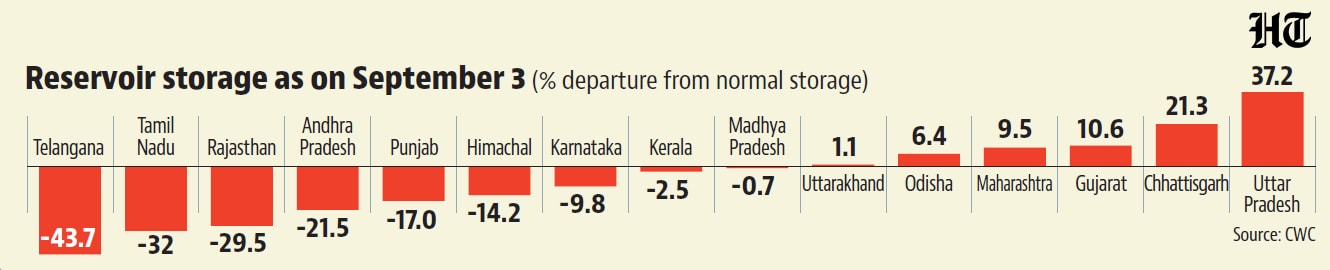
- Major reservoirs in most states are running dryWith August and September dry in large parts of the country, storage in 178 main reservoirs tracked by the Central Water Commission (CWC) had a deficit of 3.25% on September 3 (the data is published every Thursday). But this masks wide regional differences. Among 15 states with at least 1 BCM of storage, 10 had a deficit, with six having a deficit of more than 10%. Only reservoirs in Uttar Pradesh, Chhattisgarh, Gujarat, Maharashtra, Odisha, and Uttarakhand had a surplus.
- What makes these trends especially worrying is that the extended-range forecast issued by the IMD last week projected a surplus in only small pockets until the last week of September.


Unlock a world of Benefits with HT! From insightful newsletters to real-time news alerts and a personalized news feed – it's all here, just a click away! -Login Now!


