E-Paper



Politics in India’s Muslim dominated ACs – 1 | Number Theory
.

 Prefer HTon Google


The All India Majlis-e-Ittehadul Muslimeen (AIMIM) becoming the party with the largest number of Muslim MLAs in Bihar has raised serious questions on the ability of the Rashtriya Janata Dal (RJD) to retain its Muslim-Yadav or MY support base in the state. The AIMIM on its part, made an issue of the RJD enjoying the support of Muslims but giving little to the community in terms of a share in power. The Bihar developments raise a larger question about Muslims and Indian politics. Has the nature of representation in assembly constituencies (ACs) which have a higher-than-average share of Muslims in India changed in the recent past? This two-part data journalism series will try to answer this question. The first part will give an idea about the number of ACs in India by their share of Muslim population and the second will look at the changes in their party-wise representation.
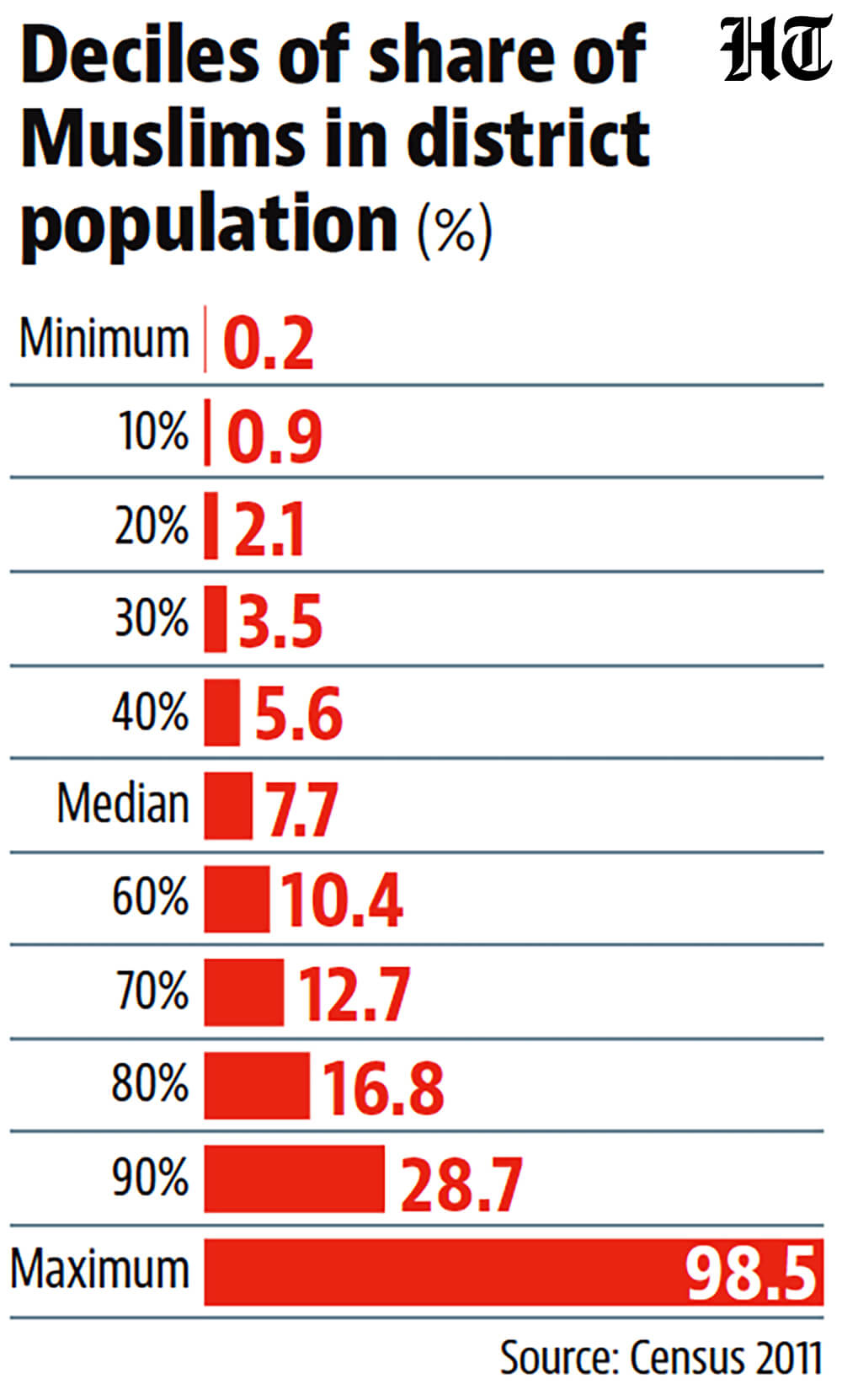
 Muslim population in India is not uniformly distributedAccording to the 2011 census, Muslims account for 14% of India’s overall population. This headline number hides a significant divergence at the level of not just states and union territories (UTs), but even districts. There are states and UTs such as Jammu and Kashmir, Assam, West Bengal, and Kerala where the share of Muslim population is around twice the national average or higher; and there are states such as Odisha and Punjab, where this number of less than half the national average. The divergence is equally stark at the level of districts, as can be seen in the decile-wise distribution of share of Muslim population across districts in the country.
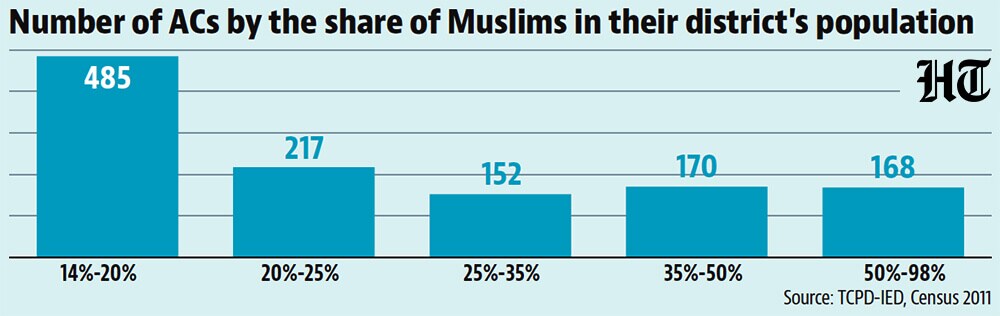
- What can we say about Muslim population across constituencies in India?Electoral rolls in India are not segregated by religion. This makes it difficult to classify constituencies by the share of Muslims in India. The closest one can get to this approximation is by classifying ACs by the share of Muslim population in that district. AC boundaries, unlike parliamentary constituency (PC) boundaries, are not supposed to overlap district boundaries in India. To be sure, while this holds true at the time of delimitation, it may not later. A consolidated district-AC mapping is available from the Trivedi Centre for Political Data (TCPD), which uses districts formed even after the 2011 census. So, this analysis had to merge some 2011 census districts for this analysis and exclude Delhi from mapping religion. This exercise shows that among the 4,118 ACs in India today, only 29% are located in districts which have a higher than national share of Muslim population in the country. This number keeps falling as one increases the threshold for Muslim population share in the country; and there are only 168 ACs (4%) which are located in the 30 districts where Muslims are in a majority. To be sure, classifying Muslim ACs by the share of Muslims in the district’s population is not necessarily a perfect way to ascertain the share of Muslim voters (more on this in part 2) but it is the best one can do with officially available data in India.
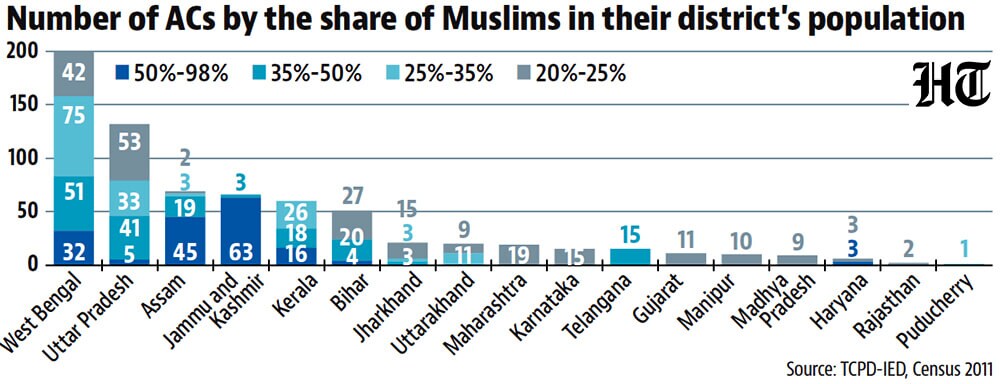
- A majority of Muslim dominated ACs in India are concentered in just a handful of statesNo matter how one sets the bar, this is the case. There are 707 ACs in districts with a Muslim population share of more than 20%. 200 of these are just in West Bengal. Just five states and UTs, namely, West Bengal, Uttar Pradesh, Assam, Jammu and Kashmir and Kerala account for 75% of such ACs in India. This distribution keeps getting more and skewed as one increases the population threshold for Muslims.
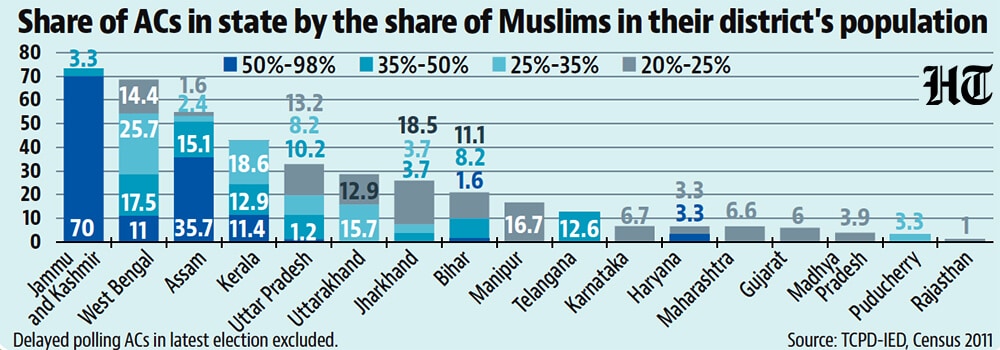
- Even within these states, the share of Muslim dominated ACs varies vs the assembly strengthThis is another important point to keep in mind. The importance, or the lack of it, of ACs with a high Muslim population share in a state is determined by the share of such ACs in the total strength of the assembly in that state. The higher this share, the more important such ACs will be to government formation in the state. Data shows this varies significantly across states. For example, West Bengal has 200 ACs with Muslim population share of more than 20% and Jammu and Kashmir only 66. However, it is the latter where such ACs matter more because its assembly strength is only 90, compared to 294 in the former.