E-Paper



SIR's cut 118mn so far: More than Brazil's '22 poll turnout | Number Theory
The first part will look at the key numbers from the SIR results and the second part will try and understand what is driving them

 Prefer HTon Google


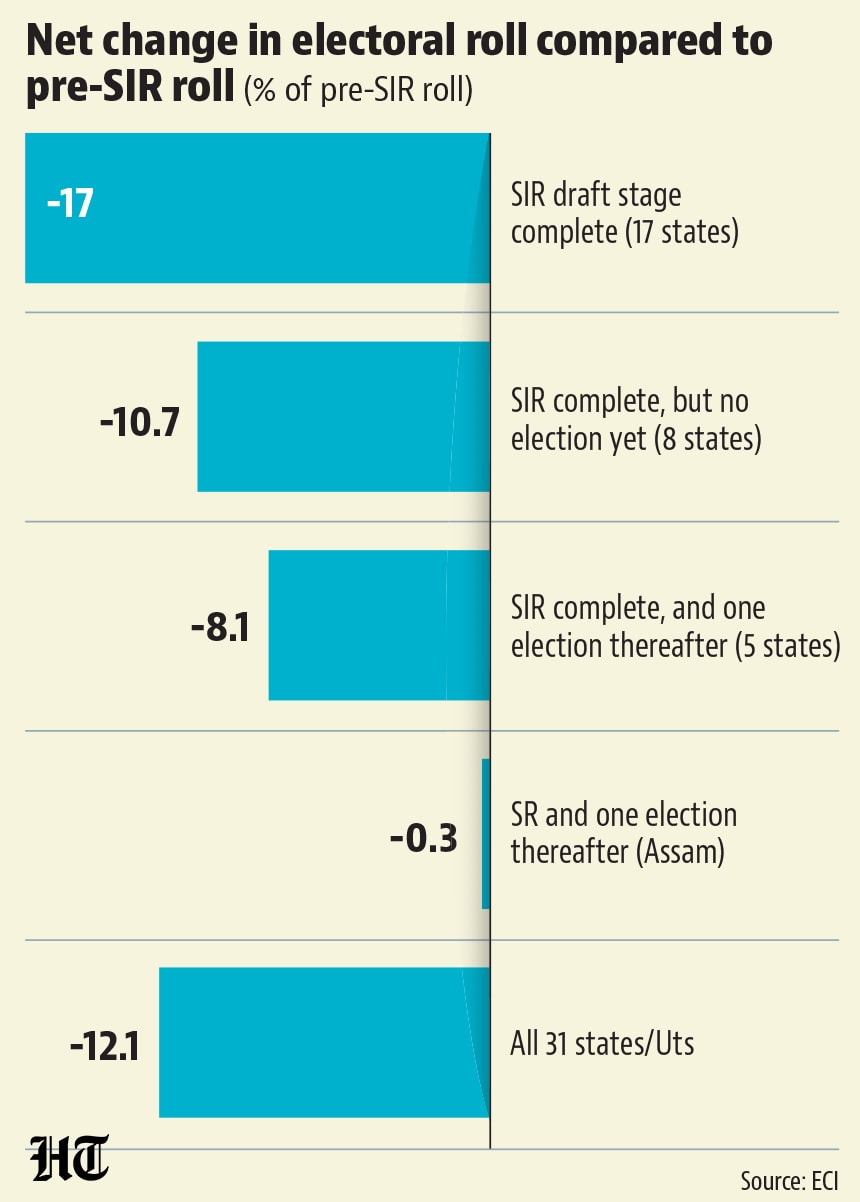
About 111.8 million people voted in Brazil’s 2022 general elections. India’s ongoing overhaul of its electoral rolls through the Special Intensive Revision (SIR), and the Special Revision (SR) in Assam, has so far resulted in the deletion of 118.3 million names, according to HT’s calculations. That is equivalent to 12.1% of the pre-revision electoral rolls covered by the exercise. Only 14 countries other than India and China are projected to have populations of more than 100 million in July 2026. These statistics underline the quagmire that the exercise has become. Critics of the government argue that a large number of those deleted have been wrongly excluded. Pro-government arguments allege that exclusions have targeted non-bonafide citizens except those who are dead. The truth, most likely, lies beyond such politically convenient binaries. And it raises questions, which need a deeper engagement with India’s demographics and associated dynamics rather than just politics. This two-part series will try and flag some of these issues on the basis of the data available so far. The first part will look at the key numbers from the SIR results and the second part will try and understand what is driving them.

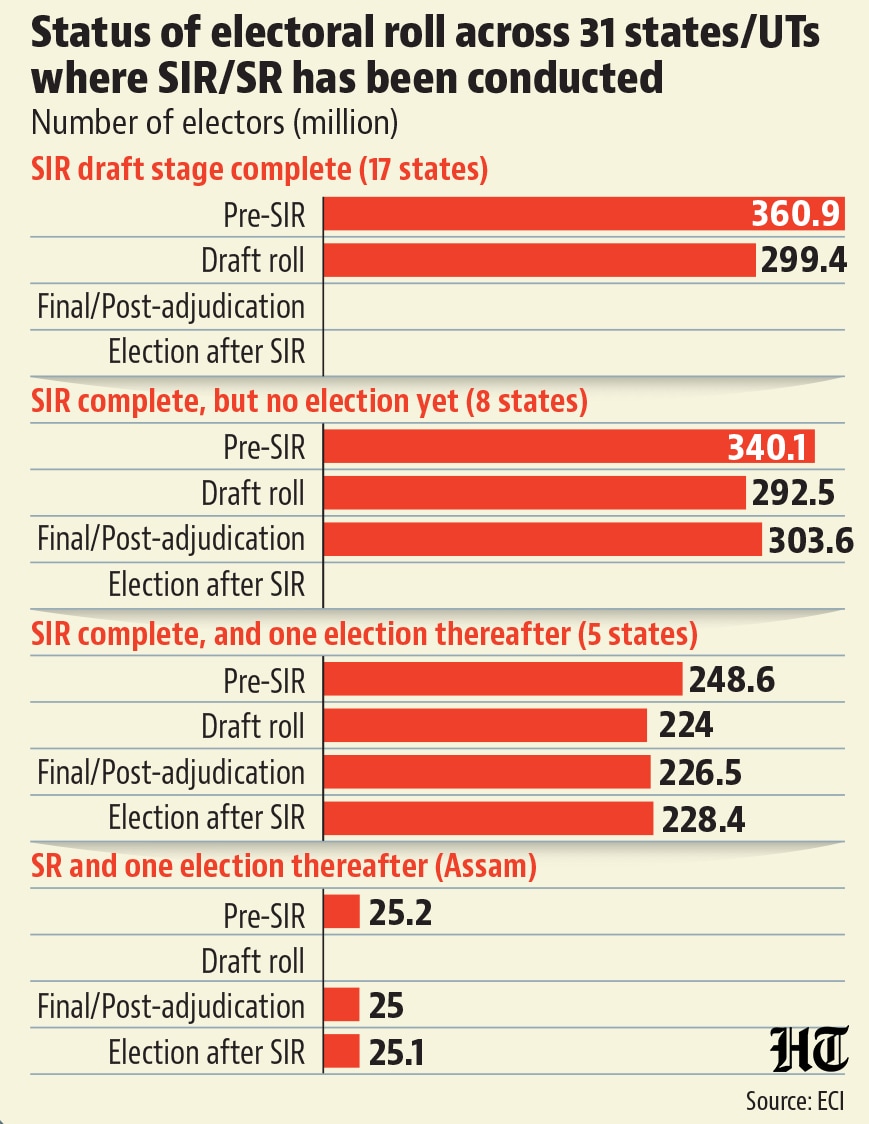
 SIR is at different stages in different states and UTs, but total deletions are to the tune of 118.3 millionThe SIR/SR process is at different stages across states and Union territories. It has been undertaken across the country except Jammu and Kashmir, Himachal Pradesh and Ladakh. Five states and Union territories – Bihar, West Bengal, Tamil Nadu, Kerala, and Puducherry – have conducted an election after the conclusion of the claims and counter-claims phase which follows the release of the draft roll of the SIR exercise. Another eight – Uttar Pradesh, Madhya Pradesh, Chhattisgarh, Rajasthan, Gujarat, Goa, Andaman and Nicobar Islands, and Lakshadweep – have completed the SIR exercise but are yet to hold an election thereafter. Of the remaining states and UTs, draft rolls have been released for 17 (all except Tripura and Nagaland) and is yet to be finalised. If one were to take all of these categories together, while discounting comparability issues, SIR exercise has seen a deletion of 118.3 million voters compared to the pre-SIR roll.
- Deletions are relatively lower in states which have conducted an election after the exerciseThis is in keeping with intuitive wisdom but worth underlining. In the five states and Union territories which have conducted an election after the SIR exercise, the voter count was 8.1% lower than the pre-revision roll (excluding Assam which saw a Special Revision not an SIR exercise). The reduction rises to 10.7% in states and Union territories where the SIR has been completed but an election is yet to be held. In states and Union territories where only draft rolls have been published, it rises to 17%. This clearly shows that the post-SIR draft roll tends to be biased towards wrong exclusions, a lot of which are undone by the time the final post-SIR roll is released. The final electoral roll for the first post-SIR election will also be higher because it also adds new voters who were not on the pre-SIR roll.
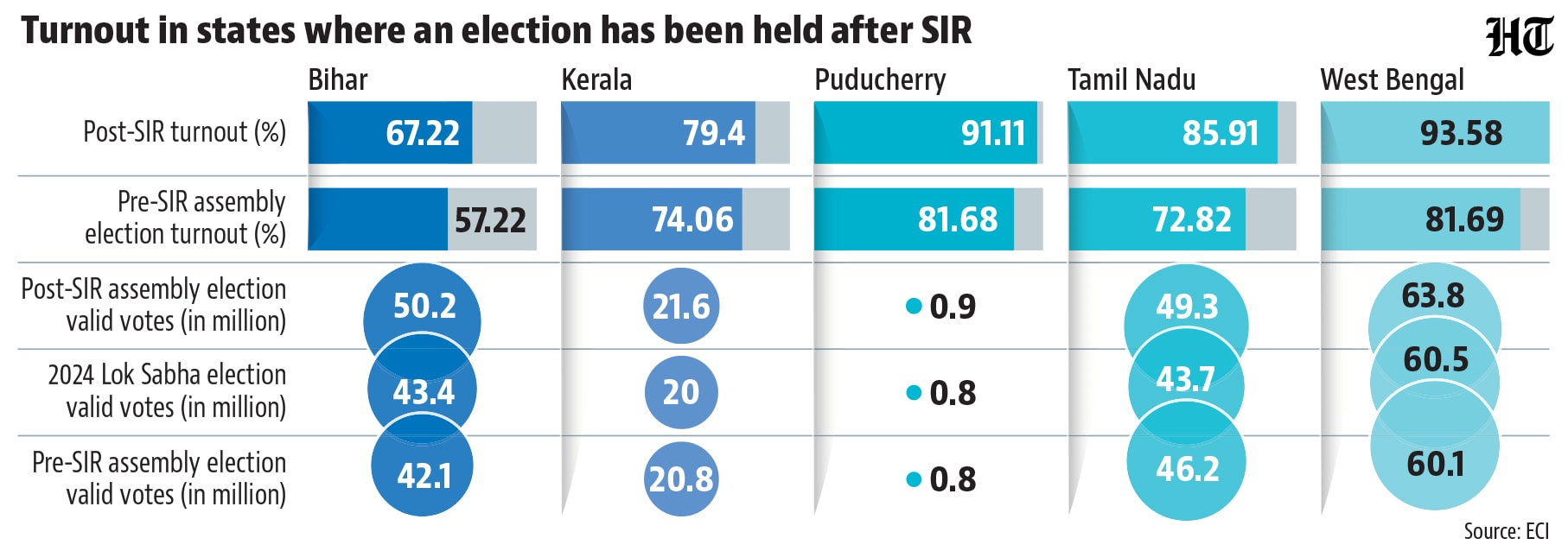
- So far, post-SIR elections have seen a surge in voter turnout rather than fall in absolute turnoutThis is the most important fact to keep in mind while discussing possible disenfranchisement because of the SIR exercise. While evidence exists of wrongful deletions at various stages of the SIR exercise and a disproportionate documentary burden testing even the social elite, a blanket disenfranchisement theory would require a fall in absolute voter turnout between a pre and post-SIR election. This has not happened so far at a state/UT level. What we have seen everywhere is a rise in voter turnout as the denominator (number of electors on the roll) fell sharply. To be sure, there are constituency-level cases where the absolute turnout in post-SIR elections fell below the previous election’s absolute turnout. In the most extreme case in West Bengal, 2.7 million electors are still engaged in legal proceedings over their exclusion from the electoral rolls.
- The numbers given above offer three key takeaways about the SIR exercise. The absolute amount of deletions are extremely large. Deletions tend to be higher initially and seem to fall once the exercise is completed. And, so far, we have not seen large-scale fall in actual voter turnout, although there are localised instances of such things happening. What exactly is driving these trends? The second part of the series will try to answer this question.