
 E-Paper



'Only pro-tem chairman': SC to bar council chief Manan Mishra amid pleas challenging his tenure
The Supreme Court said BCI chairman Manan Kumar Mishra’s continuance in office cannot be treated as an arrangement extending up to 2030

 Prefer HTon Google


The Supreme Court on Wednesday put the functioning of the Bar Council of India (BCI) under a tighter oversight mechanism, directing that the Attorney General (AG) for India and Solicitor General (SG) must be “actively associated” with every policy decision taken by the apex lawyers’ body until it is reconstituted through fresh elections.
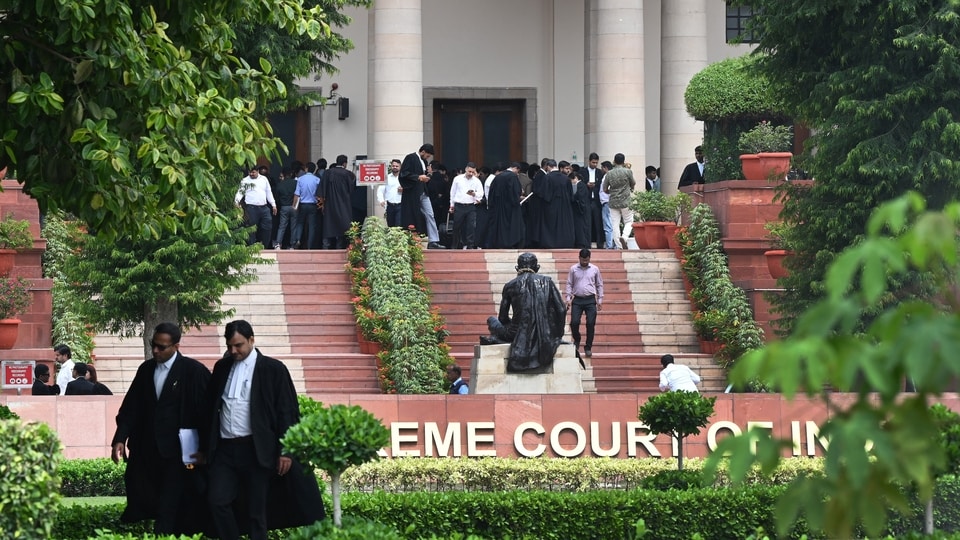
A bench, comprising Chief Justice of India (CJI) Surya Kant and justices Joymalya Bagchi and V Mohana, made it clear that BCI chairman Manan Kumar Mishra’s continuance in office cannot be treated as an arrangement extending up to 2030, observing that, prima facie, his position is only a “pro tem” continuation until a freshly constituted BCI elects its office-bearers.
The court’s intervention came during a hearing on petitions concerning elections to state bar councils, in which a fresh challenge was mounted against Mishra’s continuance as BCI chairman and the validity of notifications purporting to extend the tenure of the chairman and vice-chairman up to 2030.
Why SC direction is significant
The bench’s directions assume significance coming days after it had criticised the BCI’s intervention in the controversy over the NALSAR University of Law’s 2026 graduating batch. BCI chairman Mishra had initially directed state bar councils not to enrol the students owing to their protest over inviting the CJI for the convocation, before withdrawing the freeze and eventually closing proceedings against the batch. Mishra subsequently apologised to the students for any hurt caused by his words or the Council’s actions.
On Wednesday, the bench said that its immediate concern was not the conduct of any individual but the institutional functioning of the BCI and the need to restore the statutory electoral scheme after state bar council elections were held pursuant to the court’s directions.
The controversy before the court centred on BCI notifications issued in 2025 that purported to give Mishra and vice-chairperson S Prabhakaran a five-year tenure, despite submissions that Rule 12(2) of the BCI Rules prescribes a two-year tenure for the chairman and vice-chairman.
Senior advocate Madhavi Divan, appearing for the petitioners, told the bench that Mishra had been unanimously elected chairman on March 2, 2025, for a term beginning April 17, 2025 and ending April 16, 2030. She pointed out that a January 9, 2025, resolution had purported to extend the tenure of the chairman and vice-chairman from three years to five years, even though the rules prescribed only two years.
At this, the bench questioned how such an extension could operate when the rules prescribed a two-year tenure. “Interestingly, it purports to extend the tenure from three years to five years, whereas the rules prescribe only two years,” it observed.
Divan challenged the reliance on the proviso to Section 4(3) of the Advocates Act, which permits BCI members to continue until their successors are elected. She argued that a provision intended to prevent an administrative vacuum had effectively been used to avoid elections and perpetuate existing office-holders.
The bench said the proviso was only a transitional and ad hoc mechanism and that the controversy surrounding it may no longer survive now that elections to state bar councils had been completed.
The key development, it said, was that newly elected state bar councils must now exercise their statutory power under Section 4(1)(c) of the Advocates Act to elect their representatives to the BCI. Those representatives would thereafter elect the BCI chairman and vice-chairman. “Is there any doubt that the present office-bearers cannot continue indefinitely until 2030?” the court asked.
The court also addressed concerns raised over the concentration of power within the BCI, including allegations regarding the creation and functioning of trusts controlled by present and former BCI office-bearers.
Senior advocate Gopal Sankaranarayanan referred to the creation in 2020 of the Bar Council of India Trust for Promotion of Education, Legal and Professional Reforms and Improvement in Research (PEARL Trust), alleging that its deed made 11 managing trustees “original and permanent trustees” irrespective of their tenure as BCI members.
The bench questioned whether an elected corporate body such as the BCI could use its assets to create a trust in which particular individuals remained trustees permanently, even after ceasing to be members of the body that created the trust.
Divan then suggested that, until the reconstitution was completed, the Attorney General and Solicitor General -- both ex officio members of the BCI, should participate in every important decision of the council.
Senior advocate CU Singh said resolutions were presently being issued from the chairman’s office without wider consultation and argued that involvement of the two highest law officers would provide an institutional check during the interim period.
To this, the court clarified that the law officers need not become part of the BCI’s day-to-day functioning but should be involved whenever a decision with significant policy implications is being considered.
The BCI, through senior advocates Maninder Singh and Guru Krishnakumar, agreed to the arrangement.
The court added that while day-to-day functioning could continue under the existing arrangement until the new BCI was constituted, “when a policy decision is taken, the participation of a permanent ex officio member acting independently, such as the Attorney General, is necessary.”
The bench recorded the undertaking that the Attorney General and Solicitor General would be “actively associated” before any policy decision was taken by the BCI.
The court set a four-week roadmap for completing the state bar council reconstitution process. The chief justices of the respective high courts have been given two weeks to complete the co-option of women members, after which the state bar councils must notify their final composition within one week.
The newly constituted councils will then have two weeks to elect their chairpersons, vice-chairpersons and other office-bearers, as well as their respective representatives to the BCI under the Advocates Act. Once the compliance reports are received, the Supreme Court will take up the issue of reconstituting the BCI. The matters have been posted for September 23.



