
 E-Paper



Terms of trade: The alchemist of palace coups meets his coup d'état
In terms of pure arithmetic, it is not entirely unjustified. The BJP is the senior partner in the National Democratic Alliance (NDA) coalition in the state

 Prefer HTon Google


Even a cat has only nine lives, they say. Nitish Kumar was in his tenth life as the chief minister of Bihar when he assumed office in November last year. Turns out it was only nine point something. With Nitish filing his nomination for the Rajya Sabha, which is also referred to as the house of elders in political lingo, on Thursday, it is curtains on a political career which dominated Bihar for the last two decades.
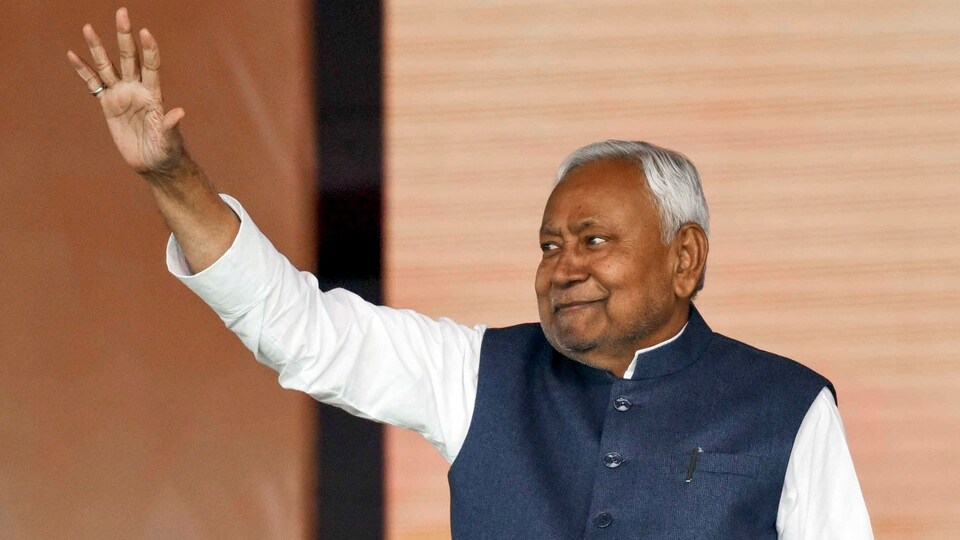
What awaits Bihar in terms of Nitish’s successor is still not clear. The grapevine in Patna — where thanks to Nitish, the only high is politics and not the stuff made from grapes or grain or molasses — has it that the new chief minister will likely be a person from the Bharatiya Janata Party (BJP). In terms of pure arithmetic, it is not entirely unjustified. The BJP is the senior partner in the National Democratic Alliance (NDA) coalition in the state. It was senior by a much bigger distance after the 2020 elections too — when it allowed (some would say encouraged) another ally in the grouping to step out and take on the Janata Dal (United) — but it let Nitish become the chief minister back then.
Whoever is appointed as the chief minister is unlikely to meet the popular and powerful threshold which the state has set for its rulers in the last three and a half decades, an era dominated by what Sankarshan Thakur famously christened the brothers Bihari, referring to the duo of Lalu Yadav and Nitish Kumar. We are more likely to see a lightweight who is more loyal to Delhi than venerated in the state of more than 130 million people. This is what the BJP has done in most, although not all, states it has won since 2014. And this is what Indira Gandhi did to Congress chief ministers when she held absolute control over the Congress party in the 1970s and 1980s.
Nitish and his comrade turned enemy—the cycle has had multiple iterations—Lalu Yadav were products of the rebellion against the Congress’s hegemonic status in Bihar, a place where the party started eroding itself pretty soon after independence. They were exceptional protégés of a movement which put caste, not class, at the vanguard of the struggle against the Congress’s dominance to build a rebellion and eventually storm the gates of upper-caste and, by extension Congress’s power. Their mentors such as Karpoori Thakur fought this battle when the odds were higher, the backlash stronger, perhaps even fatal (Jagdeo Prasad's ghost would agree) and success was short-lived and precarious. Between Bihar's first Chief Minister, Shri Krishna Singh, who passed away while holding office in 1961, and Lalu Yadav who assumed office in 1990, no Chief Minister completed a full term. Since then, politics in the state has become remarkably stable: Lalu and his family and Nitish with a short choreographed cameo for Jitan Ram Manjhi.
To be sure, it is equally important to differentiate the brothers Bihari as it is to see them as the twin protegees of the broader social justice movement in the state. Lalu’s flamboyance and wannabe Robin Hood praxis in politics were meant to keep his (numerically and increasingly economically) dominant caste base of Yadavs in control of the maximum spoils of power while drawing on the support of the larger subaltern crowd. If Lalu was the Machiavellian lion, using force and brute strength to defeat opponents, Nitish was the proverbial fox, drawing from shrewd calculated politics what a lack of numbers did not offer him. But he was not the fox which admitted defeat after failures and walked away after declaring the grapes were sour. After breaking ranks with Lalu, he made his first bet on allying with the ultra-left ML Liberation in the mid-1990s, which back then was more a party of just overground Naxalites than mainstream communists. The failure in this experiment caused Nitish to make an ideological U-turn, aided by socialist mentors such as George Fernandes and attach himself to the Hindutva bandwagon which was willing to negotiate its core politics in exchange for some parliamentary muscle.
The marriage was a successful one in Bihar and also a convenient one for Nitish. By the time he won Bihar in 2005, the BJP had lost power in the center. The asymmetry became wider after the 2010 assembly elections in the state. Nitish had a landslide victory while the BJP was buried under the debris of the 2009 national election loss.
Bihar, especially Nitish’s ideological cheerleaders, basked in a temporary ideological glory and proclaimed that the socialists had overwhelmed the saffron-ists in state’s politics. It was the best possible solution because the anti-governance socialists (Lalu) had been banished. But all good things must come to an end.
For Nitish, the end came in 2013 when the BJP, in a palace coup of its own decided to declare Narendra Modi as its prime ministerial candidate for the 2014 elections. Dizzy with the success of his self-declared ideological victory—which had only analyzed and observed the Hindutva project at its moment of weakness—Nitish termed the newly appointed BJP leader a pariah and walked away from the NDA. Modi’s BJP became the first party to win a majority of its own in 2014 after 40 years. Nitish, who had gone to polls with the more revisionist communists (CPI) this time, managed to win just two Lok Sabha seats against the BJP’s 22 and NDA’s overwhelming 31 out the 40 in the state. Nitish, driven by political survival decided to join ranks with his former comrade Lalu Yadav and change ideological track where the socialists needed to confront the saffron-ists once again.
The socialism sequel was a blockbuster in the 2015 elections and the BJP and its allies saw the tables turn on them compared to their comfortable victory in 2014. Managing democracy day-to-day proved far more difficult for the brothers Bihari than winning the election. Nitish’s ten years in power had relied as much on buon governo – he was called Sushashan Babu (the patron saint of good governance) – as on vilification of Lalu’s style of politics and its associated optics. The latter preferred the moniker of Sahab (almost a neo-feudal lord kind of imagery). Lalu’s party, the RJD could never have undertaken the creative destruction, Nitish required for the marriage to be successful. They parted ways after the 2017 Uttar Pradesh elections re-established that the BJP’s 2014 victory wasn’t a fluke and Modi was not going anywhere anytime soon.
But Nitish’s shrewd politician self perhaps believed that pragmatism did not need to lead to servility. He also, in what can perhaps be described as a reasonable act of electoral empiricism, deduced that it was he and his party which held the keys to power in Bihar. The aspiration for the former, combined by confidence from the latter, led to Nitish switching sides two more times between the BJP and RJD before he finally settled with the BJP in 2024 and 2025 elections, by which time, he would have outbursts of public servility towards Narendra Modi, a man he once challenged, detested and wrongly declared a political pariah.
As Nitish moves upstairs from Patna to Delhi, in what can only be described as a state of political hospice, should one feel sorry for him or his party? The JD(U) was largely a club of vested but capable local level politicians around a leader who got them power. Most regional parties in India are not very different, but what makes this particularly true for the JD(U) is the fact that its own caste-base (Kurmi) is not even 5% of the state’s population. Ideological sovereignty is the last thing on the mind of such people. To be sure, even Nitish trusted his bureaucrats more than his political lieutenants.
Nitish’s own legacy will be anything but insignificant in the state. He delivered it alive from the labour of social justice revolt against a dying feudal order and stabilised it. Bihar is still among the poorest states in the country today and has all the markers of underdevelopment but it is not a place where things are going south. Nitish is the biggest reason for this and the state’s people will always be grateful to him for making this happen. As far as his atrophying – personally and politically – at the hands of the BJP is concerned, it raises a question which must be asked at a larger level than vis-à-vis not just Nitish or JD(U). If the post-independence socialist strand of politics was meant only to engineer caste dynamics to game the first-past-the-post system, hasn’t the BJP done better by adding the sweetener of populist handouts for the plebians while the patricians fight for crumbs of power in Caesar's court?
“Its poverty notwithstanding, Bihar’s politics was always richer than many of its better-off peers with history and society engaged in a dialectical dance. From 2025 onwards, this might not be the case”, this author, wrote in one of his columns during 2025 election. Bihar has taken its first step towards becoming a political conformist to the regime in Delhi. This will be BJP’s one of the most celebrated coup d'états in its political history, which was almost three decades in making.
When Nitish was the Railway Minister, he started a train between Patna and Delhi and called it Sampoorna Kranti Express after Jayprakash Nayaran's clarion call before the Emergency. The train, in a way, celebrated Bihar's political radicalism too. It would be a good idea to rename the train the Sampoorn Shanti Express today.
Bihar is no longer a political rebel.


