
 E-Paper



AIPMT paper leak: Why India is the hub of cheating in exams
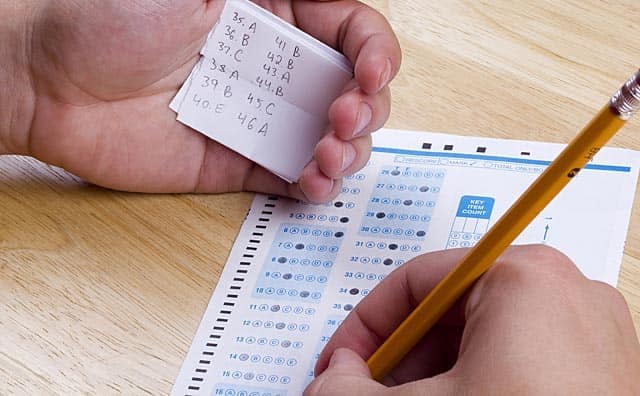
There has been a lot of talk lately on the internet, in our living rooms and on our dining tables, about the All India Pre-Medical Test (AIPMT) examination results being cancelled. But what is cheating? Is it a thing, a concept, a phenomenon restricted only to one-off instances?


There has been a lot of talk lately on the internet, in our living rooms and on our dining tables, about the All India Pre-Medical Test (AIPMT) examination results being cancelled.

The conversations about it only became intense after the Supreme Court on Monday scrapped the test following a month-long investigation into allegations of large-scale irregularities, including leakage of answer keys, by Haryana police.
And there is also a lot of talk about cheating. In the past couple of days, you would agree, there is nothing students, mothers, fathers and thinking adults, alike, are thinking, talking and writing about more.

(All photos: Shutterstock)
But what is cheating? Is it a thing, a concept, a phenomenon restricted only to one-off instances?
Apparently not.
Here's some disturbing truth.
In the past one year, about a dozen major question paper leaks have been reported affecting lakhs of students across India: From the latest AIPMT to the Uttar Pradesh Combined Premedical Test in 2014 and Jamia Millia's BTech and BDS courses entrance exams.
So, to understand why such scandals are so rampant in India, we asked experts if cheating in examinations was acceptable in the country and also why students engaged in it. And some of what they had to say -- about cheating and Indians -- left us a little embarrassed.

They cheat, because they must
According to Arun Kumar, a professor at New Delhi-based Jawaharlal Nehru University's Centre for Economic Studies and Planning, Indians are the most prolific while cheating, compared to our east and southeast Asian friends (China, included).
Explaining why 'a lot of' Indian students are 'wired' to cheat, Kumar told Hindustan Times, "Today, there is no need or want to excel among students. Students and their parents want degrees, at any cost, not education."
Renowned sociologist Dipankar Gupta said that when presented with an opportunity to cheat, students calculate the benefits of such an act against its possible cost, and then decide. And given India's current education system and its fixation with rote learning, there are no effective anti-cheating technologies to minimise cheating in schools, colleges and elsewhere.
"Cheating has always been there. But our education system has not kept up with the changing times. We still want students to mug things up, and not comprehend them and apply their mind," Gupta said.
Both Kumar and Gupta stress there is no deterrent to students in our education system even if it notices behaviour, actions or patterns that do not fall within the parameters of a normal exam scenario.

It's morality, stupid
Delhi-based practicing counselor, Geetanjali Kumar, associated cheating with our morality level. According to her, cheating is a persistent phenomenon in social contexts, where the individual is called upon to prove his/her worthiness and achievement. And the means do not always matter.
"Whether students cheat because of forces beyond our comprehension, or because a situation lends itself to unethical behavior, the truth of the matter is that not many students can resist cheating impulses," she said.
"Students are used to seeing cheating in every part of their life. Given today's society and family structure, students are more likely to cheat, as self-interest has taken precedence over morality for most people," she added.
The counselor stressed that understanding the mechanisms behind cheating could help us construct effective anti-cheating technologies to minimize cheating.
If they can, we can
According to Kolkata-based psychologist Polly Sengupta, if students believe others have engaged in illegitimate behavior and gotten away with it, they are more likely to engage in the same behaviour themselves.
"Students, like the rest of us, have the tendency to rationalise cheating, in their effort to shake off the guilt," said Sengupta.
She stressed that students (and sometimes parents) tend to rationalise cheating behaviour, because deep down they believe in the immorality of it and feel guilty about it. The act of justifying the act allows them to accept their behaviour, further encouraging them to engage in a similar actions in the future.
She made a larger point when she said that, "Taking the guilt or shame factor out we allow ourselves to delve into more unethical behaviours."
(The author tweets as SanyaHoon on Twitter)


