
 E-Paper



India must treat ‘Right to Compute’ as essential as books and pencils, says Intel India region VP and MD
Intel's Santhosh Viswanathan highlights the need for urgent investment in AI-driven education to modernise India's classrooms.

 Prefer HTon Google


Majority of India’s classrooms are still designed for the industrial and information ages, where teachers deliver one-way lectures to large groups and marks and grades dominate the cultural mindset. Despite 95% of households owning a mobile phone, less than 10% have a computer—and in many schools, the ratio is just one functional PC for every 120 students.
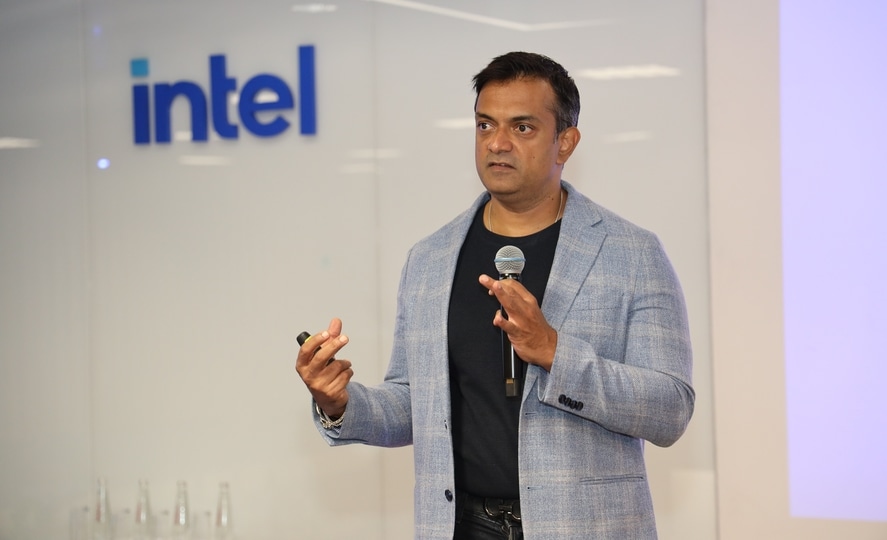
“Books and pencils are rightly treated as essential, but in the age of AI, access to computing must be seen as equally critical infrastructure,” said Santhosh Viswanathan, Vice President and Managing Director, Intel India Region, speaking at Intel’s education innovation called `PadhAI Ka Future’ showcase in Bengaluru. Without urgent investment, he warned, India risks leaving its next generation unprepared for the intelligence age.
AI, he argued, can bridge many systemic gaps—personalising learning, giving every student a voice, and helping teachers manage large classrooms. “This is not a five-year problem or a ten-year solution. It has to be done now—with urgency—otherwise our kids having the future they aspire to will be very challenging.”
In an exclusive interview with HT Digital, Viswanathan revealed how Intel is reimagining classrooms through AI PCs, the skills India’s students will need in the next decade, and why access and affordability remain central to the company’s strategy.
The new Canada? Why Indian students are now looking to Australia for education
Intel has been synonymous with hardware. What influenced your shift into education technology in India?
Hardware is incomplete without software. At Intel, the question is always: what problem can technology solve? When we launched Intel Centrino, it wasn’t about selling chips but solving the problem of connectivity. Education is now at a similar turning point. Earlier, computers were seen as distractions. But with AI, a personal computing device can act as a tutor, a coach, even a guide. AI PCs that combine CPU, GPU, and NPU make personalised learning possible—essentially giving every child a private tutor.
What problems in India’s education system are you aiming to solve?
Our current system was built for the industrial and information ages, focusing on memorisation and subject expertise. In the AI age, it’s about problem-solving, collaboration, and critical thinking. Education must evolve to prepare students for that shift.
Are you working with Indian boards or the government?
Yes. We’re working with multiple boards and the Ministry of Education. Our approach is to connect edtech partners with boards, so we don’t reinvent the wheel. India already has digitised content. Pairing this with AI agents can give students 24/7 personalised tutors—something impossible before the generative AI revolution.
What skills will be critical for students in the next 5–10 years?
Critical thinking and problem-solving will matter most. Students need to apply knowledge, not just memorise it. Alongside cognitive skills, human skills like empathy, teamwork, and collaboration will be just as important. AI can help here by providing personalised support—allowing faster learners to move ahead while ensuring slower learners don’t fall behind.
WACE in India: Western Australian curriculum offers affordable global education
Parents worry about distractions and screen time. How does Intel address these concerns?
We’re building tools that reassure parents. For example, apps can restrict usage during study hours and limit distractions. The idea is to make a device as focused as a textbook while preparing students with future-ready skills.
AR/VR is expensive. How will rural and government schools access such technology?
Many schools still don’t have a single working computer. Nearly half lack internet connectivity. So, AR/VR is premature. The priority is to expand access to basic computing—moving from one computer for 120 students to 1:15, and eventually 1:1. Phones are widespread, but they are not designed for two-way, active learning. Affordable laptops under Rs. 20,000 already exist. As parents see value in computers for education, adoption will scale—just like TVs did for entertainment.
What about teacher training and connectivity challenges?
Connectivity has improved thanks to players like Jio and BSNL. The bigger challenge is the AI gap—helping students and teachers use AI meaningfully. We run programs like AI for Youth, AI for Citizens , and AI for Workers. Teachers are at the centre of this transition, so upskilling them is a top priority.
What is Intel’s vision for India?
Our goal is to democratise access to computing and AI, so India’s 400 million children are workforce-ready for the AI age—not learning these skills for the first time at college or on the job. “Education is the only way many families have moved up the economic ladder. AI and computing can accelerate that journey by making world-class learning accessible to every child.”
HT Interview: Why cracking top Indian law schools is harder than IIT — and worth it
Data privacy is a growing concern. With AI-powered learning tools collecting student information, how is Intel ensuring data security and responsible use in schools?
Trust is the foundation of any technology in education, and without its adoption simply will not scale. Parents, teachers, and schools need to know that AI is being used in a safe and responsible way. That is why at Intel we focus on models that run directly on the device, so sensitive information never leaves the classroom. With AI PCs powered by CPU, GPU, and NPU, learning recommendations, attention tracking, and personalised feedback can all happen locally without relying on constant internet access or external servers. For instance, with partners like Physics Wallah, we have developed PiFocus, an app designed to create a safe and focused study environment. It provides parental controls such as screen time management, blocking of inappropriate content, and device management to ensure students build healthy learning habits. Solutions like this build trust for parents while keeping learners engaged and protected. For us at Intel, safeguarding data is as important as delivering outcomes, because only then can technology truly earn the confidence of families and educators.
Teachers often fear that AI could replace them. How do you position AI in the classroom?
Teachers will always be at the heart of learning, and AI should be seen as a powerful assistant rather than a replacement. The human touch, the ability to inspire, mentor, and guide students, is something technology cannot replicate. AI’s role is to relieve teachers of repetitive and time-consuming tasks, such as grading lengthy answer sheets, creating question banks, or addressing routine doubts. For example, Infinity Learn’s AI Grader can evaluate multi-page answer sheets and provide detailed feedback, while the AI Doubt Solver and AINA offer students step-by-step solutions and guidance. By taking care of these tasks, AI gives teachers more time to focus on personalised coaching, identifying gaps, and helping students build critical thinking and problem-solving skills. In this way, AI enhances the teacher’s role, making classrooms more effective while allowing educators to do what they do best, inspire and guide the next generation.
Looking ahead, what is your vision of an Indian classroom in 2030?
By 2030, we envision Indian classrooms where every child has meaningful access to compute, rather than relying on a single shared PC for an entire school. Learning will be personalised and interactive, with AI adapting to each student’s pace and language, while teachers act as mentors and guides. Gamified and immersive models will make education engaging, and vernacular AI will ensure inclusivity across India’s diverse regions. For this vision to become a reality, compute must be treated as essential infrastructure, just like books and pencils today. That is why we talk about the Right to Compute, because without access to computing, education in the AI age will remain incomplete. Our commitment is to collaborate with governments, educators, and industry partners to realise this vision, supported by initiatives such as GST relief on education PCs linked to APAAR ID and a strong domestic manufacturing base. If we succeed, classrooms in India by 2030 will not only prepare students for exams but also equip them with the skills needed to thrive in the intelligence age, including problem solving, empathy, collaboration, and creativity.


