
 E-Paper



From ‘Roti, Kapda, Makan’ to AI: India’s Next Essential Skill
India may not build the world's largest AI models, but it could become a major beneficiary if classrooms treat artificial intelligence as a foundational skill.

 Prefer HTon Google


As Artificial Intelligence (AI) spreads, India’s ability to equip its youth with AI literacy will shape its future. AI influences how we learn, work, and solve problems. This raises the question of whether it should be a basic skill.
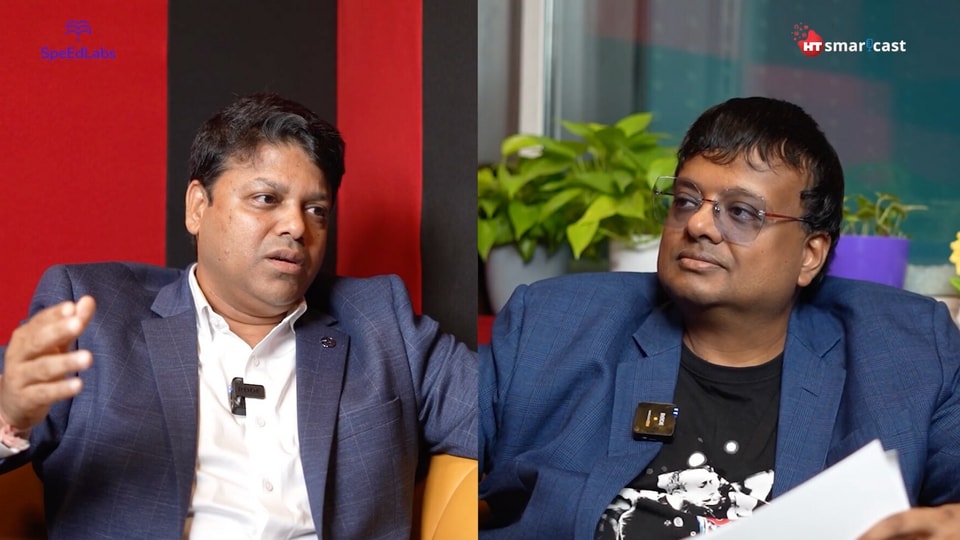
While organisations such as UNESCO and the World Economic Forum have highlighted AI literacy as essential for future education and work, Vivek Varshney, founder of SpeEdLabs and creator of STEMlearn.AI, believes India's best opportunity is to prepare a generation to work with AI rather than focus on inventing breakthrough models.
Speaking to Hrishikesh Kannan on a recent episode of HT Smartcast's Leadership Lessons, a podcast featuring leaders shaping business, technology and society, Varshney argues AI is at the same turning point as literacy and numeracy once were. It is not just for engineers but is becoming a basic skill all students need for any future career.
"The education system has to evolve," he says. "Otherwise, we will be generating a future generation, which is unemployable."
As India’s economy and workforce transform, schools must rethink what they teach and how they prepare students for a world shaped by intelligent technology. Yet Varshney insists integrating AI into existing subjects is the best way forward. He does not argue every student must build advanced AI models. Instead, all should understand how intelligent systems work, their possibilities, limitations, and how to use them responsibly. Just as maths is not only for mathematicians, AI education should prepare students to think critically in a technology-driven world.
Beyond Chatbots: Why AI Matters Now
For many, AI means chatbots, image generators, and writing tools. Over a billion people use AI-powered applications, showing how fast the technology has entered daily life.
Yet Varshney believes these tools represent only the first chapter of a much larger transformation.
"AI is going to operate at a much, much, much bigger scale," he says.
The real shift, he argues, will come as AI becomes part of healthcare, manufacturing, logistics, agriculture, research, education, and public services. Students must do more than learn prompts or use apps. They need to understand the principles of intelligent systems and develop analytical and problem-solving skills.
Preparing young people for an AI future, Varshney says, is less about developing software and more about encouraging habits of questioning, evaluating, and working with technology.
Why Schools Must Rethink Learning in the Age of AI
For decades, India's education system followed a sequence with school, higher education and then employment. Varshney argues this sequence is now out of sync with a labour market where technology changes faster than the curriculum.
His concern is not that AI will replace every job but that routine, information-based work is easier to automate. This makes human judgment, creativity, teamwork and critical thinking more important.
Mathematics gives students a language for numbers and patterns. AI should become a foundational language that helps students understand how intelligent systems function and how to use them.
Varshney often says, "For humanity, 'roti, kapda and makan', meaning food, clothing and shelter, were the first necessities. Then came education, then healthcare, and now artificial intelligence. Without AI, nothing will be possible twenty years from now. This does not mean replacing traditional subjects. It means embedding AI in daily learning through practical projects and real applications. His platform STEMlearn.AI combines textbooks, digital tools, and projects to encourage experimentation.
The National Education Policy, 2020 (NEP) promotes experiential learning, critical thinking and tech integration. This aligns with Varshney's argument that education must evolve with technology.
India's Opportunity: From Users to Innovators
Some observers argue India entered the AI race too late because most large language models were developed elsewhere, raising doubts about its competitiveness.
Varshney does not dismiss this reality. Instead, he argues the country's greatest opportunity lies elsewhere.
“We are not going to create something like Anthropic or OpenAI,” he says. “But as India adopts AI, it will continue to contribute to the global AI workforce.”
India is one of the world’s youngest major economies, with a median age of 28 and a large pool of tech talent. This opportunity matters only if students are prepared to work confidently with AI.
For Varshney, AI success depends not on a few innovators but on enabling millions to use intelligent technologies productively across sectors. India’s advantage may be measured by how widely its workforce uses AI rather than the models it builds.
Teachers in the Age of AI
Many fear AI will replace teachers, but Varshney believes the opposite is true.
Fifty years ago, teachers were the main source of classroom knowledge. The internet changed that. AI is the next stage in this evolution.
AI can become a personalised learning companion, letting educators spend more time mentoring and developing critical thinking.
Teachers have always played a key role in education. The role shifted to enabling knowledge, and now, teachers will become co-educators.
There are still major teacher shortages in government schools, especially in rural areas. Varshney sees AI not as a substitute but as a tool to support learning and bridge gaps.
What AI Cannot Replace: Curiosity and Judgement
Varshney advises students and parents to start using AI now and always stay curious.
The World Economic Forum lists analytical thinking, lifelong learning, resilience and curiosity as increasingly valuable as AI transforms work. Artificial intelligence can retrieve information, generate content and automate routine tasks, but it cannot replace human judgement, ethics, creativity or curiosity.
The world will not wait. If AI is becoming a new form of literacy, the question is no longer whether AI belongs in classrooms. The challenge is whether education can evolve fast enough for today’s students to be not just users of AI, but the architects of its future.


