E-Paper



Posers on Modi’s pet projects stump civil service aspirants
Multiple questions in civil services prelims on the pet schemes of Narendra Modi government have stumped candidates.


Multiple questions in civil services prelims on the pet schemes of Narendra Modi government have stumped candidates.
At least 13 of the 100 questions were on schemes launched by Prime Minister Narendra Modi, including Pradhan Mantri Fasal Bima Yojana, Stand-up India Scheme, Ujwal Discom Assurance Yojana (UDAY), Study Webs of Active-Learning for Young Aspiring Minds (SWAYAM), Pradhan Mantri Mudra Yojana and Atal Pension Yojna.
“It’s hard to understand why questions based on government schemes were given prominence by leaving out important topics like modern history, geography, polity and others,” said Indore’s Vineet Kumar, who has been preparing for civil services for the last two years.
The civil services exam is conducted by Union Public Service Commission to select candidates to fill administrative positions in different all-India services and central civil services, including IAS, IPS, IFS, IRS, and IRTS.
Read more: UPSC panel wants govt to reduce age limit for civil services exam
Swati Mishra from Bhopal said barring one question on the reason behind the split in Indian National Congress in Surat in 1907 there was hardly any question on modern history in the paper.
Overall, this year, questions were asked more on current affairs, system and governance, law, social and economic law. 18 questions were asked to test candidates’ knowledge on current affairs. Few questions were asked in the polity section.
Questions on import cover, transcriptome and Project Loon in the “in the news” section also left candidates in a tight spot.
Bhopal’s Aniket Kumar, who was taking the exam for the fourth time, said: “This year general knowledge paper was purely based on current affairs. A large number of questions were asked ‘in the news section’…Some questions relating to science also left candidates disturbed.”
Only 25% take test
Only 8,988 of the 34,744 candidates from Bhopal who had applied appeared for the exam on Sunday.
Exam coordinator ML Tyagi said for the last few years the number of aspirants appearing in the exam (compared to the applicants) remained low at 35-45%, but this year it came down to 25%.
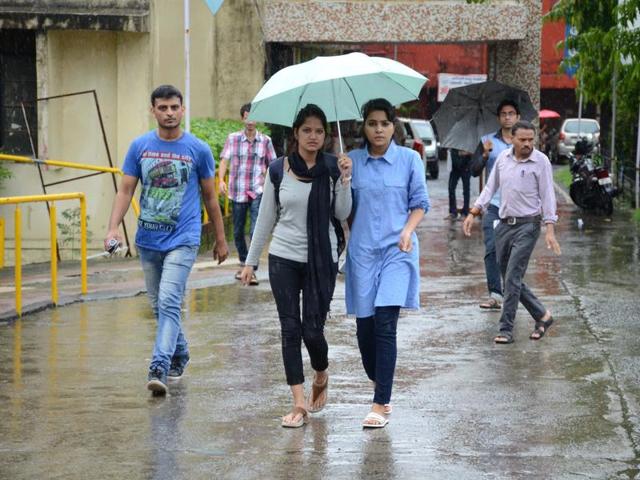
He attributed the poor turnout to heavy rainfall in the state capital.
Many outstation candidates who had planned to reach Bhopal on Sunday morning to take the test faced trouble due to the rains. Frequent power failures hassled candidates at several test centres.
The preliminary examination was conducted in two phases -- the first phase started from 9.30 am and continued till 11.30 am while the second phase commenced on 2.30 pm and continued till 4.30 pm.