
Sign in

Lure, rape, kill: Gurugram serial rapist followed pattern, always wore ‘lucky’ shirt

According to Guurgram Police, the man, accused of raping and killing a three-year-old girl in sector 66, allegedly admitted during his interrogation that he would wear his ‘lucky’ blue shirt while committing the crimes.

Updated on: Nov 22, 2018, 08:58:09 IST
Hindustan Times, Gurugram | By , Gururgam
Share
Share via
  • facebook
  • twitter
  • linkedin
  • whatsapp
Copy link
  • copy link

First he would lure a girl with money, usually a 10 note, take her to a room and once he raped her, would bludgeon her to death with a brick. In his crimes, he would wear his “lucky” blue shirt.
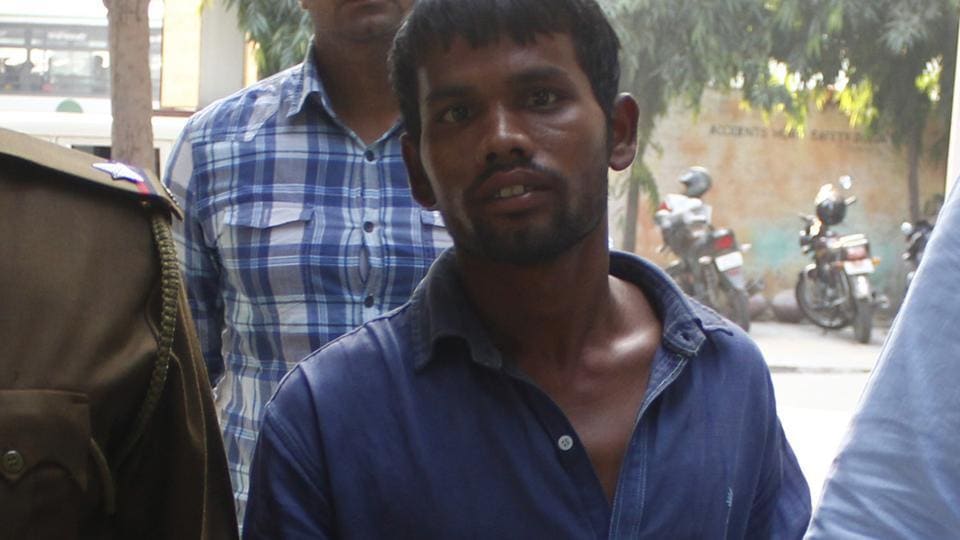
A psychological evaluation of Sunil Kumar, an alleged serial rapist -killer,  will be conducted to assess his behavioural and mental condition. (Yogendra Kumar/HT Photo)
A psychological evaluation of Sunil Kumar, an alleged serial rapist -killer, will be conducted to assess his behavioural and mental condition. (Yogendra Kumar/HT Photo)

This, police said, is how 20-year-old Sunil Kumar allegedly described how he killed three girls in Gurugram between 2016 to 2018. Police said the accused revealed this during questioning. He also allegedly admitted to killing six other girls in Delhi, Uttar Pradesh and Madhya Pradesh. The reason why he was caught, Kumar allegedly told police, is because he wasn’t wearing his “lucky” blue shirt.

Kumar was held on Monday from Uttar Pradesh’s Jhansi for the rape and murder of a three-year-old girl in Gurugram’s Sector 66 earlier this month.

“He said he felt that whenever he wore the blue shirt and committed a crime, the police could never trace him. He was surprised that despite taking all the precautions he was caught,” said K K Rao, commissioner of police.

“He would approach girls between three to eight years of age at religious community kitchens when their parents are distracted and he took advantage of the crowd,” said Sumit Kuhar, deputy commissioner of police (crime).

Police said Kumar told them that he would prepare himself before a crime. He said he used to carry out reconnaissance of the area a day before, said police, and would visit the crime spot, keep bricks and sticks close by. He also took care not to use his mobile phone while luring the victim, said police, and this made it difficult for police to track him.

“He always kept 10 note in trousers. Whenever he got an opportunity, he would offer it to the girl on the pretext of buying them a chocolate and lured them. When the victims followed him, the accused would take them to an isolated place, spend some time talking to them to ensure the victim was comfortable and that no one suspected anything,” said Raj Kumar, sub-inspector CIA said. “He would then commit the crime.”

Police said that their probe into the Sector 66 incident had a stark resemblance to a similar crime a few years ago. Then too, the accused lured girls from community kitchens. With this in mind, the police tried to lay a trap by organising community kitchens in the garb of a religious function. They spent around 3 lakh in this operation across Gurugram, Delhi and UP. However, the suspect was finally arrested from an independently-organised community kitchen.

Based on Kumar’s “confession”, police on Wednesday spoke to the families of two other victims. While one could not identify the accused from a photo, the other said they knew him and had seen him on the day the girl was kidnapped but could not confirm if he was involved in the crime, police said.

The accused on Tuesday had allegedly confessed to his involvement in nine cases of raping and murdering minor girls. During the probe, the police examined around 150 hours of CCTV footage from the areas where the crimes had taken place, Rao added.

A psychological evaluation of the accused man will be conducted to assess his behavioural and mental condition, officials said.

Gururgam police will write to its counterparts regarding unsolved rape and murder cases of minor to check his involvement at the suspected locations in Delhi, Agra, Gwalior, and Jhansi.

  • Leena Dhankhar
    ABOUT THE AUTHOR
    Leena Dhankhar

    Leena Dhankhar is Senior Editor and Bureau Chief, Gurugram, at Hindustan Times, where she has spent over 17 years chronicling the transformation of one of India's fastest-growing urban regions. From starting her career as a crime reporter to leading the Gurugram bureau, her journalism has been defined by investigative reporting, in-depth storytelling and an unwavering focus on public interest. Over nearly two decades, she has reported extensively across crime, politics, civic governance, elections, real estate, environment, courts, sports, education and entertainment, covering Gurugram, Faridabad, Nuh and Palwal. Her reporting has exposed several major scams and systemic failures, including insurance frauds, waste management irregularities, illegal arms manufacturing units in Nuh, illegal mining in the Aravallis, organised crime networks and governance lapses affecting millions of residents. Known for her investigative work and exclusive stories, Leena has reported on high-impact national issues, including the Nicaragua charter flight carrying Indian migrants that was turned back amid allegations of human trafficking, exposing the growing network of illegal immigration rackets. Her work has also focused on gang wars, prison administration, juvenile crime, women and child protection systems, the functioning of the Juvenile Justice Board and Child Welfare Committee, and environmental challenges such as pollution, waterlogging and deteriorating civic infrastructure. Beyond hard news, Leena has extensively documented Haryana's rich heritage, forests and wildlife, bringing attention to the state's historical landmarks, biodiversity, conservation efforts and ecological challenges through immersive reportage and feature writing. Her journalism has consistently gone beyond breaking news. She has documented Gurugram's rapid urbanisation through long-form narratives and enterprise reporting on issues ranging from pothole-ridden roads, flooding and waste management to the changing social fabric of India's Millennium City. She also writes widely read feature columns, including The Outsider, Changemaker, and Concern for Gurugram, profiling people, places and ideas shaping the city's identity. Leena is the author of Gurugram School Murder, published by Juggernaut Books, a deeply reported account of one of India's most high-profile school murder investigations. She is currently working on her second book, an investigative work exploring some of India's most significant scams and fraud investigations. Beyond print journalism, she has expanded her storytelling through public speaking and digital media. She is a TEDx speaker and has produced podcasts exploring Gurugram's transformation, civic challenges and untold stories. Her work reflects a commitment to narrative journalism that combines rigorous reporting with compelling storytelling. A law graduate with an MBA in Human Resources, Leena brings a multidisciplinary perspective to her reporting, particularly on governance, public policy and legal affairs. She has travelled extensively across India to pursue investigative assignments, often reporting from remote locations and conflict-prone areas in search of stories that matter.Read More