E-Paper



ASEAN and East Asia summits: How the regional blocs evolved over the years
The Philippines will host ASEAN’s 2026 summit meetings in Manila from November 15 to 17, bringing regional and global leaders together.

 Prefer HTon Google


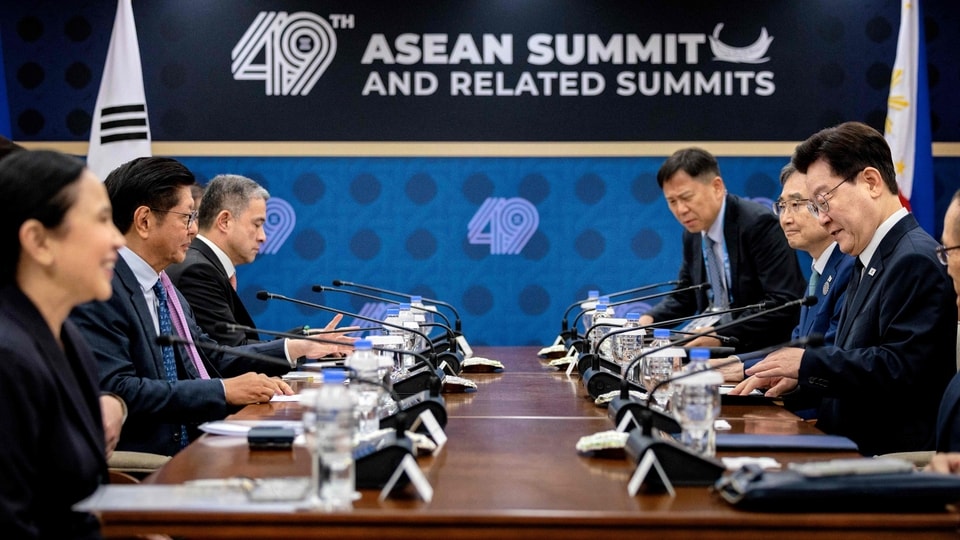
The Philippines is hosting the 49th Association of Southeast Asian Nations (ASEAN) Summit and Related Summits in Manila from November 15 to 17, 2026, bringing together leaders from Southeast Asia and major Indo-Pacific powers to discuss regional security, economic cooperation and geopolitical challenges.
Prime Minister Narendra Modi is undertaking a three-day visit to the Philippines, landing in the country on November 16 to participate in the 23rd ASEAN-India Summit and the 21st East Asia Summit, according to the Ministry of External Affairs (MEA).
The Philippines, which holds ASEAN's chairmanship for 2026, is hosting the meetings under the theme "Navigating Our Future, Together". Discussions are expected to cover maritime security, regional economic cooperation, tensions in the South China Sea and the political situation in Myanmar.
While the ASEAN Summit brings together leaders of the grouping's 11 member countries, the East Asia Summit provides a wider platform involving additional countries, including India, China, the United States and Russia. Both forums have evolved over the decades as regional countries have sought ways to address shared political, economic and security concerns.
What is ASEAN and why was it formed?
The Association of Southeast Asian Nations was established on August 8, 1967, in Bangkok, Thailand, with the signing of the ASEAN Declaration, also known as the Bangkok Declaration.
Indonesia, Malaysia, the Philippines, Singapore and Thailand were its five founding members. According to ASEAN's official history, the organisation was formed to promote regional cooperation and strengthen peace and stability in Southeast Asia.
The grouping emerged during the Cold War, when the region was dealing with political instability, conflicts and tensions between major powers. Its founding members sought to create a framework for cooperation rather than allow regional differences to deepen.
The Bangkok Declaration identified economic growth, social progress and cultural development through joint efforts as key objectives. It also called for promoting regional peace and stability through respect for justice and the rule of law, alongside adherence to the principles of the United Nations Charter.
Over time, ASEAN developed into a regional organisation with regular leaders' meetings, institutional mechanisms and partnerships with countries outside Southeast Asia.
Also read: Asean ties at the heart of India's Act East Policy: PM Modi before leaving for Manila
How ASEAN expanded over the years
ASEAN began with five members but gradually expanded to include more countries across Southeast Asia.
Brunei joined the organisation in January 1984, followed by Vietnam in July 1995. Laos and Myanmar became members in July 1997, while Cambodia joined in April 1999.
Timor-Leste became ASEAN's 11th member on October 26, 2025, completing a long process of integration into the regional grouping, according to the ASEAN Secretariat.
As its membership grew, ASEAN also developed a broader institutional framework. The ASEAN Community, formally established in 2015, is organised around three pillars: the ASEAN Political-Security Community, the ASEAN Economic Community and the ASEAN Socio-Cultural Community.
These pillars cover cooperation on regional peace and security, economic integration, trade and investment, as well as social, cultural and developmental issues.
The grouping also established partnerships with countries and international organisations outside the region, giving it a larger role in discussions on Indo-Pacific affairs.
What is the East Asia Summit and how did it begin?
As ASEAN expanded its regional role, the need for a wider platform involving countries beyond Southeast Asia also grew. This led to the creation of the East Asia Summit in 2005, with its first meeting held in Kuala Lumpur, Malaysia, on December 14 that year.
The inaugural summit brought together the 10 ASEAN members at the time, along with Australia, China, India, Japan, New Zealand and South Korea, taking the total participation to 16 countries.
The grouping was designed as a leaders-led forum to discuss wider regional and international issues. The 2005 Kuala Lumpur Declaration described it as a platform for dialogue on "broad strategic, political and economic issues of common interest and concern".
The United States and Russia joined the forum at its sixth summit in Bali, Indonesia, in November 2011. With Timor-Leste's entry into ASEAN in 2025, the East Asia Summit now has 19 participating countries: the 11 ASEAN members and eight external partners.
The forum covers issues such as maritime security, trade, energy security, climate change, public health, connectivity and regional stability. ASEAN remains its driving force, with the ASEAN chair also presiding over the East Asia Summit.
How are the ASEAN and East Asia summits different?
Although the two meetings are often held alongside each other, they have different memberships and functions.
The ASEAN Summit is the principal meeting of leaders from the 11 member countries. It provides a platform to discuss the organisation's priorities, take decisions on regional cooperation and review progress on initiatives involving its members.
The East Asia Summit, meanwhile, brings ASEAN leaders together with eight additional countries: Australia, China, India, Japan, New Zealand, South Korea, Russia and the US. It focuses on broader strategic, political, security and economic issues affecting the Indo-Pacific.
Another important mechanism is ASEAN Plus Three, which brings together the 11 ASEAN countries with China, Japan and South Korea. It was established in 1997, initially in response to the Asian financial crisis, and has since expanded cooperation in areas such as finance, trade, food security and regional economic integration.
ASEAN also holds separate summit meetings with individual dialogue partners, including India, China, the US and Australia. Together, these platforms form part of the region's wider diplomatic framework.
Also read: Global powers converge on Manila as ASEAN summit kicks off
What is India's role in the groupings?
India's engagement with Southeast Asia predates the establishment of the East Asia Summit. Its relationship with ASEAN began with a sectoral dialogue partnership in 1992, which was upgraded to a full dialogue partnership in 1996 and a summit-level partnership in 2002.
India was among the 16 founding participants of the East Asia Summit in 2005. Its participation reflects its interest in maintaining closer economic, political and strategic ties with Southeast Asian countries and the wider Indo-Pacific region.
India's engagement with ASEAN also gained a renewed push through its Act East policy, announced in 2014. According to the MEA, the policy focuses on strengthening connectivity, commerce and cultural ties with ASEAN member countries.
The two sides cooperate across areas including trade, investment, infrastructure, defence, maritime security and people-to-people exchanges. For India, the summits also provide an opportunity to engage with major regional powers on developments affecting the Indo-Pacific.
What challenges lie ahead?
Despite the expansion of ASEAN and the creation of wider regional forums, differences among participating countries continue to pose challenges to cooperation.
Maritime disputes in the South China Sea remain a major concern, particularly disagreements involving China and several Southeast Asian countries. Negotiations between ASEAN and China over a proposed Code of Conduct have continued for years.
The political crisis in Myanmar is another challenge for the grouping. ASEAN's Five-Point Consensus, agreed upon in 2021 to address the crisis, has faced difficulties in implementation.
The region is also navigating growing strategic competition between the US and China, alongside concerns over trade, supply chains and economic uncertainty.