
 E-Paper



50 tumultuous days of Mamata Banerjee’s government 3.0
While the battle for the state witnessed a high-pitched election campaign, the first six weeks following the TMC’s victory were as turbulent politically, with allegations of post-poll violence, arrest of TMC ministers in Narada scam, the controversy around cyclone Yaas and the retirement of chief secretary

 Prefer HTon Google


The Trinamool Congress (TMC) in West Bengal, which swept the assembly polls for the third consecutive time in May, will complete 50 days in power on June 24.
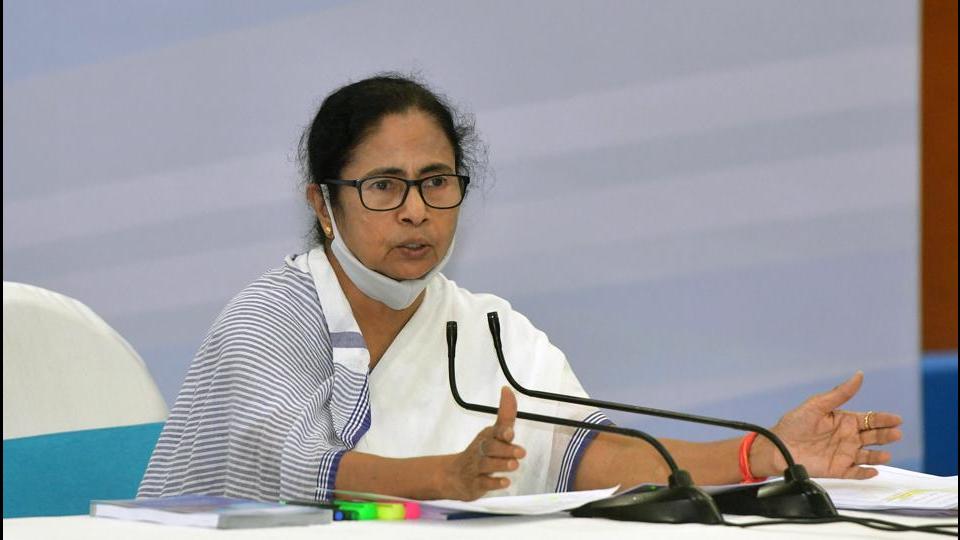
While the battle for the state witnessed a high-pitched election campaign, the first six weeks following the TMC’s victory were as turbulent politically, with allegations of post-poll violence, the arrest of TMC ministers in the Narada scam, the controversy around cyclone Yaas and the sudden retirement of state chief secretary Alapan Bandyopadhyay. West Bengal has witnessed dramatic political developments in this period, and political experts say this is just a trailer of what lies ahead in the run-up to 2024 for the eastern state.
Here’s a look at the tumultuous first 50 days of Mamata Banerjee 3.0:
The arrest of TMC leaders
On May 17, less than a fortnight after Banerjee took oath as chief minister (CM), sleuths from the Central Bureau of Investigation (CBI) arrested two ministers, a legislator and a former mayor in connection with the Narada sting operation case, in which the leaders were allegedly seen accepting bribes.
The incident prompted Banerjee to hold a dharna at the CBI office demanding that the agency also arrest her. This, while state law minister, Moloy Ghatak, led a 3,000-strong crowd of supporters to the lower court.
However, this backfired as the CBI cited these incidents to tell the court how influential the accused are. While they are out on interim bail, a five-judge bench is still hearing the bail plea.
The TMC alleged that this was the work of the Bharatiya Janata Party (BJP), which, after a humiliating defeat in the assembly elections in the state, had grown vindictive. The BJP said that the law was simply taking its course.
Post-poll violence deepens divisions
Incidents of post-poll violence erupted soon after the results. On May 6, one day after taking oath, Banerjee said that at least 16 persons were killed in post-poll violence.
The Union ministry of home affairs was quick to send a four-member team to assess the situation and sought a report from the Governor.
Also Read | Now, SC judge recuses from hearing pleas in Narada case
This left the TMC government seething. “The BJP is not able to digest the defeat in the assembly polls. I would appeal to them to accept the people’s mandate and allow us to work to tackle the Covid situation. We are not interested to quarrel with you now,” Banerjee said at the time.
The BJP, however, continued to sharpen its attack with allegations of political violence, even as Governor Jagdeep Dhankhar took a tour of some of the alleged trouble-torn areas. He even went to Assam where some people were believed to have taken shelter to escape violence.
“With a heavy heart, I am constrained to observe your continued silence and inaction over post-poll retributive bloodshed, violation of human rights, outrageous assault on the dignity of women, wanton destruction of property, perpetuation of untold miseries on political opponents... worst since independence... and it ill augurs for democracy,” Dhankhar wrote in a letter to Banerjee in June.
Meanwhile, the Calcutta high court directed the National Human Rights Commission (NHRC) to examine cases of human rights violations. Families of victims of post-poll violence have also moved the Supreme Court.
“Our workers are being murdered and thousands of them still can’t return home because of the violence. The court can see this, central agencies can see this, people can see this but the TMC government can’t see this,” said Samik Bhattacharya, BJP spokesperson.
The return of the turncoats
Even though more than two dozen legislators abandoned the TMC ahead of the assembly elections to join the BJP, the former got a shot in the arm after Mukul Roy, BJP’s national vice-president, returned to the TMC on June 11. He had earlier left the TMC to join the BJP in 2017.
After Roy’s return, the BJP filed a petition before the assembly Speaker, seeking his disqualification under the anti-defection law.
But Roy — a legislator from Kishnanagar North constituency in Nadia district — is not alone. Senior leaders of the Bengal ruling party have said that several former TMC leaders, who had sided with the BJP, are prepared to return to the TMC.
Also Read | Bengal forms 10-member expert committee to tackle possible third Covid wave
“We are the largest party in the world and there is a democracy in the party. We are not a family-centric party. We have some ideologies which run the party. If someone feels stifled here and feels would be able to serve the people by moving to another party, then BJP respects it,” said Jay Prakash Majumdar, BJP’s vice-president in West Bengal.
TMC chief, Banerjee, however, asserted that the party will not accept all the turncoats who are willing to return.
“Those who had betrayed the party ahead of the elections to strengthen the BJP and had bitterly attacked the TMC party during campaigns will not be taken back. Mukul never attacked the TMC. There are, however, some leaders who may have gone with Mukul and may want to come back. The party will take a decision on this,” said Banerjee.
Other defectors such as Sonali Guha, Dipendu Biswas and Sarala Murmu have openly said that they want to return to the party. They even sent apologies to Banerjee, while others have sent “feelers” by criticising the BJP.
All eyes on 2024
Banerjee is now setting her eyes on the TMC playing a bigger role on the national stage. Poll strategist Prashant Kishor, credited for his earlier role in the BJP’s Lok Sabha win in 2014 as well as the TMC’s 2021 assembly election win, has officially quit the Indian Political Action Committee (I-PAC). Despite this, Banerjee has renewed her contract with the firm.
The CM’s nephew and TMC national general secretary Abhishek Banerjee, seen as the driving force behind the party’s national expansion plan, has announced that the TMC will set up units in other states with the sole purpose of winning elections and putting up a formidable front against the BJP.
Also Read | NIA to probe links between Maoists of Bihar, Bengal, Jharkhand
For the record, the TMC projected Banerjee as the next prime minister before the 2019 Lok Sabha polls, but stitching together an alliance of regional forces to defeat the BJP proved to be unsuccessful.
Meanwhile, Sharad Pawar of the Nationalist Congress Party (NCP) and Kishor met twice in two weeks amid buzz about a national coalition against the BJP. The TMC also went for a major rejig by activating a younger, more versatile leadership and eradicating centralism in the ranks of the 23-year-old party.
Centre-state relations take a hit
Centre-state relations took a nosedive after CM Banerjee and the state’s chief secretary Alapan Banerjee skipped a review meeting held by Prime Minister Narendra Modi to take stock of the damages caused by cyclone Yaas, even though they met Modi for a few minutes to hand over a report of the damage on his arrival in the state.
Alapan Banerjee, who was to retire on May 31, was given an extension of three months and was asked by the Centre to report to Delhi. The state, however, refused to release him calling the Centre’s order “unprecedented” and “unilateral.” The chief secretary retired on May 31 and was appointed as special adviser to the CM.
However, the battle had only just begun. The Centre sent a show-cause notice to Alapan Banerjee on May 31, insisting that his decision to miss the meeting convened by Modi was a violation of the Disaster Management Act 2005. Banerjee responded to it.
Also Read | Centre begins action against ex-chief secy of Bengal
On June 21, following up on its show-cause notice, the Centre warned of major penalty proceedings against him. Banerjee has to respond within 30 days.
CM Mamata Banerjee, soon after coming to power, raised allegations of the Centre depriving West Bengal. She had even sent a barrage of letters to the Centre almost every day.
“No breathing space to the ruling party”
The BJP, which had suffered a blow in the elections, decided to go on the political offensive too. This became clear when the party’s president in the state, Dilip Ghosh, said that they won’t give any breathing space to the ruling party.
Ghosh said, “We have 75 seats in the assembly. We will not allow any breathing space to the ruling party in the assembly even as protests would continue outside. The TMC won so many seats but there was no victory rally. It is because the people don’t want to be a part of their sins.”.
If the first 50 days are any indication, the Bengal election result has only sparked the next round of political confrontation between the national and regional, Centre and the state, and the BJP and TMC.
 ABOUT THE AUTHORJoydeep Thakur
Joydeep Thakur is a Special Correspondent based in Kolkata. He focuses on science, environment, wildlife, agriculture and other related issues.


