
 E-Paper



After 9.5% in 1st week of session, Rajya Sabha productivity up to 82% in 2nd week
The upper house was scheduled to meet for three days in the second week, interrupted by two holidays for Holi. The house outdid itself by sitting for 13 hours and 38 minutes against the scheduled 16 and 30 minutes.


After averaging a mere 9.5% productivity during the first week of the second half of the Budget session of Parliament, the Rajya Sabha has seen a spike to nearly 82% in the second week.
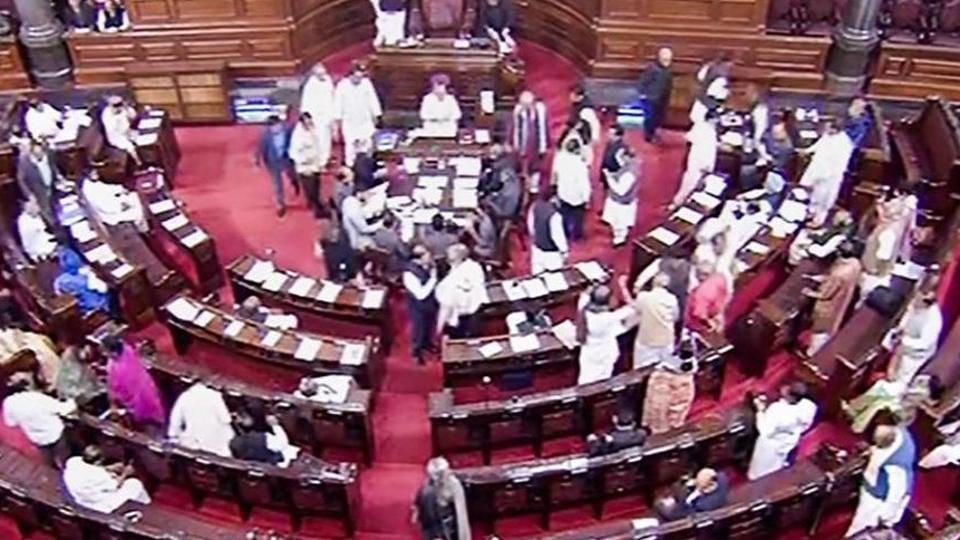
The upper house was scheduled to meet for three days in the second week, interrupted by two holidays for Holi. The house outdid itself by sitting for 13 hours and 38 minutes against the scheduled 16 and 30 minutes. Only a total of 1 hour and 53 minutes was lost, considering the house sat through lunch for 3 hours and 58 minutes. This is a far cry from the first week, where the upper house was scheduled to meet for 28 hours and 30 minutes, but barely managed three hours because of disruptions over the February Delhi riots.
“Out of the 2 hours of Question Hour scheduled, one hour has been successfully completed. On 13 March 2020, 9 Starred Questions were raised during the Question Hour. The Question Hour on 11 March 2020 was lost due to forced adjournment while on 12 March 2020 it was dispensed with to take up Government Legislative Business,” said a statement by the Rajya Sabha.
The first week of proceedings was disrupted because members wanted an explanation from home minister Amit Shah on the Delhi riots last month, said Congress Rajya Sabha MP Rajeev Gowda
“Members were agitated about the failures of the government and Delhi police, and many had called for his resignation. He, however, didn’t show up,” Gowda said.
“After the home minister came and faced the house, we have worked fully. We also worked the previous week when the health minister and foreign minister discussed their efforts related to the Coronavirus outbreak. Last Friday, we worked through lunch and the opposition cooperated with the government to ensure ordinances were turned into law. If the government does its job and takes responsibility then things will work smoothly. The opposition is keen on the House functioning and to do its job of holding the government accountable,” he added.
BJP Rajysa Sabha MP GVL Narasimha Rao, however, blamed the disruptions on the “stubbornness of the opposition”.
“The stubbornness of the opposition and their unreasonable conduct was responsible for the non-functioning of the Rajya Sabha in the first week,” he said. “The government expressed willingness to debate the Delhi violence but felt the time was not suitable for an immediate discussion on the subject. Scheduling debate on Delhi violence after Holi was explained by home minister Amit Shah in Rajya Sabha earlier this week.”
“The opposition derailed debate until discussion on Delhi violence happened. Only after it was taken up did they allow Rajya Sabha to function. This adamant attitude of opposition against spirit of parliamentary democracy,” he added.
It was on March 12, almost two weeks after Parliament convened, that home minister Amit Shah made a statement on the “Law and Order situation in Delhi” at the start of a discussion that lasted 4 hours and 15 minutes,with a total of 21 members participating.
Shah also clarified that the government would not label any citizen “doubtful”, stressing the point that no document will be required during the National Population Register (NPR) exercise.
“The minorities, especially Muslims, were fed with fear that the CAA will revoke their citizenship,” Shah said of the Citizenship (Amendment) Act. “I clearly once again say, under the NPR, no document will be asked for. You don’t have to provide any information you don’t possess. Lastly, nobody will be marked ‘doubtful’. Nobody needs to be scared of the process of the NPR in this country,” he added.
According to a Rajya Sabha functionary who did not wish to be named, productivity of the house can’t always be evaluated in terms of the numbers of hours the members sit for.
“The number of hours put in is a great entry point, but a better understanding of productivity comes after that. One can assess how productive the Rajya Sabha has been in terms of the number of legislations passed or from the prism of disruptions as well,” the functionary said.
“One assumes, when measuring it in hours, that the time put in has been productive. Analysing week by week is also a bit premature, since the analysis should be done at the end of the session,” he added.
Ten private member bills were also introduced in the Rajya Sabha. “Further discussion on two Bills, namely, the Foreign Investment in Financial Services, Critical Infrastructure and Technology Affecting National Security (Regulation) Bill, 2018 (moved by Dr. Narendra Jadhav) and the Representation of the People (Amendment) Bill, 2014 (moved by Prof. M.V. Rajeev Gowda) were discussed. Both the Bills were withdrawn,” said the Rajya Sabha statement.


