
 E-Paper



Pakistan violates ceasefire: Drone attack on Jammu, Srinagar; Barmer on alert
The violation of ceasefire agreement by Pakistan came hours after it agreed to stop all firing and military action against India.

 Prefer HTon Google


Jammu and Kashmir's Udhampur was again attacked by drones, while explosion sounds led to sirens and blackout in Srinagar on Saturday evening, hours after a ceasefire was agreed between India and Pakistan.
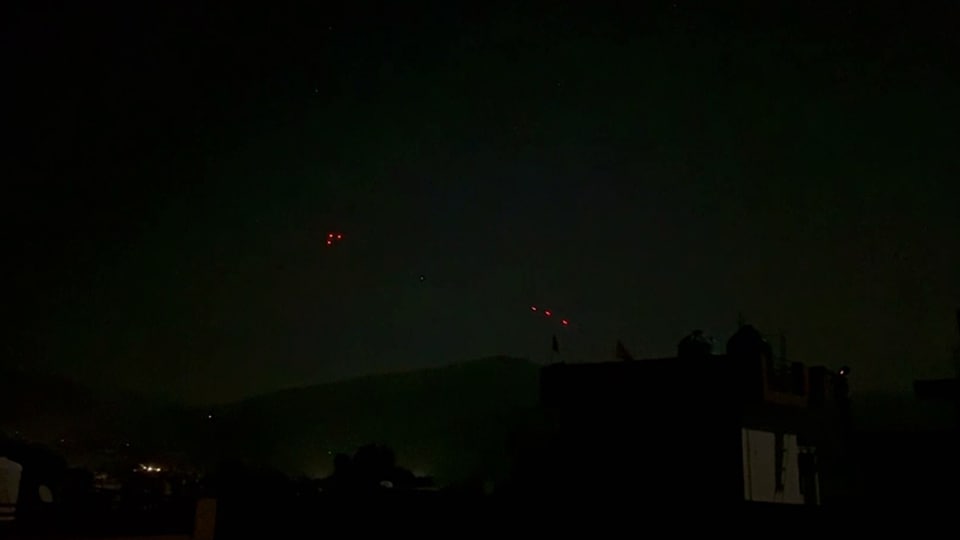
Shortly after reports of ceasefire violation came in, foreign secretary issued a statement and confirmed that Pakistan violated understanding reached on stopping firings, saying that armed forces have been given instructions to deal with violations along the border in a tough manner.
Additionally, an incoming air raid alert was issued in Rajasthan's Barmer along with an urgent blackout enforcement in the district. Gunshots were also heard in Jammu and Kashmir's Baramulla and Budgam side. While a blackout was enforced in several parts of Punjab, drones were spotted in Gurdaspur district. Follow India Pakistan tensions live news coverage here
“Ceasefire violations along the LoC [Line of Control] and drones over Srinagar in Jammu and Kashmir, Punjab and Rajasthan,” a senior government official told Hindustan Times. Border Security Force (BSF) also ceasefire violation in Akhnoor, RS Pura, adding that the force was responding appropriately.
A complete blackout was also enforced in Jammu's Katra and Mata Vaishno Devi Bhawan among other areas.
The violation of ceasefire agreement by Pakistan came as Pakistani Prime Minister Shehbaz Sharif said his country “believes this marks new beginning in resolution of issues that plagued region, prevented journey to peace, prosperity, stability”.
Jammu and Kashmir chief minister also took to X and posted about the explosions. “What the hell just happened to the ceasefire? Explosions heard across Srinagar!!!” Omar Abdullah wrote.
Also Read | ‘What the hell just happened?’: Omar Abdullah after shelling, blasts reported in Srinagar post ceasefire
India-Pakistan ceasefire
Just hours before the fresh wave of attack by Pakistan, New Delhi and Islamabad had agreed to stop military action against each other after over three days of intense exchange of fire, which started after the neighbouring country launched drones towards India post the Indian armed forces' ‘Operation Sindoor’ on May 7, which targeted terrorist infrastructure.
The ‘Operation Sindoor’ military strikes on Pakistan and Pakistan-occupied Kashmir (PoK) had been carried out by Indian armed forces in response to the April 22 terrorist attack in Jammu and Kashmir's Pahalgam, which had killed 26 civilians, and was found to have been carried out by gunmen having links with Pakistan.
The "full and immediate" ceasefire between India and Pakistan was first announced on Saturday by US President Donald Trump, claiming that it was a result of the US-mediated talks.
US Secretary of State Marco Rubio termed it a US-brokered ceasefire while commending Prime Ministers Narendra Modi and Shehbaz Sharif on "their wisdom, prudence, and statesmanship in choosing the path of peace."
The ceasefire came hours after the militaries of India and Pakistan attacked each other's military facilities, dangerously escalating the ongoing conflict.
"After a long night of talks mediated by the United States, I am pleased to announce that India and Pakistan have agreed to a FULL AND IMMEDIATE CEASEFIRE," the US president announced in a post on Truth Social.
"Congratulations to both Countries on using Common Sense and Great Intelligence. Thank you for your attention to this matter!" Trump added.
Later, foreign secretary Vikram Misri announced that the ceasefire had kicked in from 5 pm on Saturday.
Indian military, at a press briefing on the India-Pakistan ceasefire agreement, had said that while forces will be adhering to the understanding that has been reached, they “remain fully prepared and ever vigilant and committed to defending the sovereignty and integrity of the motherland.”


