E-Paper



In Charts: Putting the BJP’s Karnataka loss in perspective
BJP managed to win just 64 seats, down from 104 in 2018, despite a high-voltage campaign that included rallies and roadshows by Prime Minister Narendra Modi.

 Prefer HTon Google


One feature that makes the result of the latest Karnataka election interesting is that it marks only the second time since May 2019 that the Bharatiya Janata Party has lost a significant state where it was in power.
Jharkand was the first. Sure, the BJP also lost Himachal Pradesh where it was in power but the state has only four Lok Sabha constituencies. Karnataka has 28. Maharashtra doesn’t feature in this list because of the circumstances -- the BJP was running a government in alliance with the Shiv Sena in the state; the latter broke the alliance after contesting the polls as part of it and then formed the MVA with the Congress and the NCP; and a split in the Sena helped the BJP come to power in 2022.
Read | Karnataka Assembly election arithmetic: Take a look at how seats flipped for Congress
Between the BJP’s 2014 and 2019 Lok Sabha election wins, the only three states where it had lost power were Rajasthan, Madhya Pradesh and Chhattisgarh in 2018 where the Congress defeated it. While the Congress did win the 2017 Punjab elections as well, the BJP was only a junior partner in the alliance.
Read | Karnataka elections result: 5 crucial factors that hurt the BJP, helped Cong script win
This raises an interesting question. How does BJP’s Karnataka loss compare to the 2018 elections in Rajasthan, Madhya Pradesh and Chhattisgarh, the 2019 loss in Jharkand, and the 2022 loss in Himachal Pradesh?
Here are three charts which try to answer this question.
Karnataka looks like a smaller loss in terms of seat share and vote share…
A simple comparison of Karnataka 2023 with Himachal Pradesh 2022, Jharkhand 2019 and Rajasthan, Madhya Pradesh and Chhattisgarh 2018 shows that this is the smallest loss in terms of change in both seat share and vote share for the BJP, except in Jharkhand. Part of this is also because the BJP did not have a majority after the 2018 Karnataka results and it formed a government after the 2019 Lok Sabha results based on defections.

The BJP’s strength in the assembly at the time of the elections was 117, according to the website of the legislative assembly, which implies a 22.7 percentage point fall in seat share (compared to 17.4 percentage point fall from 2018 election results) and the headline change in vote share number in the Karnataka elections hides an increase in ACs with low vote share in 2018 and fall in ACs with high vote share.
...and except in Chhattisgarh, the ratio of retained ACs is not very different
The BJP has retained 41.3% of the ACs it won in the 2018 elections in Karnataka. In terms of retention ratio, this is largely a similar performance with Rajasthan and Madhya Pradesh in 2018, Jharkand in 2019 and Himachal Pradesh in 2022.
The only exception to this were the 2018 Chhattisgarh elections, where the Congress won an overwhelming 80% of the ACs won by the BJP in 2013. In terms of retaining ACs of different reserved status, the BJP performed somewhat better in General and Scheduled Caste (SC) reserved ACs in Karnataka than in ACs reserved for Scheduled Tribes (STs).
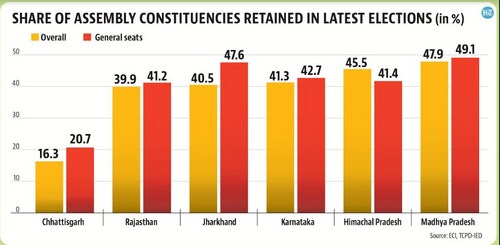
It lost all six ST reserved ACs it won in 2018. This is roughly in line with its performance in the other states. In all states except Himachal Pradesh, its retention ratio was higher in General category seats than overall in the state.
But the Congress’s Karnataka gains are fairly impressive compared to the other elections
If one were to compare Congress’s gains relative to the last election, this would not be true. This is because unlike Rajasthan, Madhya Pradesh, Chhattisgarh, and Himachal Pradesh, the Congress was not as far behind the BJP in Karnataka as it was in the former four.
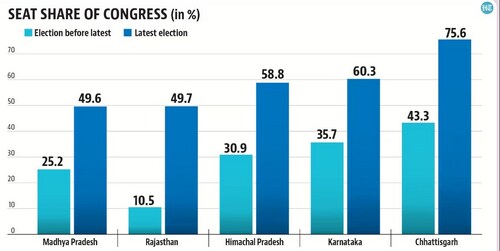
However, the Congress is going to be stronger in the Karnataka assembly than it was in those four states. Not only does this offer parliamentary comfort for the Congress – it has lost governments in Karnataka and Madhya Pradesh due to defections – but also a rare instance when the grand old party has been able to push a regional force, in this case the Janata Dal (Secular), and increased its footprint in a contest against the BJP.
If the Congress wants to capitalise on this fact, it must perform well in the forthcoming Rajasthan, Madhya Pradesh and Chhattisgarh elections towards the end of the year where it will be in a direct fight with the BJP.