
 E-Paper



At 3°C, Delhi colder than hill towns as northern India in cold wave grip
A chilling cold wave blanketed the northern plains on Thursday, with the minimum temperature in Delhi falling steeply to 3 degrees Celsius (°C) — the lowest for the month of January in two years — making the national capital colder than several hill stations.


A chilling cold wave blanketed the northern plains on Thursday, with the minimum temperature in Delhi falling steeply to 3 degrees Celsius (°C) — the lowest for the month of January in two years — making the national capital colder than several hill stations.
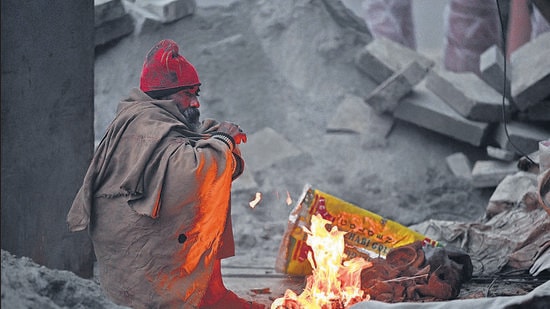
While Ayanagar in southwest Delhi recorded a minimum of 2.2°C, Safdarjung, which is representational of Delhi’s weather, recorded a low of 3°C — four degrees below normal.
A layer of dense fog over Delhi and the rest of north India also impacted several flights and trains, with the visibility level at 50 metres at 5.30am, according to the India Meteorological Department (IMD). At the Safdarjung observatory, the minimum temperature recorded on Wednesday was 4.4°C and on Tuesday, it was 8.5°C.
The large cover of fog stretched from Punjab up to Bangladesh for a third day, leading to extremely low visibility during the morning hours. About 50 flights being delayed between 3.30am and 9am, and at least 12 trains were delayed by two hours or more, railways data showed.
Srinagar recorded the lowest temperature of the season at -6.4°C. Churu and Sikar in Rajasthan were the coldest in the plains at -1.5°C.
The last time the Safdarjung observatory recorded a lower minimum temperature than the one on Thursday was 2.1°C on January 26, 2021. Delhi also recorded a low of 1.1°C in the same year — on January 1, which is Delhi’s lowest minimum in the last decade.
Delhi’s minimum temperature was lower than Dalhousie (4.9°C), Dharamshala (5.2°C), Kangra (3.2°C), Shimla (3.7°C), Dehradun (4.6°C), Mussoorie (4.4°C) and Nainital (6.2°C). The weather stations at Lodhi Road, Ayanagar and Ridge in Delhi recorded minimum temperatures of 2.8°C, 2.2°C and 2.8°C, respectively.
Parts of Delhi also recorded “cold day” conditions on Thursday, with the maximum recorded at 12.1°C in southwest Delhi’s Jafarpur, followed by a high of 12.4°C in Palam, as upper-level fog and cold northwesterly winds were recorded during the day.
The season’s lowest minimum temperature also led to increased power consumption. According to records, the peak demand was clocked at 5,247MW at 10.56am, the highest winter demand for Delhi in three years; it touched a peak of 5,343MW in the winter of 2019-2020.
IMD has issued a “yellow alert” for the national capital for Friday, predicting cold wave conditions to continue. Dense fog is also expected on Saturday and Sunday. A cold wave is declared in a region when the minimum temperature is 4.5°C or more below the normal mark, or when the mercury drops to 4°C or lower.
“Cold northwesterly winds are beginning to impact the region and as forecast, the minimum has dipped sharply by 1-3°C in most parts. Delhi is likely to see a similar minimum on Friday, too, before it gradually begins to rise again, touching 5°C on Saturday and 6°C by Sunday,” said RK Jenamani, scientist at IMD.
He said a western disturbance will influence the northern plains on January 7 and 8, leading to the minimum temperature hovering around 8°C; the maximum temperature, too, is likely to rise gradually over the coming days. “The maximum will be 18°C by Saturday and 20°C by Monday,” he added.
Mahesh Palawat, vice president, climate and meteorology, Skymet Weather, said: “Perforations or areas with less fog and better visibility were being seen over major urban centres mainly due to heating from concrete surfaces and other activities such as vehicular traffic and industries but a dense layer has been persisting for three days over entire Indo-Gangetic Plains stretching from Punjab to northeast India and, even covering parts of central India.”
“Cold day” to “severe cold day” conditions are likely in pockets over Delhi, Punjab, Haryana and Uttar Pradesh over the next 2-3 days.
“The weather is stable and there is ample low-level moisture available, creating favourable conditions for persistence of a layer of dense fog. This will continue for another 1-2 days before winds pick up and disrupt the stable atmosphere. We are expecting winds to pick up gradually from January 6, which will lead to a reduction in intensity and extent of fog and also cold day conditions over northwest India,” said M Mohapatra, director general, IMD.


