
 E-Paper



Biren Singh chosen as legislative party leader, to stay Manipur CM
The announcement, made by Union finance minister Nirmala Sitharaman, the party’s central observer to the northeastern state, ended 10 days of uncertainty and political activities since the assembly election results were announced

 Prefer HTon Google


Nongthombam Biren Singh will remain the chief minister of Manipur for a second straight term after he was unanimously elected as the Bharatiya Janata Party (BJP) state legislature party leader on Sunday.
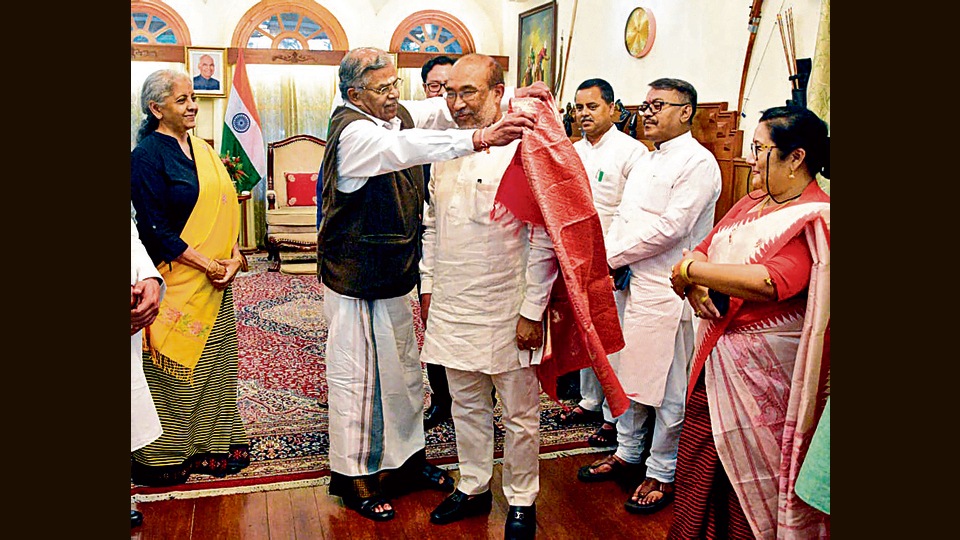
The announcement, made by Union finance minister Nirmala Sitharaman, the party’s central observer to the northeastern state, ended 10 days of uncertainty and political activities since the assembly election results were announced.
“It is a good decision taken unanimously, which will ensure that Manipur has a stable and responsible government,” Sitharaman said after a two-hour long closed-door meeting at Thambal Sanglen, BJP state head office here. “The Centre, under the leadership of Prime Minister Narendra Modi, gives special attention to the northeastern states.”
Later in the day, Sitharaman, Union law minister Kiren Rijiju, who is the co-observer, and caretaker chief minister N Biren Singh called on Manipur governor La Ganesan at Raj Bhavan in Imphal and staked claim to form the government. Senior BJP legislator Th Biswajit Singh and former assembly speaker Yumnam Khemchand also accompanied the party leaders to Raj Bhavan.
On March 15, Biren Singh and senior MLA Th Biswajit along with BJP Manipur chief A Sharda Devi had rushed to New Delhi to meet party’s central leadership. They told the reporters that the parliamentary board of the party would decide on the appointment of chief minister.
“Whatever decision the party takes, we should welcome it,” Singh had recently said. Biswajit Singh had shared a similar sentiment.
Biren Singh (61), a former footballer and journalist, has been credited for the BJP’s return to power for a second consecutive term.
The BJP won 32 seats in the 60-member House in the recent assembly elections, results of which were announced on March 10. The National People’s Party (NPP), a coalition partner of the BJP in the previous government, came second with seven seats. The opposition Congress and the Naga People’s Front secured five seats each. The Janata Dal (United) secured six, newly floated Kuki People’s Alliance won two seats, while the remaining three seats went to independent candidates.
In the 2017 polls, though the BJP had won only 21 seats, it managed to lure MLAs from the Congress, which clinched 28 seats, and Biren Singh was sworn in as the first-ever BJP chief minister in Manipur.
The five-time MLA from his native Heingang constituency, Biren Singh has been widely credited for bringing peace and bridging the divide between the people of the valley and the hills, in multi-ethnic state during his previous tenure as the chief minister.
Former editor of a vernacular daily ‘Naharolgi Thoudang’, Biren Singh was elected to the assembly for the first time in 2002 on a Democratic Revolutionary People’s Party ticket. Later, he joined the Congress before heading to the BJP in 2016. In the recently concluded assembly polls, Biren Singh retained his native Heingang seat by defeating his rival and Congress candidate P Sharatchandra by over 17,000 votes.
Biren Singh had been endorsed by the central leadership as the CM face ahead of the elections. Despite the opposition to his chief ministership during the first term, with a clutch of legislators seeking his removal, the central leadership chose to back him.
A senior leader in Delhi said Biren Singh was picked for a second term because of his “performance”. “There has been effective delivery of all social schemes and more than that there has been an end to an atmosphere of conflict, road blockages etc that had thrown life out of gear,” the leader said.
In June last year, the BJP-led coalition government in Manipur suffered a jolt when Biren Singh withdrew 11 major portfolios from his deputy Joy Kumar Singh for criticising him publicly. This was followed by resignation of nine members of the coalition, which included four ministers. Of the nine legislators, three were fro m the BJP, four from the NPP, one independent and one from the Trinamool Congress.
Peace was brokered when Union home minister Amit Shah and then Assam finance minister Himanta Biswa Sarma held a meeting with the NPP legislators and party chief Conrad Sangma in Delhi. Biren Singh also faced criticism for clamping down of freedom of expression after a bunch of people were arrested and some charged with sedition after they criticised the chief minister on social media platforms.


