
 E-Paper



BJP hails ‘fulfilled’ UCC promise; Muslim bodies plan legal action
The head of the Dehradun-based minority group said they will deliberate with senior lawyers on Thursday and file a petition in the high court after it reopens post winter vacation.


As Uttarakhand became the first state in the country to implement the Uniform Civil Code (UCC) on Monday, a Muslim organisation threatened to move the state’s high court against the move, which triggered mixed political reactions, with the Opposition Congress calling it a “a political manoeuvre” rather than “a social necessity” and the ruling Bharatiya Janata Party (BJP) hailing it as yet another promise fulfilled by its government.
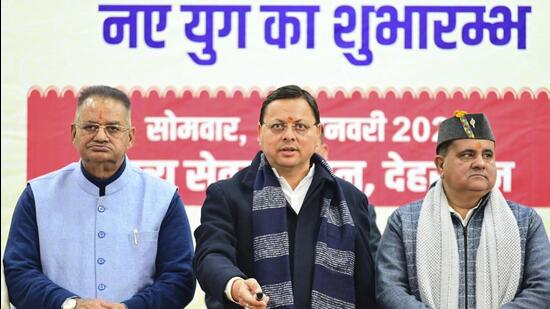
On Monday, Uttarakhand chief minister Pushkar Singh Dhami launched the UCC portal and rules, implementing the contentious law, which aims to simplify and standardise personal laws related to marriage, divorce, succession, and inheritance.
“The law has been brought to divide Hindus and Muslims and to target the minorities, as they (BJP) have been doing so since 2014. As far as the general public is concerned, it (the UCC) will neither improve their daily life, which should be the agenda of the government, nor the overall development of the state,” Naeem Qureshi, president of the Muslim Sewa Sangathan, alleged.
The head of the Dehradun-based minority group said they will deliberate with senior lawyers on Thursday and file a petition in the high court after it reopens post winter vacation.
Besides Muslim organisations, Qureshi said, Azad Samaj Party (Kanshi Ram) chief and Lok Sabha MP Chandrashekhar Azad will also be among the litigants.
Qureshi alleged that UCC “violates” Article 246 of the Constitution, which provides for the seventh schedule to categorise subjects into Union, state and concurrent lists, and questioned how it could be called “uniform” if it exempts tribals from the ambit of the law.
The Sangathan also submitted a memorandum to Uttarakhand governor Lt General (retd) Gurmit Singh, urging him to repeal the contentious law brought in by the BJP government, claiming it violates religious freedom enshrined in the Constitution under Articles 25, 26 and 27.
Prominent Muslim organisation Jamiat Ulema-e-Hind also said that it will challenge the legislation in both the high court and the Supreme Court. “The organisation believes that since this law is based on discrimination and bias, it cannot be called a uniform civil code. Another important question that arises is whether a state government has the authority to enact such a legislation,” a statement by the organisation said.
Razia Baig, former chairperson of the Uttarakhand bar council, said he along with few others will soon move the high court against the UCC law.
“They (government) have untouched the Hindu personal laws and also exempted the tribals from the UCC. It is not a uniform law. They just see the flaws in one community...and by legitimising the live-in relationships, what message do they want to send in the society?” he said.
The implementation of UCC was one of the promises made by the BJP to the residents of the Himalayan state ahead of the 2022 assembly polls, which saw the party returning to power for a second consecutive term.
The Congress alleged that UCC has never been part of public demand in Uttarakhand.
“UCC is neither practical nor constitutional because it is quite different from the civil code mentioned in Article 44 of the Constitution which envisages a UCC applicable in the whole country and not limited to any particular state. UCC has never been a part of public demand in Uttarakhand. It seems to have been brought more as a political manoeuvre than a social necessity,” party’s state chief Karan Mahara alleged.
Hitting back his Congress counterpart, BJP state chief Mahendra Bhatt said the Constitution provides for the UCC and attacked the Opposition for its “appeasement politics”.
“Our government has fulfilled another promise made to the people of the state. The UCC will completely end legal discrimination in the state on the basis of caste, religion, region, gender etc,” Bhatt said.
Even as the BJP hailed the implementation of the UCC in the Himalayan state, its National Democratic Alliance (NDA) partners remained guarded in their response, but said any such move at the national level will require “consensus building exercise” from all sections of society, including religious minorities.
“This is just one state’s UCC and even if other states bring it, there will be no uniformity. UCC is an important and sensitive issue nationally and it needs to be brought out by involving different sections of society. Unity in diversity is the core of the issue and the law needs to be made with an intent to integrate the society,” Neeraj Kumar, spokesperson of the Janata Dal (United), told HT.
The JD(U), which has 12 lawmakers in the Lok Sabha and four in the Rajya Sabha, is a key ally of the ruling NDA at the Centre and in Bihar, where assembly elections are due later this year. The Nitish Kumar-led party has said that Bihar has no plans to bring in the UCC.
Another key ally, the Telugu Desam Party (TDP), which has 16 MPs in the Lok Sabha and two in the Rajya Sabha, maintained the party has no plans to bring in such a law in Andhra Pradesh until “the UCC is passed in Parliament”. “For us, what other states are doing are not important. We will be taking it forward based on the guiding principles of the Constitution,” TDP national spokesperson Deepak Reddy Gunapati said, when asked whether intervention on live-in relationships–like in Uttarakhand–was an issue for the ruling party in the Telugu state.
According to legal experts, a state is constitutionally competent to implement the UCC.
“Article 36 of the Constitution defines ‘State’ and it correlates to the meaning given in Part III (fundamental rights) of the Constitution. Hence, a state government has the power to make and implement the UCC for its residents. In January 2023, the Supreme Court also ruled that state governments have the power to examine the feasibility of implementing a UCC,” senior advocate of Uttarakhand high court Kartikeya Hari Gupta explained.
(With inputs from Abhishek Angad in Delhi)


