E-Paper



BJP names 8 Rajya Sabha candidates in UP, drops union ministers Hardeep Singh Puri, BL Verma and sitting members
The list includes Union ministers Hardeep Singh Puri and BL Verma among those denied renomination, while two women are also among the new candidates.

 Prefer HTon Google


The Bharatiya Janata Party (BJP) on Monday announced eight candidates for the upcoming Rajya Sabha elections from Uttar Pradesh, dropping all sitting members, denying tickets to two Union ministers, and inducting fresh faces that carefully balanced caste dynamics.

The announcement of the names –– many of them organisational and state-level leaders, including three other backward classes (OBC) leaders, two Dalits, two Brahmins, and one Thakur –– came a day before the last date for filing nominations. The election is scheduled for October 16. Two of the eight nominees are women.
The National Democratic Alliance (NDA) has the numbers to comfortably win seven seats and is only a couple of votes short for the eighth. There will be an election for this seat if the Samajwadi Party –– which has numbers enough for two seats – fields a third candidate.
Deep Dive

Also read: UP’s four-way division debate takes centre stage again before 2027 polls
NDA holds advantage in seven seats
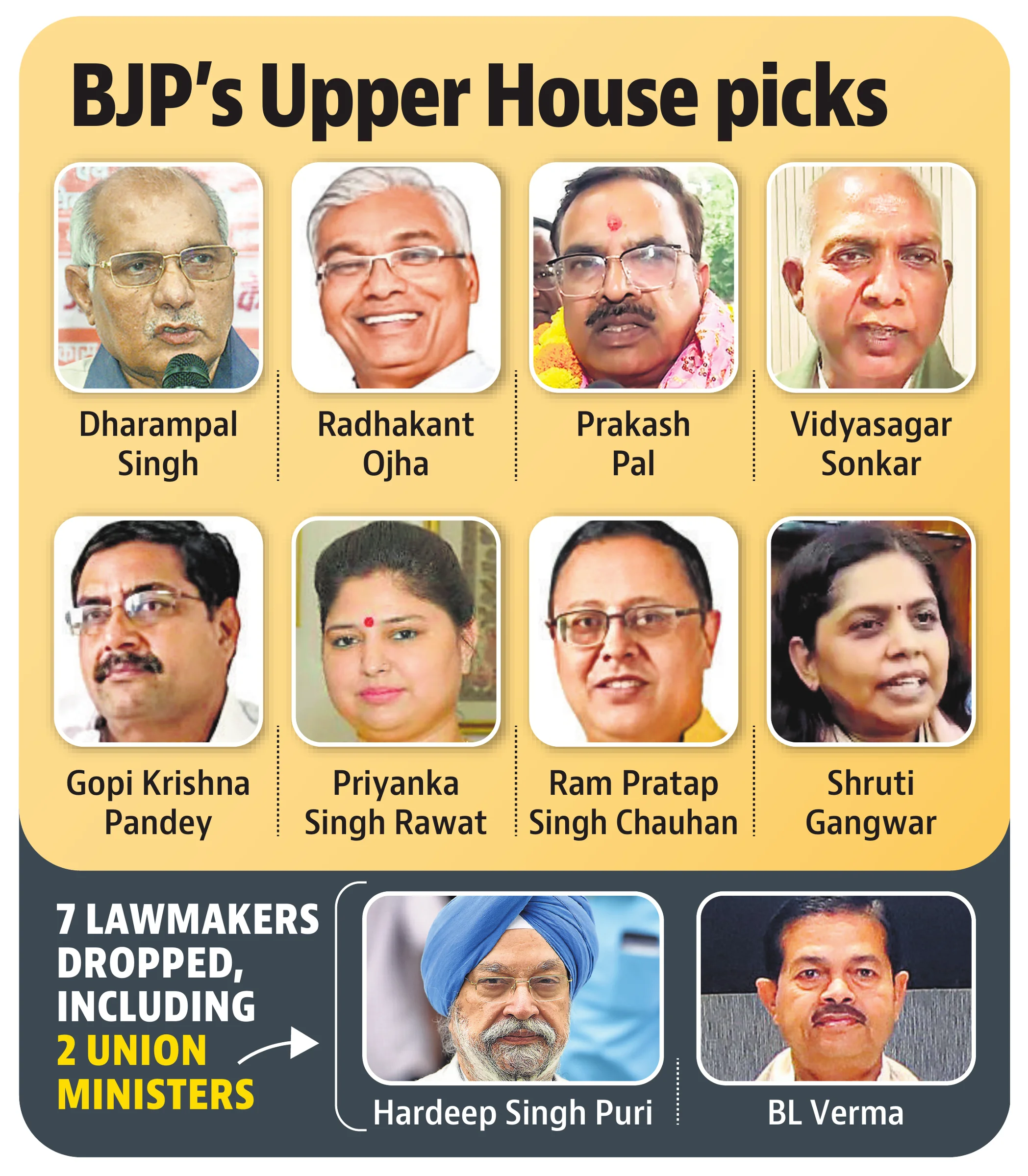
The party did not renominate any of the seven retiring lawmakers, including Union ministers Hardeep Singh Puri and BL Verma, whose terms in the Upper House are ending in November. Earlier, Ravneet Singh Bittu and George Kurien resigned from the Upper House. With four ministers out of the Rajya Sabha, the speculation of a rejig in the Union council of ministers has again gained currency.
The candidates are Uttar Pradesh cabinet minister Dharampal Singh, Radhakant Ojha, Prakash Pal, Vidyasagar Sonkar, Gopi Krishna Pandey, Priyanka Singh Rawat, Ram Pratap Singh Chauhan and Shruti Gangwar.
Seven BJP members — Arun Singh, BL Verma, Brijlal, Hardeep Singh Puri, Geeta Shakya, Seema Dwivedi and Neeraj Shekhar — were among those whose terms are ending in November. One seat fell vacant following former deputy chief minister Dinesh Sharma’s resignation from the Rajya Sabha and his appointment as the lieutenant governor of the Andaman and Nicobar Islands.
Also read: Election Commission likely to hold special revision of voter rolls ahead of UP assembly elections
Dharampal Singh brings Lodh representation
Dharampal Singh, a Lodh leader, is a legislator from Aonla and animal husbandry and dairy minister in Uttar Pradesh. He served as a minister in the previous government also in 2017 but was dropped midway. Singh replaces BL Verma who is also a Lodh.
Voters in the community have largely backed the BJP since the emergence of Lodh leader Kalyan Singh, who later become the state’s chief minister twice. The community is spread across western and central Uttar Pradesh, and has significant political weight, with the capacity to influence the outcome in around 70 of the state’s 403 assembly constituencies.
Also read: Rajya Sabha election: BJP expected to announce Uttar Pradesh nominees today
BJP seeks to strengthen non-Yadav OBC outreach
Prakash Pal is an OBC leader and currently heads the BJP’s OBC Morcha in UP. He represents the Pal community and comes from the Kanpur-Bundelkhand region. The Pal community is one of the widely distributed non-Yadav OBC groups in Uttar Pradesh. The community has a significant presence across western and central Uttar Pradesh, including the Agra-Aligarh-Hathras-Mathura belt and parts of the Kanpur, Etawah, Mirzapur and Varanasi regions. It has political influence over around 30 assembly constituencies in the state.
Shruti Gangwar, an OBC leader from the Gangwar community in Bareilly, is the daughter of Santosh Gangwar, the Jharkhand governor, former Union minister and eight-time former MP. She currently serves as chairperson of the Bareilly Urban Cooperative Bank.
Vidyasagar Sonkar is a veteran Dalit leader who has served as Lok Sabha member from Saidpur in Purvanchal in 1996 and later as a member of the UP Vidhan Parishad. He has also held organisational responsibilities in the state BJP. He comes from the Khatik caste. The Khatik community is primarily concentrated in Varanasi, Kanpur, Prayagraj, Lucknow, Bulandshahr, Agra and Mainpuri districts.
Also read: Amid battle for Brahmin vote, BJP to sharpen outreach ahead in UP
Priyanka Singh Rawat brings Pasi and women representation
Priyanka Singh Rawat, a Pasi leader, is former Lok Sabha member from Barabanki. She was denied a ticket in 2024. She is also the BJP’s national vice-president. Her nomination will bring both Dalit and women’s representation to the new Rajya Sabha team. The Pasis are second-largest Dalit community after Jatavs in Uttar Pradesh. They are mostly located in districts like Barabanki, Lucknow, Sitapur, Hardoi, Unnao, Rae Barelli and Amethi.
Radhakant Ojha, a senior advocate with the Allahabad high court, served as president of the Allahabad High Court Bar Association from 2015-16 and 2022-23. This is his political debut.
Gopi Krishna Pandey is a Brahmin leader associated with the BJP organisation. Seen as a low-profile leader, he began his public life as a child volunteer and later became active in the Akhil Bharatiya Vidyarthi Parshad. Coming from Balia in eastern UP, Pandey has served as state secretary of the BJP.
Ram Pratap Singh Chauhan gets Thakur representation
Ram Pratap Singh Chauhan, a Thakur leader from Agra, is a former BJP lawmaker from Etmadpur and has held organisational responsibilities in the party. Currently, he serves as state general secretary of the UP BJP.
The nominations come months ahead of scheduled assembly elections in UP. The BJP’s choice of largely organisational and state-level faces, instead of prominent or national-level names, appeared to signal the party’s poll focus, including the distribution of tickets to key demographics such as upper-caste, non-dominant OBCs and non-Jatav Dalits.
The much-awaited announcement came hours after BJP national general secretary (organisation) BL Santhosh met chief minister Yogi Adityanath at his official residence here. The meeting, which lasted one-and-a-half hours, came a day before the last date for filing nominations.
Also read: Keeping up with UP: Bureaucrats entering politics – the hits and many misses
All eight nominees come from party organisation
A senior BJP leader described it as probably the first time in recent history that all eight Rajya Sabha nominees from the state were from the party’s organisational fold.
“In the past, the party has accommodated one or two prominent outsiders or leaders with a different profile—a civil servant, industrialist, public figure or a turncoat in its Rajya Sabha nominations. This time, however, the list is dominated by leaders and functionaries who have long been associated with the Sangh Parivar,” the party leader said.