
 E-Paper



Caste politics is back in focus as JD(U) and RJD reunite in Bihar
There are indications that the Grand Alliance will speed up the process of the socioeconomic and caste survey.


The renewed alliance in Bihar between the Janata Dal (United) with the Rashtriya Janata Dal, which are the main constituents of the erstwhile Janata Dal, is likely to boost mobilisation of backward classes based on data of the soon to be conducted socioeconomic and caste survey, political leaders and experts said.
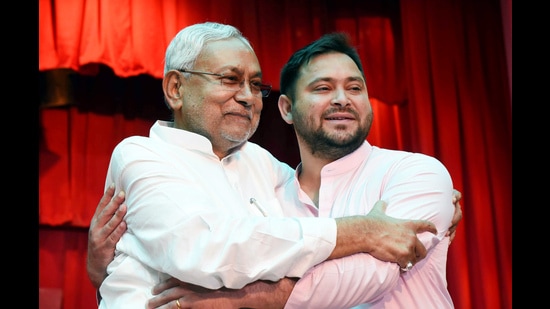
There are indications that the Grand Alliance, which formed the government in Bihar for the second time on August 10, a day after the JD(U) severed ties with the Bharatiya Janata Party (BJP)-led National Democratic Alliance (NDA), will speed up the process of the socioeconomic and caste survey.
The exercise to collect and collate data of different caste groups, including other backward classes and extremely backward classes, is likely to be completed by the end of next year, months ahead of the 2024 parliamentary polls.
“The survey work will be over in 45 days once it starts,” said a Bihar government official familiar with the ongoing preparatory work for the survey. “The format of the survey sheet will have a large number of columns pertaining to caste, educational qualification, income, assets and source of income of households. The sheet is being finalised.”
“The format will then be sent to the district magistrates and, subsequently, training of officials will be done as enumerators,” he said, requesting anonymity. The process is likely to gain momentum from next week, the official said, indicating a push from the new government to quickly complete the preparatory work for survey.
The door-to-door survey is likely to begin in November and the exercise will be completed by February, another government official said. “District magistrates have already been asked to mobilise officials and staff for the survey work by roping in teachers and contractual workers, as well as those working with self-help groups,” he said, declining to be named.
Every household in the state will be covered in the survey, a third official said. “We are also in the process of creating a digital platform where data of the caste survey will be collected and stored,” he said, wishing to remain unnamed. “Right now, we do not have the exact number of officials to be engaged in the exercise, but it will be in big volume.”
Bihar’s politics has revolved around caste identities since Independence. In 1978, former chief minister Karpoori Thakur’s Janata Party government implemented reservation in government jobs for other backward classes and extremely backward classes, as well as for women and economically backward among upper castes.
In the 1990s, after the implementation of the Mandal Commission’s report on job reservation, the RJD played the social justice card aggressively to mobilise backward classes, especially Yadavs and EBCs, to weaken the grip of upper castes in state polity.
In 2006, chief minister Nitish Kumar announced 20% reservation for EBCs in rural local bodies, paving the way for higher representation of the communities in the category in panchayats, a move that political observers say has yielded rich dividends for the JD(U) in consolidating its grip over the EBCs, which comprise nearly 26% state’s electorate.
After the survey data are published, it could lead to a fresh churning in state politics, with both the RJD and JD(U) making an evaluation of their caste equations to select candidates from various caste groups, political observers said.
“The RJD-JD(U) coming together already has posed a threat to the BJP. The caste survey will bring back Mandal politics of backward mobilisation. Even the NDA will be forced to follow the caste theory,” said Nawal Kishore Choudhary, former principal of Patna College.
“The caste survey in Bihar could be used for development and upliftment of the poor, if there is a political will,” said D M Diwakar, former director of AN Sinha Institute of Social Studies. “Otherwise, it will just remain another survey like the socioeconomic survey conducted in 2011 without much use.”
The regrouping of the two parties when the caste survey is underway will help the Grand Alliance government use the data to uplift the poor and downtrodden, leaders of the political parties said.
The caste survey data will not only facilitate representation of people in government jobs and educational institutes as per their numerical strength, but will also become a guiding force in allotting tickets to candidates from various castes as per party vote base, RJD leader and former minister Abdul Bari Siddiqui said.
“At least, the caste survey will give fair idea of which community has how much population and how they are placed in various indices,” Siddiqui said. “We will have to re-evaluate our strategy based on the caste data in ticket allotment. It will strengthen our fight for social justice.”
The caste survey data will help the party consolidate its vote base among Yadavs, OBCs and weaker sections, RJD insiders said on condition of anonymity.
On Thursday, RJD leader Tejashwi Yadav accused the BJP of “creating hurdles” in the caste survey. He had earlier claimed that the caste census is necessary to implement welfare schemes for the poor.
The caste survey will help in identifying the actual number of various communities in Bihar, said Chandeshwar Prasad, JD(U) Lok Sabha MP from Jahanabad.
“Jiski jitni aabadi, uski utni bhageydaari (community representation on share in population),” said Prasad. “We have long being propounding this theory, and it will fructify with the caste survey data. Now, when we have a government which is fully aligned to caste survey, the work will be completed soon.”
The survey data will influence politics in Bihar as there will be higher representation of backward classes in ticket distribution and voting pattern would also change, he said. “Once the data is published, there will be demand for increasing the quota for backward classes in educational and government jobs,” Prasad said, adding that the present politics of Hindutva being pursued by the BJP would take a beating in Bihar.
The BJP, meanwhile, is treading a cautious path, aware of the wider ramifications of the caste survey data. The party’s biggest challenge lies in keeping its backward classes vote base intact by not allowing the Grand Alliance poach its core voters after the survey.
“We are not concerned much about the caste survey as our party has a considerable base among all sections in Bihar, including backward classes,” said BJP MLC Devesh Kumar. “There have been number of MLCs from EBCs in recent years. Besides, we have doubts whether the caste survey report would ever be published because in the past many such surveys have never seen the light of the day.”
BJP’s state spokesperson Nikhil Anand said the party is not seriously against caste census. “But we are concerned about the technicalities and procedure of the whole issue,” he said, adding that the party has supported the state government’s decision for the survey. “The caste should not open a Pandora’s box for petty politics.”
As things stand, the impending caste survey in Bihar is expected to stir the political pot in the run-up to the 2024 general elections.


