E-Paper



Cold day, dense fog to remain over northern India for 4-5 days: IMD
The IMD has issued a red category warning for the entire Indo-Gangetic Plain states, including Uttar Pradesh, Haryana and Punjab. It has issued an orange category warning over Rajasthan, parts of Madhya Pradesh and Chhattisgarh for fog and cold

 Prefer HTon Google


New Delhi: Dense to very dense fog and cold to severe cold day conditions are likely to continue to prevail over north India for the next four to five days, the India Meteorological Department (IMD) said on Sunday.
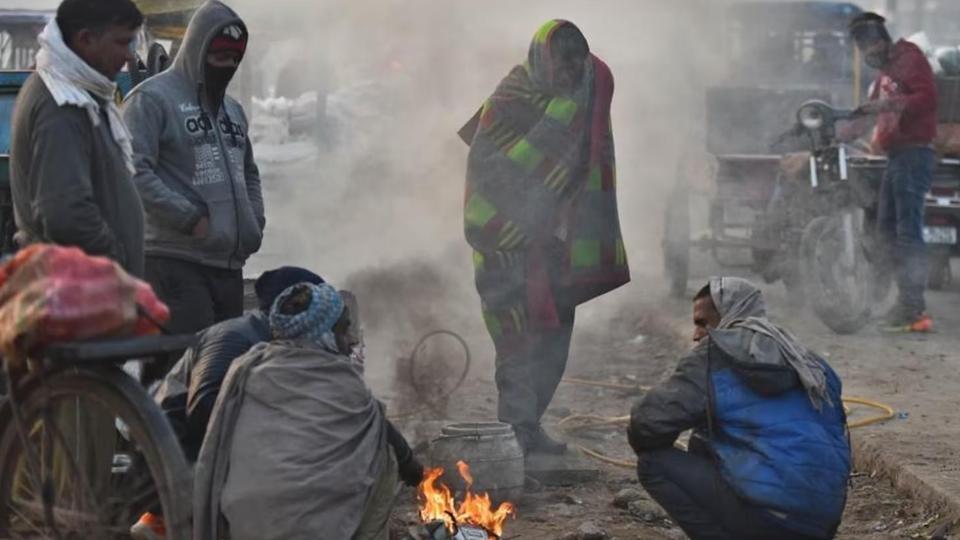
Cold wave conditions are likely to prevail over Punjab, Haryana, Chandigarh and north Rajasthan for the next three to four days, it warned.
On Sunday, the Delhi-NCR region experienced a slight improvement in weather conditions as dense fog dissipated. There was marginal relief with longer hours of sunshine. But strong jet stream winds at the upper levels are continuing to cause subsidence of cold air over the region, IMD said on Sunday.
Jet stream winds of the order of 250 to 300 kmph at 12.6 km above mean sea level are prevailing over the plains of North India, it said.
Officials at IMD said that a strong western disturbance (WD) is expected to impact the Western Himalayan region on January 26 but it is too early to say whether it will be intense enough to disrupt the fog and severe cold spell over the northern plains.
“For the past few days, there is some sunshine but that is for a very limited period. Dense fog is continuing to impact northwest India during the morning hours at least till 9.30-10am. These conditions will continue for a few days. Only a marginal relief is expected,” said M Mohapatra, director general, IMD.
Also Read: Cold spell lifts slightly, 11 trains delayed by fog
“A western disturbance is approaching and is likely to impact the Western Himalayan region from January 26. But the impact may be limited to higher elevations and may not penetrate the plains,” added Mohapatra.
Minimum temperatures are in the range of 3-7 degrees Celsius over most parts of Punjab, Haryana-Chandigarh-Delhi, West Uttar Pradesh and some parts of Rajasthan and Madhya Pradesh. These are below normal by 2-4 degrees Celsius, IMD informed. The minimum temperature in many parts of East Uttar Pradesh and Bihar was 8-10 degrees Celsius.
On Sunday, the lowest minimum temperature of 2.8 degrees Celsius was reported at Hissar (Haryana). Cold wave to severe cold wave conditions prevailed in isolated pockets of Rajasthan. Cold wave conditions prevailed in isolated pockets of Himachal Pradesh, Uttarakhand, Punjab, and Haryana.
Moreover, parts of Punjab, Haryana-Chandigarh-Delhi, including isolated pockets of Uttar Pradesh, Rajasthan & Madhya Pradesh, parts of Uttarakhand, a few pockets of Jammu division, Sub-Himalayan West Bengal, Odisha, Assam and Tripura observed dense to very dense fog.
On Saturday, cold to severe cold day conditions prevailed in many parts of East Uttar Pradesh, in some parts of Punjab, West Uttar Pradesh & East Madhya Pradesh, in isolated pockets of Uttarakhand and Haryana, in isolated pockets of Rajasthan, West Madhya Pradesh and Bihar.
The IMD has issued a red category warning for the entire Indo-Gangetic Plain states, including Uttar Pradesh, Haryana and Punjab. It has issued an orange category warning over Rajasthan, parts of Madhya Pradesh and Chhattisgarh for fog and cold.
Red category warning implies that agencies need to act to prevent “extreme weather-related disasters” while orange category warning implies agencies need to be prepared for “extreme weather”.
Cold wave conditions are very likely in isolated pockets of Punjab, Haryana and Chandigarh from January 21 to 25, and over north Rajasthan from January 21 to 23, the IMD said. Ground frost conditions are very likely at isolated places over Uttarakhand on January 21 and 22.
Also Read: Experts blame lack of strong western disturbances for fog
“This severe weather over north India primarily owes to the lack of any western disturbances over northwest India during December and January. Generally, 5-7 WDs impact northwest India from December to January. But this winter, no such WD has been impacted,” IMD officials said, adding that there was about 80% rainfall deficiency in December and no rain or snow was recorded in January.
The lack of active WDs can also be attributed to El Nino conditions over the equatorial Pacific, the IMD said, Strong jet stream winds with speed of about 250 to 320 kmph at about 12 km above sea level have been causing subsidence of cold air and enhancing both the chill both at night and during the day.
Such cold conditions are likely to continue for five more days due to strong jet stream winds, the IMD added.
HT had reported on January 17 that dense fog and low clouds over the Himalayan foothills and the entire Gangetic plains till the Bay of Bengal have persisted because of high moisture content in the upper atmosphere and lack of strong western disturbances, compounded by heavy particulate pollution and cold day temperatures.
A cold wave is declared when the minimum temperature is less than 10 degrees Celcius over plains and 4.5-6.4 degrees Celcius below normal. A severe cold wave is declared when the minimum temperature is over 6.5 degrees Celcius below normal or the actual minimum temperature is less than two degrees Celcius. A cold day is declared when the maximum temperature is less than 10 degrees Celcius over plains and is 4.5-6.4 degrees Celcius below normal and a severe cold day is declared when the maximum temperature is 6.5 degrees Celcius below normal.