E-Paper



‘Real-time updates’: Delhi’s new traffic system to track stolen vehicles, detect traffic jams and road accidents
The system will link with CCTNS, e-Sarathi and VAHAN to alert traffic officers when stolen vehicles are likely to enter their zones.

 Prefer HTon Google


Delhi’s proposed Intelligent Traffic Management System (ITMS) is set to give traffic police a real-time view of the city’s roads, from tracking stolen vehicles after an FIR to flagging accidents, traffic snarls, slow-moving stretches and sudden drops in vehicle speeds, senior officers said.
The system, officers said, is also expected to generate real-time alerts about road accidents, traffic disruptions and stretches where vehicle speeds drop significantly.
The Delhi Traffic Police currently has a functional strength of about 5,000 traffic police officers, while 6,500 are sanctioned. The HT had reported earlier that traffic police officials are often absent at critical junctions even during peak hours.
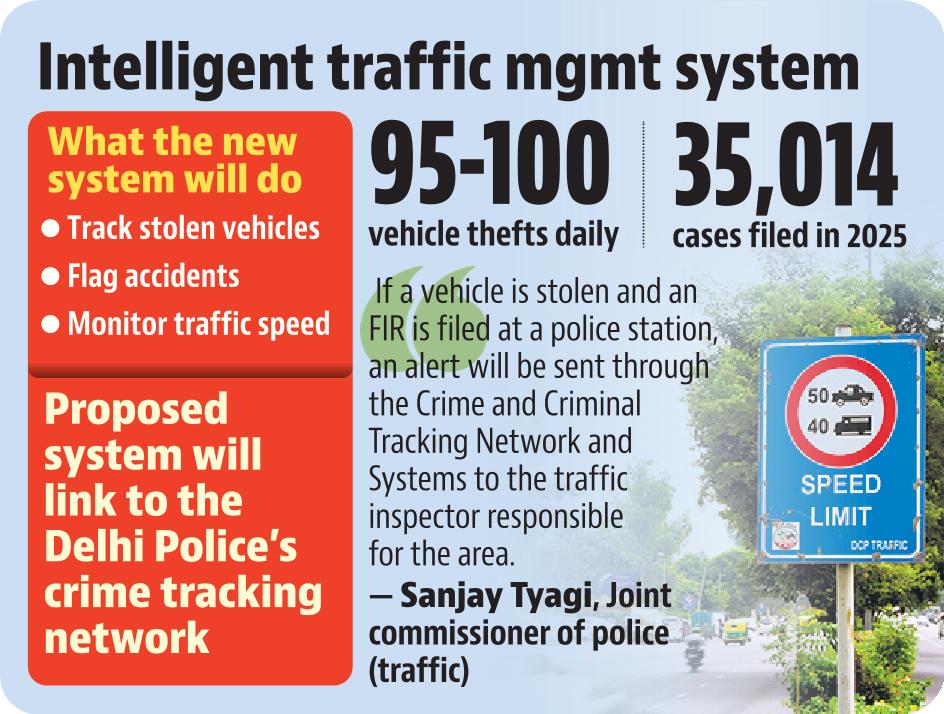
According to police, Delhi records around 95-100 vehicle thefts every day, or roughly one theft every 14-15 minutes. About 35,000-40,000 motor vehicle theft cases are registered in the city annually. In 2025, Delhi Police registered around 35,014 such cases, according to the data provided by police.
Also read: How Delhi’s AI-enabled traffic management system will create green corridors for ambulances?
Stolen vehicle to trigger alerts across traffic zones
Joint commissioner of police (traffic) Sanjay Tyagi said one of the key benefits of the ITMS would be its ability to track stolen vehicles and alert traffic police about their movement.
“If a vehicle is stolen and an FIR is registered at the concerned police station, an alert will be sent through the Crime and Criminal Tracking Network and Systems (CCTNS) to the traffic inspector (TI) responsible for the area,” Tyagi said.
The ITMS will be integrated with Delhi Police’s CCTNS as well as the Centre’s e-Sarathi and VAHAN platforms, officials said.
Tyagi said the system would also enable police to anticipate the movement of a stolen vehicle. If the vehicle continues to move within Delhi, the traffic zonal officer (ZO) concerned would receive an alert indicating that the vehicle is likely to enter their area at a particular time.
“The ZO will then coordinate with the local police to take necessary legal action,” Tyagi added.
Also read: Barapullah Phase III: A decades-long traffic plan left to solve a 2026 problem in Delhi
Real-time alerts planned for accidents and congestion
The ITMS will also monitor road conditions and generate alerts when an accident occurs, traffic comes to a halt or vehicle speeds fall below normal levels, another traffic officer said.
Such alerts will be sent to the concerned traffic inspector, allowing officers or their staff to reach the spot, take necessary action and work to clear the congestion.
Tyagi said that the system is expected to give Delhi Police real-time information on traffic jams, slow-moving stretches and incidents on roads, enabling quicker diversions and operational responses.
Also read: Barapullah Phase III: A decades-long traffic plan left to solve a 2026 problem in Delhi
The entire system will be operated through an integrated Traffic Control and Command Centre, bringing traffic management, enforcement and public information onto a single platform. That’s the plan for the next few years in three phases, senior officers said.
The project will include 1,092 adaptive traffic control systems and 1,029 enforcement locations. More than 2,500 cameras will be installed initially, officials said.
The project will be implemented in a performance-based manner, with each subsequent phase beginning only after the previous phase has undergone testing, commissioning, acceptance and performance assessment, they added.
Rising vehicle numbers add pressure on Delhi roads
Traffic officials explained that the rapid increase in vehicle numbers has placed greater pressure on the city’s road network, while traffic management continues to rely significantly on fixed-time signals and manual intervention. “Due to this, congestion is reported across the city at several stretches and due to limited number of officials available with the unit, commuters suffer” an official said on the condition of anonymity.
The ITMS is intended to allow traffic signals and management measures to respond to actual road conditions in real time, officials said.