E-Paper



Electoral gains in states, a growth-inflation balance remain highlights of NDA term so far
One year after its performance in LS elections, what many describe as the beginning of the end of BJP’s phase of dominance, where does the NDA government stand?


In 2014, Narendra Modi became the second non-Congress Prime Minister in India to assume office on the strength of his party winning a parliamentary majority of its own. The first time this has happened was in 1977 when the Congress lost power in a landslide election held after the Emergency imposed in 1975. Modi’s 2019 victory which saw the Bharatiya Janata Party (BJP) not just retaining but adding to its 2014 majority sent a loud and clear message that the BJP’s parliamentary dominance was no flash in the pan.
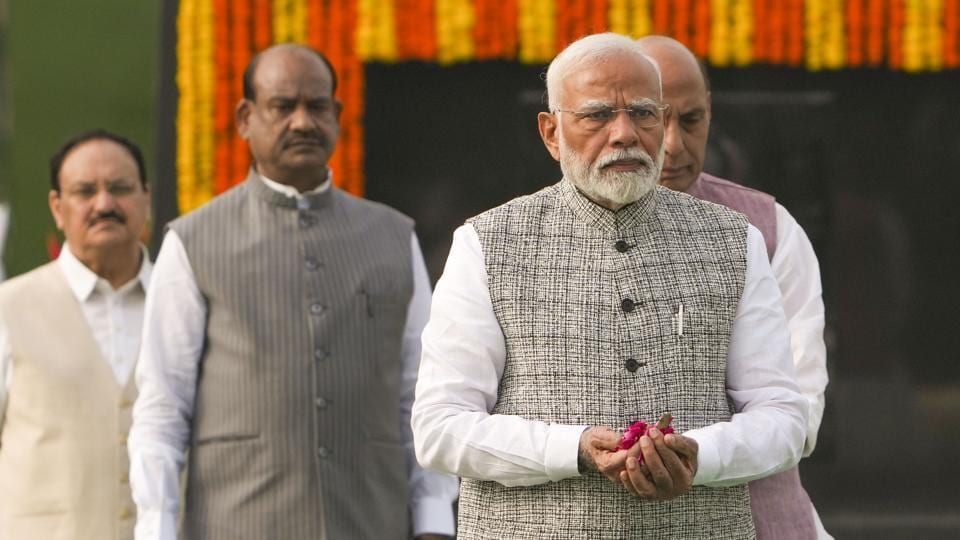
When read with the failure of the Congress party to resurrect itself – it won a paltry 44 and 52 parliamentary seats in 2014 and 2019 –this gave an impression that Indian politics had become a one-sided contest. The results of 2024 challenged these assumptions. Not only did the BJP lose its parliamentary majority, the Congress made a significant comeback to almost bounce back to the triple-digit mark in the Lok Sabha.
Narendra Modi assumed office as the Prime Minister for the third time on June 9, 2024, but the government was seen more as a National Democratic Alliance (NDA) government than the Modi government – the moniker which had gotten attached with it in the last ten years. One year after its sobering performance in the general elections, what many described as the beginning of the end of the BJP’s current phase of dominance, where do the BJP and the NDA government stand? Here are three charts which answer this question.
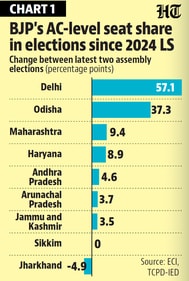
The BJP and its allies have gained ground in every state election since except in Jharkhand
Nine states and union territories (UTs) have had assembly elections since (or with) the 2024 Lok Sabha elections. The BJP, either on its own or along with allies, has gained in terms of seat share and vote share in all of them except Jharkhand if one were to compare the results with the previous assembly elections. If the results were to be aggregated at the parliamentary constituency level, the BJP’s performance in post-2024 assembly elections is better than its 2024 Lok Sabha performance in four states, but it won a majority of seats on its own in all but Andhra Pradesh and Jharkhand among the remaining five. Even among the latter two, it was part of the winning coalition in Andhra Pradesh. There can be only one takeaway from these numbers: the BJP has been able to recover the ground it lost during the 2024 Lok Sabha elections.
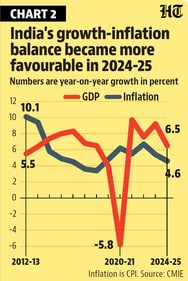
The growth-inflation balance has become more favourable in the last one year
Among the most counter-intuitive things the second Narendra Modi government did in the 2024-25 Interim Budget before the 2024 election was to not focus on the imminent elections. Instead, it brought down the fiscal deficit from 5.8% in 2023-24 to 5.1% in 2024-25 according to the interim budget estimates (the actual reduction between 2023-24 and 2024-25 is from 5.6% to 4.8%). In hindsight it was a bad decision which perhaps added to political headwinds for the BJP. While the process of fiscal consolidation continues – something which is in keeping with India’s medium term fiscal glide path – the Indian economy has a healthier growth inflation balance for 2024-25 than it had in 2023-24. While growth continues to be a healthy, inflation has come down from 6.5% to 4.6%, the second lowest in the current series. This balance has allowed monetary policy to play a cushioning role even as the fiscal stimulus is withdrawn.
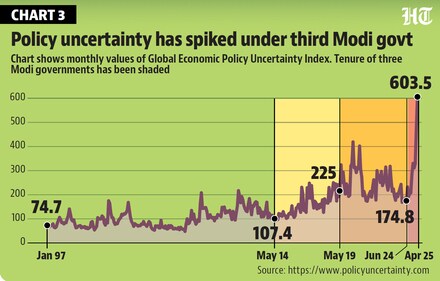
But the external environment is the most volatile it has been in a long time
Of the 62 national elections held in 2024, only 34 saw the incumbent being returned. The most consequential of all anti-incumbency verdicts was the re-election of Donald Trump in the US. Trump 2.0 has inflicted a tectonic shock to the global economic order by unleashing his trade wars with much more fury than what the world saw in his first term. The meltdown of the global economic order is bad news for India as it tries to exploit manufacturing to buttress its economic growth and non-farm employment. The headwinds from the ongoing economic turbulence are not limited to the future alone. They have heightened economic uncertainty and also acted as a dampener for stock markets in India, which have seen a large outflow of foreign investors. The uncertainty regarding trade is also likely to dampen foreign investments, both in the real economy and the financial markets in India. It is the challenge on the external front rather than domestic politics or economics which is the major challenge to the third Modi government on its first anniversary.