E-Paper



Locality to assembly, divisions dog Manipur at every level
Manipur’s politics is complex, particularly at this time, and there are several factors at play. But one of those factors is simply personal safety.


Last Friday, the Manipur government, led by N Biren Singh, recommended to governor Anusuiya Uikey that the next session of the state assembly be convened on August 21. The governor is yet to officially convene the session but if she acquiesces, it will be the first time the assembly will be in session since ethnic violence broke out in the state on May 3, and the first time the legislators will have met since March .
But like everything else in Manipur, even its house of legislators is divided.
On Sunday, two MLAs from the Kuki People’s Alliance(KPA) withdrew support from the BJP led coalition in the state. The government is in no immediate danger; the BJP alone has 37 MLAs and the coalition 52. But importantly, 10 Kuki MLAs of the 60-member house, seven from the ruling Bharatiya Janata Party (BJP), two from the KPA, and an independent legislator said they were all unlikely to even attend the session.
Also Read: Manipur cops file FIR over rape of 37-yr-old on May 3
Manipur’s politics is complex, particularly at this time, and there are several factors at play. But one of those factors is simply personal safety. The legislators are afraid for their lives if they step foot in the Meitei dominated Imphal valley. “There is no question of attending the session under the present circumstances. There is no guarantee of what could happen to us,” one fearful KPA legislator said, requesting anonymity.
The fear is not entirely unfounded. Manipur has been in the throes of ethnic violence, close to a state of civil war, for well over three months. Over 160 people have lost their lives, over 300 are injured, and over 50,000 have been displaced from their homes. Political leaders have not been spared, even those from the ruling party. On May 4, Vungzagin Valte, a Kuki BJP MLA was brutally assaulted by a mob in Imphal on his way home from a meeting with Chief Minister Biren Singh. He had to be airlifted to Delhi for treatment, and is yet to return to the state. On June 14, a mob set on fire the home of Nemcha Kipgen, the only female minister in the state cabinet and a Kuki, in Imphal West. Kipgen, fortunately, was away from Imphal when the mob arrived at her door.
In many ways, this is symbolic of the anarchy of Manipur on the ground -- where battle lines between the Meiteis and the Kukis have only hardened in three months; where violence continues to take lives in the Imphal Valley and the hill districts; where the quantity of aid in a relief camp depends on the ethnicity of the people that live under the tarpaulin tents; where there is no official discussion about separation but the sentiment on the ground is hardening, in no small short measure because the state and the union government have failed to apply any balm to a festering wound; and where even a legislator is unsure of safety in “opposing territory.”
Barricaded borders
Manipur is a state of barricades.
Arrive in Imphal and travel towards the foothills, and every few kilometres there is a traffic roadblock. Some are set up by the Manipur Police, others by the Assam Rifles and the Indian Army, and some by the paramilitary forces. They each check and ask questions, every wanderer under a microscope.
Also Read: Shah urges Manipur tribal body to find alternative site for mass burial
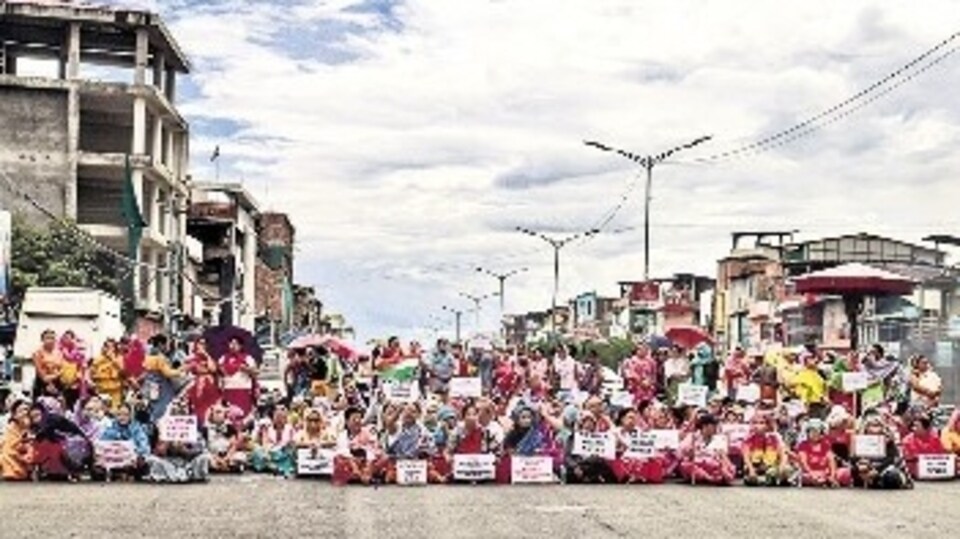
But perhaps the most intrusive are those that aren’t set up by security agencies at all, but by hostile people zealously guarding territories themselves, some barely metres away from a police checkpoint, a parallel authority unto themselves. There are barricades in Imphal, where the Meiteis are dominant, and in Churachandpur and Kangpokpi, where the Kukis have the numerical advantage. As every vehicle arrives at the checkpost that mostly have bamboo gates, large pipes placed on the side of the road, and bunker made of sandbags on either side, the group of men, and often just women, converge to peer inside, asking the travellers to step out. They ask who the person is, where they are going, why they are going where they are going, and check identification. This reporter was forced to show his credentials on multiple occasions at checkposts in Thoubal, Bishnupur, Churachandpur, Kangpokpi and Imphal.
“We have to stay vigilant since our village is close to Kuki habitation and we are scared they might attack us. All women of the village have been guarding the roads since May 4 to ensure that no one is able to enter our area,” said Sinam Surnalata, secretary of the Meira Paibi unit at Nogpok Sekmai in Thoubal district. The Meira Paibis, once a symbol of resistance against injustice, and now accused by the Kukis of being active participants in the violence against them. The Meira Paibis have also targeted Assam Rifles for what they believe to be partisanship, and on Monday, the force was removed from a key checkpost.
Movement from one district to another is therefore fraught with danger. No Kuki can enter a Meitei area, and no Meitei can enter a Kuki areas. People from communities other than these, or from outside the state, are allowed to travel but the only taxis available are those driven by Pangals, a Meitei Muslim community.
These blockades affect the movement of the security forces as well. The Indian Army has complained on social media on how hundreds of women are traveLling from one place to another to block roads, and prevent vehicles carrying personnel to move to violence affected areas. Even essentials required by personnel deployed in the state are mostly delayed or never arrive. “It is very difficult for us to manage our daily routine due to lack of supply of food items and other essentials. For several days we had to rely on local grocery shops to provide us with cereals and other things,” said a security personnel posted at a checkpoint near Kwakta in Bishnupur district.
Sometimes it is worse than just a delay. On July 25, two private buses on the way to fetch security reinforcements from Dimapur in Nagaland were burnt in Kuki dominated Kangpokpi because the owners of the vehicle were Meiteis.
The anarchy in administration
Off the roads, the barricades are intangible, but they are there all the same, cleaving Manipur in two. As violence spread in the first week of May, most Meitei officials in Kuki areas rushed to the Imphal valley, while Kuki officials fled to the hill districts. If Kukis want to leave Manipur, the route they take is not the drive to Imphal, but the long arduous journey to the Nagaland or Mizoram borders. In Kuki areas, there no Meitei officers left. In Meitei areas, there are no Kukis.
Also Read: I.N.D.I.A, NDA squabble over Manipur in no-trust debate
These divisions have hit essential services like health, even more crucial when death and injury still take continue, and people still live cloistered in relief camps. The fractures are clear. In the tribal dominated hill districts, supply of medicines to hospitals and relief camps have been hit, affected by transportation issues and consignments being stopped at the district borders by civilian mobs. “Since May 5, we have received only five consignments of medicines from the medical directorate in Imphal. We have 108 relief camps with nearly 15,000 displaced people in our district as well as 67 hospitals and health centres. The supply was hardly enough for two relief camps. Fortunately we have had some help from church bodies, NGOs and the public,” said a senior health official in Churachandpur district on the condition of anonymity.
The hospitals in Imphal have no such issue, officials said. Professor L Deben Singh, director of Jawaharlal Institute of Medical Sciences(JNIMS) in Imphal said, “We have had no problems with the supply of essential medicines and equipment.”
A representative of the health department in Imphal denied that there was a conscious bias. “The problem is due to transportation bottlenecks due to the blockades and the precarious law and order situation.” .
Inside the relief camps the differences are clear as well. Manipur has 349 relief camps that house its over 50,000 displaced, that include over 10,000 children, according to Manipur government records (till late July). At a Kuki relief camp run by the Christian Fellowship Church in Tuibong in Churachandpur, Khaimang Haokip says the situation is dire. “Our relief camp was set up on May 6 and currently houses around 100 displaced Kuki people. Till date we have received aid only once from the district administration. Most of the essentials we need to run the camp are supplied by church organisations and NGOs,” he said.
22 kilometres away, at a high school in Bishnupur’s Phubala, there are 250 Meitei people, most that once lived in Churachandpur, and operations are looked after by panchayat members. “The government sends us rice, dal, cooking oil, salt, mattresses, mosquito nets and medicines. Sometimes money is also provided to procure firewood to cook meals. The camp was set up on May 8 and we have been providing the displaced people with two meals a day plus tea and snacks,” said Kh Apabi Devi, a panchayat ward member from Phubala.
Officials in Imphal said that much like the supply of medicines, transportation of essentials meant for the relief camps suffer not from purposeful rerouting or bias, but from security concerns, having to navigate hostile road blockades, and civilians from one community blocking aid meant for the other. Others aren’t so sure.
In Manipur, they point out, even relief has an ethnicity.
 ABOUT THE AUTHORUtpal Parashar
A seasoned senior journalist, I have nearly three decades of experience across print, digital, and online platforms, covering political transitions, insurgencies, environmental issues, and development stories in India and Nepal. I am skilled in breaking news, leading editorial teams and launch of newspaper editions. I am adept at leveraging digital trends and social media to expand global reach, with a strong ethical foundation and a reputation for impactful journalism. An alumnus of Asian College of Journalism, I joined Hindustan Times in New Delhi as a trainee reporter in May 1997. Over the years, I have been posted in Dehradun, Kathmandu (Nepal) and Guwahati. Currently, as Senior Assistant Editor at Hindustan Times, I lead a team reporting on India’s northeastern states. My work involves in-depth analysis, and engaging multimedia storytelling across formats, including text, photo, video, and interactive content. I am skilled in producing timely, shareable content, leveraging digital platforms and social media to engage global audiences. Throughout my career with the Hindustan Times, I have led diverse editorial teams, designed capacity-building activities, and supported reporters in developing strong story ideas, ethical reporting practices, digital skills, and fact-checking techniques. As Senior Assistant Editor for Northeast India, I have been responsible for guiding correspondents through complex political, humanitarian, and community-level stories using multimedia formats. Earlier, as Foreign Correspondent in Nepal, I produced extensive reporting during Nepal’s democratic transition and the 2015 earthquake and its aftermath.Read More