
 E-Paper



Fear of President's rule, 'BJP by backdoor': How ‘Thalapathy’ Vijay got the support he needed to become Tamil Nadu CM
And then there was the importance of May 10, the day the previous assembly's tenure formally ends. No oath by then could have meant President's rule too.

 Prefer HTon Google


When Tamil Nadu's election results came in on May 4, Vijay's Tamilaga Vettri Kazhagam (TVK) had won 108 seats in a 234-member Assembly — the single largest mandate, but short of the majority. What followed was five days of negotiations in which every party that eventually backed Vijay did so citing not confidence in his leadership as such, but the fear of what would happen without it.
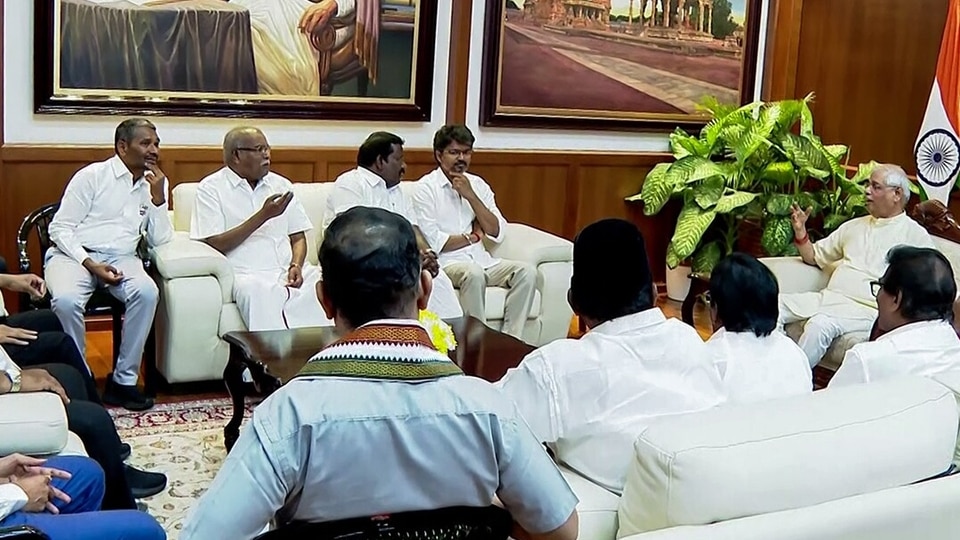
That fear had two faces: President's Rule, and the Centre's ruling BJP. This, even when the BJP has a grand total of one seat in the new, 17th Tamil Nadu assembly.
Legal spectre: Article 356
When no party can demonstrate a majority in a state assembly, the Governor may recommend to the President that the state cannot be governed constitutionally. Under Article 356 of the Constitution, the President can then impose central rule, dissolving or suspending the state assembly and placing the state under direct governance from New Delhi.
In Tamil Nadu, with its fierce tradition of state autonomy and deep suspicion of the central government, the prospect of President's rule was, for most regional parties, politically unacceptable. At least one of the parties supporting Vijay expressly said so.
And then there was the importance of May 10, the day the previous assembly's tenure formally ends. No oath by then would have meant President's rule anyhow.
Congress, the first to go formal
The Indian National Congress was the first major party to break ranks with the losing DMK-led alliance, announcing support on May 6 through a formal statement signed by AICC in-charge for Tamil Nadu, Girish Chodankar. The statement placed a caveat on record: "Our support shall be conditional upon the TVK keeping out from this alliance any communal forces that do not believe in the Constitution of India." The reference was to the BJP, which is a junior partner of the AIADMK, their NDA alliance having finished third.
The Congress also announced state-wide protests against Governor Rajendra Arlekar, with state unit president K Selvaperunthagai declaring: "Governments are not decided on the lawns of Lok Bhavan. They are decided on the floor of the House." The Governor wanted to see majority on paper first.
The Left: Stopping BJP at the door
The Communist Party of India (CPI) and the CPI (Marxist) held state committee meetings on May 8 and arrived at the same conclusion as the Congress had. The CPI's formal letter conveyed "unconditional support" to TVK for government formation. CPI state secretary M Veerapandian was direct in his reasoning: "We have given our support; it is our democratic duty. This is a people's democracy. We will stand with democracy, we will stand with people."
The CPI(M) said, "At present, TVK is the only party in a position to form the government. To prevent BJP from coming to power indirectly, we have decided to support TVK." The two Left parties added four seats, taking the tally to 116 voting MLAs and 117 seats (Vijay won two seats, but can vote in the assembly once).
VCK's reasoning
VCK chief Thol Thirumavalavan, whose two seats were the most fiercely contested in the negotiations, was the most unambiguous of all the supporting leaders when he finally spoke.
“We have to support Vijay to avoid President's Rule. We would not be an obstacle for Vijay to form the government. These are the two reasons for which we extended our support. There is no other political justification,” he said.
"We don't believe that they are secular or non-secular. We don't bother about that," he added.
With VCK's two seats, Vijay got the majority.
IUML supports from within DMK alliance
The Indian Union Muslim League's (IUML) position was the most unusual of all. Party leader KAM Muhammed Abubacker confirmed support to the TVK while simultaneously stating that the IUML remained within the DMK-led alliance.
"There is no change. Still, the Indian Union Muslim League Tamil Nadu State Committee is continuing in the DMK-led alliance. We have given support to TVK to form the government... Without our support, they can't form the government. We are exercising our democratic right. We discussed this with them (DMK)," he said.
The IUML's two seats took the final confirmed tally to 120 voting MLAs, and 121 seats in the House of 234.
MK Stalin-led DMK has already said it would work as Opposition and that constitutional processes must be followed to allow formation of a government. It is statedly angry with the Congress for not informing it before breaking ranks, but has quelled speculation that it wanted to form an alliance with arch nemesis AIADMK to keep Vijay away from power.
The BJP kept a distance from it all, saying the governor was only following rules. The debate over constitutional propriety and precedents raged on.
Governor relents
Through it all, Governor Rajendra Arlekar — a BJP veteran from Goa who has served as Kerala's Governor since January 2025 and took additional charge of Tamil Nadu only in March this year — had been the immovable point.
He met Vijay three times in three days, each time declining to extend a formal invitation, citing the absence of written proof of majority support.
On Saturday, with his flight to Thiruvananthapuram (Kerala) booked for 7:10 pm, Arlekar cancelled his travel plans and met Vijay's delegation at 6:30 pm.
Vijay had got final letters of support only around 5 pm.
The Governor was finally satisfied. The oath-taking was thus scheduled for May 10, Sunday, just in time.


