
 E-Paper



Fewer stone-pelting cases in Kashmir under central rule
According to data reviewed by Hindustan Times, the total number of stone-pelting cases registered under the NC-INC regime between 2009 and 2014 was 2,690 with a spike in 2010, when protests took place against alleged killings by the army in the Macchil sector.

 Prefer HTon Google


The number of stone-pelting incidents in the Kashmir valley has dipped under direct federal rule compared to the number reported under the two previous political administrations — the Peoples Democratic Party-Bharatiya Janata Party (PDP-BJP) coalition that was in power between 2015 and mid-2018, and the National Conference-Indian National Congress (NC-INC) alliance that stayed in office between 2009 and 2014.
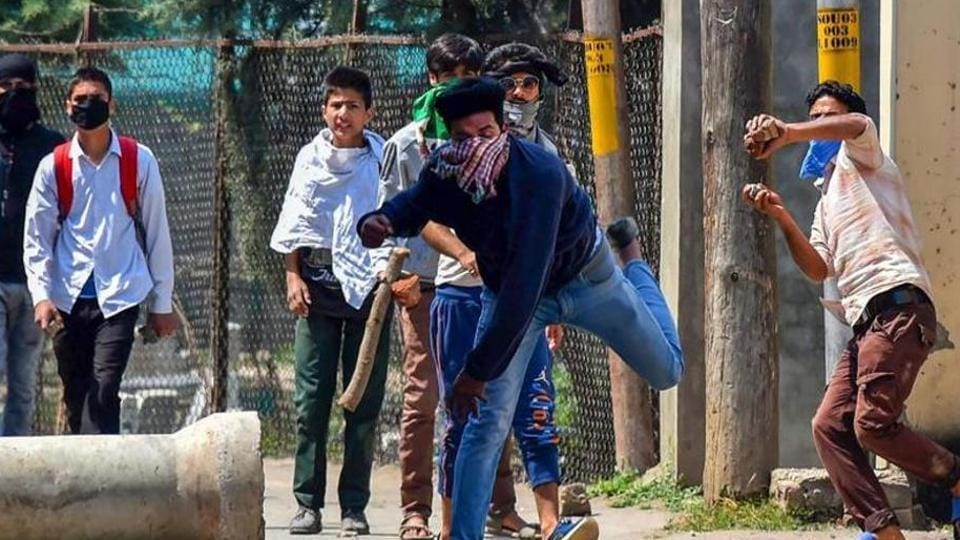
Governor’s rule was imposed in Jammu and Kashmir on June 18, 2018 after the BJP withdrew support to the PDP, forcing chief minister Mehbooba Mufti to resign. A total of 349 stone-pelting cases were registered in the remaining part of last year. Thus far in 2019 (until July 17), there have been 355 incidents of stone-pelting. The state is currently under President’s rule.
According to data reviewed by Hindustan Times, the total number of stone-pelting cases registered under the NC-INC regime between 2009 and 2014 was 2,690 with a spike in 2010, when protests took place against alleged killings by the army in the Macchil sector.
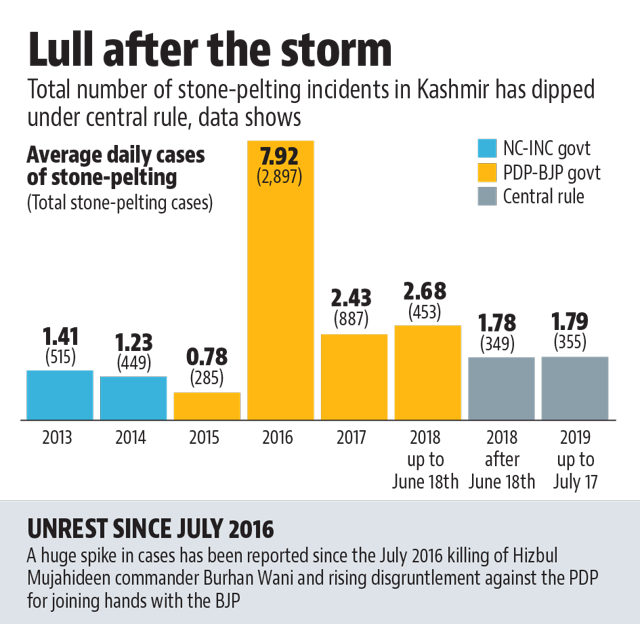
The PDP-BJP government, headed initially by Mufti Mohammed Sayeed and then, after his death, by his daughter Mehbooba Mufti, recorded a high of 4,522 cases against stone-pelters with a huge spike of 2,897 cases in 2016 amid widespread protests over the killing of Hizbul Mujahideen militant commander Burhan Wani in an encounter with security forces and rising disgruntlement against the PDP for joining hands with the BJP.
The data shows that the average number of daily incidents was the highest under the PDP-BJP government, although the spikes mentioned above had a part to play in that. The average number of daily incidents was the lowest during the NC-INC government between 2009 and 2014 -- when the state went through a period of relative calm before Wani’s killing -- as compared to the periods under the PDP-BJP regime and Governor’s rule.
Data over a decade also suggests that Srinagar, the base of the pro-Pakistan umbrella separatist group Hurriyat Conference, witnesses the most number of instances of stone-pelting. Sopore, a hotbed of the Jamaat-e-Islami, Kashmir and Tehreek-e-Hurriyat activity, Baramulla and Pulwama aren’t far behind.
While militant activity in north Kashmir towns is dominated by the Pakistan-based Lashkar-e-Taiba, south Kashmir towns like Pulwama, Kulgam and Anantnag are hubs of terrorists from the Hizbul Mujahideen and the Pakistan based Jaish-e-Mohammed. Kupwara, Avantipora, Handwara, Ganderbal and Bandipora are, in general, more peaceful, going by the data.
Senior Jammu and Kashmir police officials believe that the free hand given to security forces under Governor’s and now President’s rule is largely responsible for the decline in the number of stone-pelting incidents, and blame the politicians for being soft on troublemakers. For instance, the PDP-BJP government, at Mehbooba Mufti’s instance, announced an amnesty for first-time stone-pelters.
Avinash Mohanney, a Kashmir expert who spent long years in Kashmir and Pakistan with the Intelligence Bureau, disagrees with such a hypothesis.
“It is wrong to blame politicians for stone-pelting. All governments have taken strong action against stone-pelters. This phenomenon picked up in the 2010 agitation as people were very upset with the Machchil killings of innocents by the Army. Stone-pelting peaked again in 2016 as public was very unhappy with Mehbooba Mufti tying up with the BJP. I am not saying that the {Narendra} Modi government should talk to Hurriyat or Pakistan on Kashmir. All I am saying is that democracy through elections must be restored as soon as possible,” he said.
Top home ministry officials also understand that the alienation of the Kashmiri must end, apart from neutralizing terrorists or launching big-ticket schemes. “ Home minister Amit Shah made it very clear to district commissioners in Kashmir during his visit that all 354 central government schemes that touch an average Kashmiri must be implemented in toto. He made it clear that the priority is Kashmiri public — with big infrastructure schemes and counter-terrorism operations going hand in hand,” said a senior home ministry official who spoke on condition of anonymity.
According to counter-terrorism operatives, there are a total of 300 terrorists in the valley currently, of which 115 are of Pakistani or Afghan nationality. The focus of security agencies is to not allow these numbers to go up by stopping replenishment from across the border and putting an end to the recruitment of local young men in South Kashmir.


