
 E-Paper



Govt’s affidavit defending nullification of Art 370 lacks logic: Mehbooba Mufti
The Union government in its affidavit in the Supreme Court on Monday said the nullification of Constitution’s Article 370 has led to “unprecedented development, progress, security and stability”

 Prefer HTon Google


Former Jammu and Kashmir (J&K) chief minister Mehbooba Mufti has hit out at the Union government over its affidavit in the Supreme Court (SC) defending the nullification of the Constitution’s Article 370, saying it lacks logic.
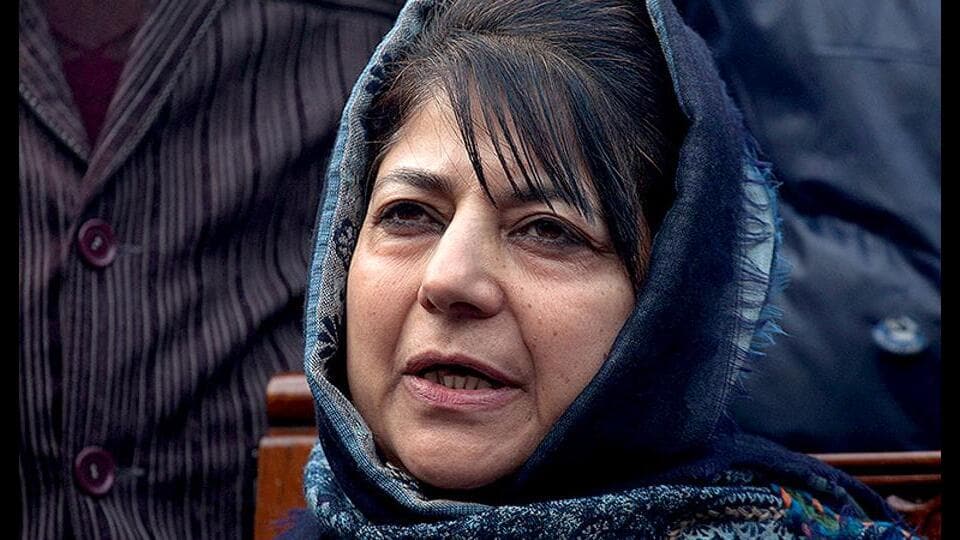
The government in the affidavit filed on Monday said the nullification has led to “unprecedented development, progress, security and stability” in the region.
In a tweet on Monday, Mufti maintained the abrogation of Article 370 that gave J&K semi-autonomous was “illegal and unconstitutional”. She added brute majority was used to subvert the constitution that extended guarantees to the people of J&K. “...GOI [government of India] also violated earlier rulings of Hon’ble SC [Supreme Court] which held that only J&K’s constituent assembly could recommend the removal of Article 370 to the President of India. Drum beating about an enforced silence & so-called grassroots democracy cant be used to justify constitutional harakiri.”
The Supreme Court on Tuesday directed a day-to-day hearing from August 2 of a clutch of petitions against the nullification. Some petitioners have brought up the requirement of consent from J&K’s erstwhile constituent assembly for the abrogation of Article 370. Others highlighted the Supreme Court’s ruling of 2018 that observed that Article 370 had gained a status of permanence.
Another former chief minister Omar Abdullah, whose National Conference is among the petitioners, called the contents of the affidavit political arguments. “These are definitely political arguments the BJP [Bharatiya Janata Party]/Union Govt can make to sell their decision to the voter but they are not legal arguments. The entire case in the SC is about the illegality & unconstitutionality of what was done on 5th Aug 2019, not whether the Govt has a strong enough political case,” Abdullah tweeted.
Former J&K minister Sajad Lone said the Article 370 case is one of the biggest challenges facing the judiciary. “The role of the apex court is not to pass judgment on whether the abrogation of Article 370 was beneficial or detrimental to J&K but the court’s duty lies in determining the legality of the abrogation.”
Lone said the government’s affidavit focuses on issues post-abrogation. “What will eventually be discussed in the court is the legal pathway to abrogation, not the so-called perceived political or law and order benefits post abrogation. Whether abrogation of Article 370 is good or bad for J and K is not what the Apex court has to decide. They have to decide whether it was good or bad in law,” Lone said in a statement.
He said Article 370 in essence was a form of federalism and a power-sharing arrangement. Lone added it has been slandered and defamed beyond recognition. He added clamour for federalism will progressively gain momentum over time. “The biggest threats facing the country today are the attacks on its federal structure...”
Communist Party of India (Marxist) leader Mohammad Yusuf Tarigami, who is also a petitioner, said democratic and civil rights have vanished after the abrogation of Article 370. He added those wanting to speak are not allowed to do so. “...if anybody protests, they are being arrested.” He said there is “forced peace”.
The ruling BJP has maintained that Article 370 was a temporary provision in the Constitution that had to be removed.


