
 E-Paper



German conglomerate, India’s MDL ink pact to bid for submarine project worth ₹43k-cr
ThyssenKrupp Marine Systems and Mazagon Dock Shipbuilders signed an MoU to bid for a ₹43,000-cr project to build 6 advanced submarines under ‘Make in India’

 Prefer HTon Google


German conglomerate ThyssenKrupp Marine Systems (TKMS) and Indian shipyard Mazagon Dock Shipbuilders Limited on Wednesday signed a memorandum of understanding (MoU) in Mumbai to bid for a ₹43,000-crore project to build six advanced submarines in India under the government’s strategic partnership (SP) model.
The project, called P-75 India, is one of the biggest Make in India programmes.
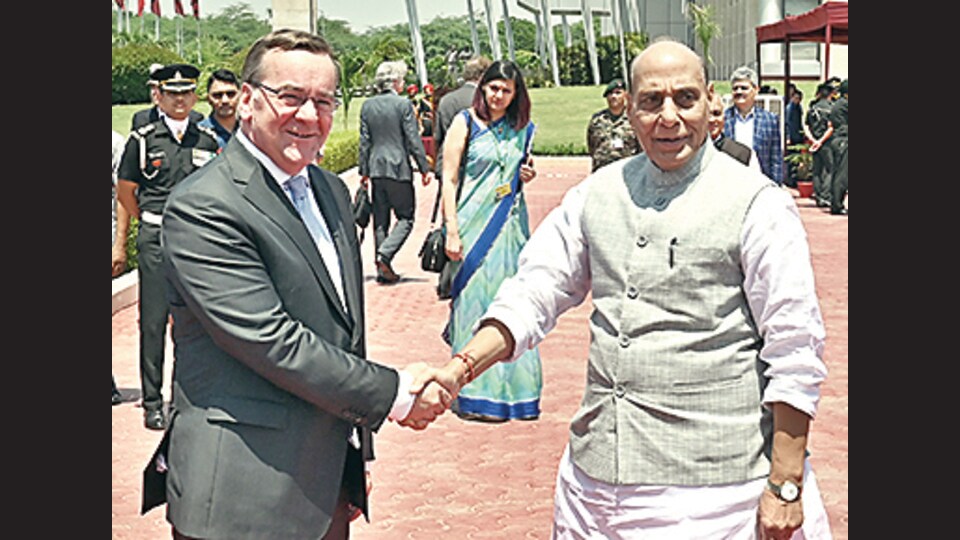
The MoU was signed in the presence of visiting German defence minister Boris Pistorius who on Tuesday held talks with his Indian counterpart Rajnath Singh in Delhi and pitched for building the submarines in India with German collaboration. HT reported on Tuesday that the MoU would be a step towards the two firms bidding for the multibillion-dollar submarine deal.
“I am pleased I was present at the MoU signing ceremony. This partnership between TKMS and MDL for the possible construction of six submarines is an important milestone in a key technology domain,” Pistorius told German reporters accompanying him. The Indian partners praised German technology, its reliability and the longevity of equipment, he said.
Four HDW Class 209 submarines built in the 1980s have already proved to be a successful model of Indo-German cooperation, TKMS said in a statement after the MoU was signed. The first and second of those submarines were built in Germany while the remaining two at Mazagon Dock Shipbuilders Limited in Mumbai. The four submarines continue to serve the Indian Navy.
TKMS has now offered India the advanced HDW Class 214 submarines.
“We look back on a trusting and decades-long partnership with India. The boats we built in the 1980s are still in service today. We are very proud of that and would be delighted to continue contributing to India’s national security in the future. We are ready when India calls,” said TKMS CEO Oliver Burkhard.
Both parties can draw on many years of expertise, knowledge and professional competence in fulfilling this project to everyone’s satisfaction, TKMS officials said.
India cleared the estimated ₹43,000 crore project two years ago to strengthen the navy’s capabilities and provide momentum to the defence indigenisation drive, one of the government’s key priorities.
The SP model envisages indigenous manufacturing of major defence platforms by an Indian strategic partner who will collaborate with a foreign original equipment manufacturer (OEM) to set up production facilities in the country.
“It remains to be seen how the process will take its course over the next few months. I also specifically campaigned for it on Tuesday during my talks with defence minister Singh,” the German minister said.
In January 2020, the defence ministry cleared two Indian and five foreign shipbuilders, including TKMS, to take part in P-75I.
The Indian strategic partners cleared to collaborate with the foreign OEMs are Mazagon Dock Shipbuilders Limited and L&T. The foreign yards cleared for partnerships include the French Naval Group, Russia’s Rubin Design Bureau, Spain’s Navantia and South Korea’s Daewoo Shipbuilding & Marine Engineering Company.
P-75I, first talked about more than two decades ago, has moved at a notoriously slow pace. It was a part of the 30-year submarine-building programme approved by the Cabinet Committee on Security in 1999.
The German side believes TKMS is one of the main contenders for the submarine deal following the withdrawal of France’s Naval Group and Russia’s Rubin Design Bureau a year ago, as reported by HT on Wednesday. South Korea’s Daewoo is also in the fray, but the submarine pitched by it is reportedly based on a German design.
Submarines built under P-75I will be equipped with air independent propulsion (AIP) systems that will enable the vessels to stay underwater for longer periods and enhance their combat capabilities. A minimum 45% indigenisation has to be ensured by the strategic partner in P-75I in the first submarine, with the indigenous content going up to 60% in the sixth, the officials said.
With P-75I being cleared in 2021, the country took a step forward towards achieving the goals of its 30-year submarine construction programme. The navy plans to operate a fleet of 18 new conventional submarines and six nuclear-powered boats. The government approved the plan to build six nuclear-powered submarines in 2015, tweaking the 1999 submarine-building programme. Also, it plans to operate a fleet of four nuclear-powered ballistic missile submarines.



