
 E-Paper



Punjab haunted by 1988 nightmare: Hundreds died, bodies flowed into Pakistan, and an assassination
Nightmare from 4 decades ago speaks of bodies flowing across the border into Pakistan; people from the time or with family history recall horror

 Prefer HTon Google


Punjab is struggling with floods again, and a ghost from 1988 is walking, again, among its people as they struggle to save their fields and homes from angry rivers amid heavy monsoon rain.
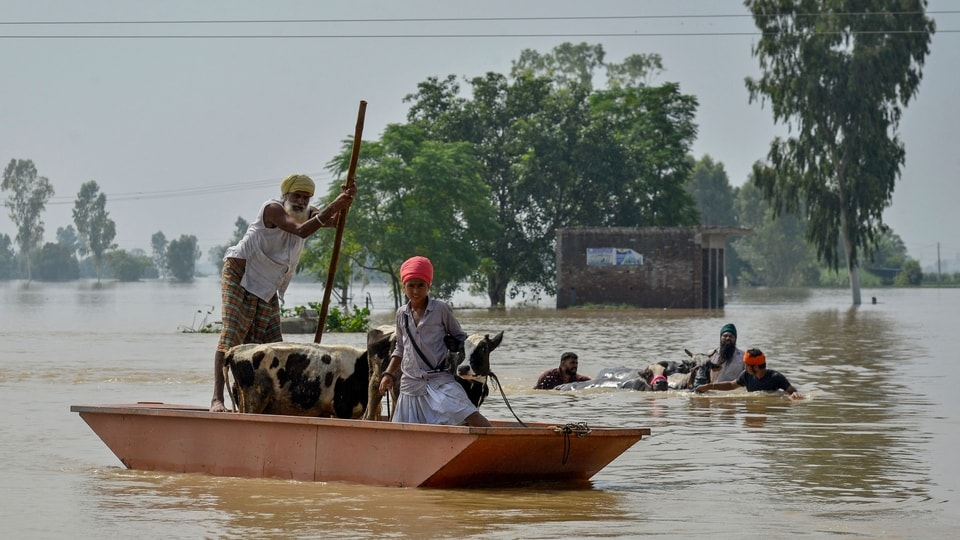
The nightmare from four decades ago speaks of hundreds of deaths, bodies flowing across the border, widespread loss of crops and livelihood, and the assassination of an army general in the heart of the capital, Chandigarh.
The situation is not yet as dire. But devastation and fear are widespread.
Over the past week or so, thousands of acres of farmland, mostly with near-ripe paddy (rice), and hundreds of homes have been submerged or marooned. This has displaced people across around 500 villages along the rivers Sutlej, Beas, and Ravi, as water has been released from overflowing reservoirs of the hydropower projects.
Recalling the nightmare
The floods of 1988 come up as the hellish extreme when people in Punjab speak about their current misery. Among the people are those who lived through that nightmare, and those with family histories coloured by it. Statements referencing 1988 could be heard during the floods of 2023 and 2018, and 15 years ago.
“After decades, we are suffering this situation again. As per my observation, it is worse now,” Gurnam Singh, a former sarpanch of Dugri village near the Ravi in Gurdaspur district, told HT earlier this week. He alleged that the AAP government led by Bhagwant Mann has failed on this front.
Gurnam Singh's Gurdaspur is one of the worst-hit districts, besides Pathankot, Hoshiarpur, Kapurthala, Amritsar, Tarn Taran, Fazilka, and Ferozepur. Ludhiana is affected too, as is Patiala, as per the latest reports.
As for August 30, the reported death toll remains in single digits in the Punjab on the eastern side of the international border, while Pakistan's Punjab has seen over 800 deaths, caused by the same rivers. The most recent rain and floods have killed over 40 people in the Jammu region, while Himachal has seen several hundred deaths this monsoon overall.
In 1988, deaths in the September floods in the Indian Punjab alone were estimated to be between 600 (closer to the official data) and 1,500.
Charges of sabotage, and bodies flowing in the Ravi
Allegations of mismanagement of the Pong and Bhakra dams, on rivers that flow in from the Himalayas, can be heard.
These two dams had reportedly come close to bursting back in 1988.
Reports from the time say the dam management had expected the catchment area to receive up to 120 mm of rain that September, since the monsoon is usually over in the North by that time. But, between September 22 and 26, 1988, there was more than five times the forecasted rain.
This led to flash floods that damaged around 75 per cent of what promised to be a record kharif (summer-sown, winter-harvested) crop in the districts that are deluged this time too, as per an India Today archive report.
Around 9,000 of the 12,000-odd villages were hit in Punjab, plus there was devastation in large parts of Himachal and J&K upstream, and Haryana, Rajasthan, and Delhi further down the Indo-Gangetic plains.
Prominent Punjabi newspapers also reported that bodies flowed into the Punjab across the border, in Pakistan, which was also ravaged. Images of one such news report, which speaks of 1,300 bodies flowing across the border, have gone viral on social media.
Back then, militant groups saw the opening of the floodgates as not just an administrative failure but an act of aggression against Punjab by the central government.
Assassination in Chandigarh, and a killing in Lahore 35 years later
It was the midpoint peak of separatist militancy in Punjab that lasted from the 1980s to the mid-’90s.
The Bhakra Beas Management Board (BBMB), which administers the mega hydel power plants with massive reservoirs, was led by an army officer, Major General BN Kumar.
He was killed in November 1988 near his home in Chandigarh. Maj Gen Kumar was among the highest-ranked army officers to have been killed during those years of “kaale din” ('dark days') in Punjab.
He had said the massive rain and flash floods were a “once in a thousand years” phenomenon, and that he was open to an inquiry.
His life and death returned to the headlines in 2023, when Khalistan Commando Force (KCF) chief Paramjit Singh Panjwar, wanted for this assassination and other acts of violence, was shot dead in a mysterious attack in Lahore, Pakistan.
CM Bhagwant Mann says situation ‘unprecedented’
That violent period may long be over, but the misery of the deluge is a lasting scar. Social media is flooded with posts about the crisis, as the diaspora also pitches in with awareness and donations.
Chief minister Bhagwant Mann, who toured some of the flood-affected areas, has described the situation as unprecedented. He said deputy commissioners of flood-affected districts will further intensify the pace of relief and rescue.The army is also working with the administration.
Farmers have come together to repair or temporarily build bundhs using earth and plastic bags, working to ensure the ghost of 1988 does not return to life.


