
 E-Paper



Hasina in Delhi, Zia’s son in Dhaka: Why Bangladesh polls are big focus of India's neighbourhood watch
Bangladesh elections on February 12: India has viewed late Khaleda Zia's BNP with deep suspicion, but political realities have forced reassessment on both sides

 Prefer HTon Google


India is watching keenly while Bangladesh stands at a crossroads, as it goes to polls on February 12, the first national vote since a students-led uprising swept Sheikh Hasina from power in August 2024.
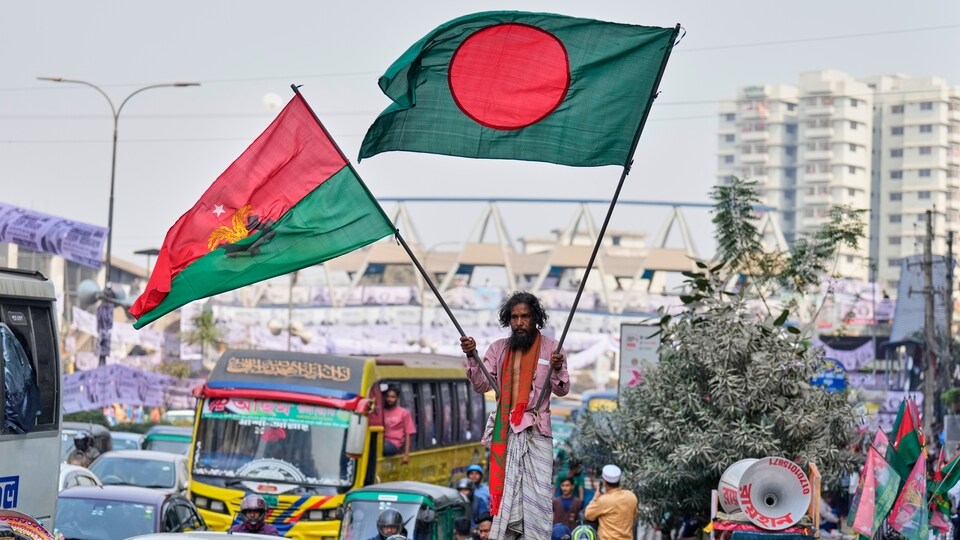
The scale of the elections — being conducted under an interim government led by Nobel laureate economist Muhammad Yunus — is formidable by numbers alone.
Nearly 13 crore or 130 million Bangladeshis are registered to cast ballots at close to 43,000 polling stations across the country.
We will come back to the immediate context in a bit.
First, let's see why India is so keenly invested in the Bangladesh political situation:
The India-Bangladesh relationship has its roots in the bloody partition of British India in 1947. The Muslim-majority eastern region of Bengal became East Pakistan, a geographic oddity separated from West Pakistan by over 1,600 kilometres of Indian land in between.
The arrangement proved unsustainable — also because of language, as West Pakistan was dominated by Urdu/Punjabi while East was dominantly Bengali. Tensions simmered through the 1950s and 1960s before boiling over. After the Awami League, led by Sheikh Mujibur Rahman, won Pakistan's 1970 general election, the West Pakistani establishment refused to transfer power.
What followed was brutal: a military crackdown. India's Prime Minister Indira Gandhi, after an influx of approximately 10 million or 1 crore refugees into the state of West Bengal, chose intervention. India's military action in December 1971 was swift. Pakistani forces in Dhaka surrendered within two weeks.

Bangladesh emerged as an independent nation on December 16, 1971. India became the first country to extend recognition to the newborn state.
But tensions remained and resurfaced in this relationship, too, as Mujibur Rahman sought to consolidate power. He was assassinated along with most of his close family in 1975 by some junior army officers in August 1975, leading to the first military coup in the country. His daughter Sheikh Hasina was not in the country, and later returned and went on to become PM in a deeply divided political system.
In the period of instability and political violence in the mid-1970s, Maj Gen Ziaur Rahman rose from Chief of Army Staff to President in 1977, and later founded the Bangladesh National Party (BNP). He was assassinated, too, in 1981, by a group of officers in another failed coup attempt. His wife Khaleda Zia went on to become a major political player as democracy returned by the 1990s. Their son Tarique Rahman is now BNP chairman.
Sheikh Hasina was also accused of dictatorial tendencies like her father, and unseated in the 2024 protests. She is now in India — self-exiled but protected in Delhi — and has been sentenced to death in Dhaka for alleged crimes against humanity.
Textbooks in Bangladesh have been tweaked to underplay Sheikh Mujib's leadership and India's role in the 1971 liberation.
Bangladesh elections and India: Interlinked in past too
For decades, relations between India and Bangladesh ebbed and flowed with electoral tides. Hasina’s Awami League generally maintained close ties with New Delhi. The Bangladesh Nationalist Party (BNP) and its sometime-ally Jamaat-e-Islami charted a different course, one viewed with wariness in Indian corridors of power due to their perceived pro-Pakistan orientation and Islamist views.
Sheikh Hasina's tenure from 2009 to 2024 marked a period of cooperation. The 2015 Land Boundary Agreement was a breakthrough after a 1974 agreement languished unratified by India for decades. The 2015 pact facilitated the transfer of 111 enclaves (17,160.63 acres) from India to Bangladesh, whilst India received 51 enclaves (7,110.02 acres) from Bangladesh.
Bilateral trade expanded too. India provided lines of credit worth billions to Bangladesh and exported 500 megawatts of electricity daily. Hasina's government cooperated with India on counter-terrorism, cracking down on insurgent groups operating in Bangladesh's northeastern regions. The partnership appeared solid.
What changed in Bangladesh, for India, in 2024
That stability shattered about two years ago. Student protests ignited in July 2024 against a quota system in government jobs for children of freedom fighters from 1971. It soon turned into a nationwide uprising against Sheikh Hasina's government. Security forces responded with lethal force. Al Jazeera reported that the crackdown killed an estimated 1,400 people.
On August 5, 2024, with hundreds of thousands of demonstrators surrounding her residence, Sheikh Hasina fled to India by military helicopter. She remains there still. Her father's statues have been demolished, and his legacy is being denounced as dictatorial whereas he was once widely seen as the founding father of the country.
The International Crimes Tribunal in Bangladesh convicted Hasina in absentia in November for ordering the use of lethal force against protesters. Bangladesh has formally requested her extradition.
This extradition request, and India’s persistent denial so far, has also become an election issue in Bangladesh. The BNP led by Khaleda Zia’s son after her death recently has been speaking about this as part of its poll pitch.
Violence against minorities, Hindus in particular
The aftermath of Hasina's departure also brought fresh turmoil for religious minorities in the Muslim-majority country. The Bangladesh Hindu Buddhist Christian Unity Council documented over 2,000 incidents of communal violence between August and December 2024, according to the Associated Press.
India’s minister of state for external affairs Kirti Vardhan Singh informed Parliament that "over 2,400 minority-related incidents have been reported from August 5, 2024, to March 23, 2025". He added: "It is expected that Bangladesh will thoroughly investigate these incidents and bring all perpetrators of killings, arson, and violence against minorities to justice without justifying any of these killings or arson as politically motivated."
The killing of 27-year-old Hindu garment worker Dipu Chandra Das drew international attention. Accused of blasphemy, he was beaten to death, his body hung from a tree and set ablaze. Ranjan Karmaker, a Dhaka-based Hindu human rights activist, told AP: "No one feels safe anymore. Everyone is terrified."
India's foreign ministry has suggested that Bangladesh is downplaying "a disturbing pattern of recurring attacks" on Hindus.
Bangladesh, in turn, has described India's criticism as "systematic attempts" to stoke anti-Bangladesh sentiments. Both sides temporarily suspended visa services.
Bangladesh even boycotted the T20 World Cup of cricket being co-hosted by India, after BJP leaders and rightwing Hindutva vigilantes objected to Kolkata Knight Riders, an IPL team owned by actor Shah Rukh Khan, contracting a Bangladeshi Muslim player. Pakistan later joined forces with Bangladesh at the International Cricket Council (ICC) that's led by India's home minister Amit Shah's son Jay Shah. Pakistan anyhow has been growing closer to Bangladesh with direct flights resumed recently and a possible defence deal.
With cricket, films, and politics in the mix, the relationship appears to have deteriorated to a historic low.
India an issue in Bangladesh campaign
The election campaign in Bangladesh reflects this situation too. The Awami League's registration and electoral activities have been suspended. Around five dozen registered political parties are participating.
The BNP, led by Tarique Rahman, has emerged as a principal contender. Rahman's return to Bangladesh on December 25, 2025, after 17 years in London was dramatic. His mother, former PM Khaleda Zia, was ailing and died days later.
He then assumed party leadership, and is now seen as a potential next PM.
When the BNP unveiled its 51-point manifesto on February 6, the principle it cited was ‘Bangladesh Before All’. Rahman struck a conciliatory tone for domestic audiences: "The BNP believes not in revenge, but in a politics of justice and humanity. The rights of the people, not power, are at the core of our politics. Production, not plunder; rights, not fear; fairness, not discrimination — these are the principles that will guide the governance of the state."
The manifesto India-related friction points head-on: border shootings, infiltration, and the pending Teesta river water-sharing agreement. Yet, it also committed to building relations with neighbouring countries "based on equality, fairness, pragmatism, and mutual interest", reported the state news agency.
Jamaat, once banned, a big player in league with student protest leaders
The Islamist party Jamaat-e-Islami, once banned from elections, has re-entered the fray. The party released its 26-point manifesto, and party leader Shafiqur Rahman offered an expansive vision: "I do not want the victory of Jamaat-e-Islami; I want the victory of 180 million people."
The Jamaat manifesto also promises to build "peaceful, friendly, and cooperative relations with neighbouring and nearby countries”. It expressly names India, Bhutan, Nepal, Myanmar, Sri Lanka, Maldives, and Thailand.
Notably, local media outlets such as The Daily Star pointed out the manifesto's "conspicuous omission of Pakistan”. The document does say that "strengthening of relations with countries of the Muslim world shall be a key foreign policy priority”.
But what happened to the students in the uprising?

The Jamaat is in an electoral alliance with the National Citizen Party, founded by student leaders of the 2024 uprising, and the Liberal Democratic Party. In a historic first, Jamaat is even fielding a Hindu candidate, Krishna Nandi, from Khulna.
A December survey by the International Republican Institute showed the race to be tight. The BNP commanded support from 33 per cent of respondents. The Jamaat-led alliance polled at 29 per cent. A post-poll alliance looks likely.
India's diplomatic reset
New Delhi has already adjusted its approach. External affairs minister S Jaishankar has met Tarique Rahman in Dhaka. "On arrival in Dhaka, met with Mr Tarique Rahman, Acting Chairman of BNP and son of former PM of Bangladesh Begum Khaleda Zia. Handed over to him a personal letter from Prime Minister Narendra Modi," he posted on X.
He added: "Expressed confidence that Begum Khaleda Zia's vision and values will guide the development of our partnership."
Bangladesh's High Commissioner to India, Riaz Hamidullah, also spoke positively about it. He said Jaishankar "expressed optimism to strengthen Bangladesh-India ties following the democratic transition in Bangladesh through the upcoming election”. He added, “Bangladesh and India would look forward to script a new chapter in ties, in shared interests driven by pragmatism and mutual interdependence.”

Indian High Commissioner in Dhaka Pranay Kumar Verma met Tarique Rahman in January, a day after he formally assumed charge of the BNP.
For years, India viewed the BNP — particularly during its alliance with Jamaat between 2001 and 2006 — with deep suspicion.
Political realities, however, have forced reassessment on both sides. These are two young nations looking also to the future. The Bangladesh electorate skews young. Nearly 44% of the registered voters are aged between 18 and 37.
Reports say the voters are focused on three issues: restoring democratic rule, reviving the garment-export industry, and recalibrating ties with India.


