
 E-Paper



How Congress lost, and AAP won Punjab
Last year, when the Congress leadership in Delhi actively orchestrated a revolt against the then chief minister Captain Amarinder Singh and ousted him from his position, there were two views within the party — and in the rest of the state

 Prefer HTon Google


Last year, when the Congress leadership in Delhi actively orchestrated a revolt against the then chief minister Captain Amarinder Singh and ousted him from his position, there were two views within the party — and in the rest of the state.
The first was the spin put out by the Delhi leadership’s trusted aides. It went thus: The Captain was unpopular, the party was destined to lose elections under him; Navjot Singh Sidhu represented a break from the past; Charanjit Singh Channi was a revolutionary selection and would win the party’s state substantial Dalit vote; and Rahul and Priyanka Gandhi had displayed astuteness in taking on the “old guard” and positioned the party as a front-runner in the election.
The second view, shared by party veterans and almost everyone outside, was that the Congress had lost the plot.

They said that Captain may have been unpopular but he still commanded authority; Sidhu was unreliable; selecting Channi was good for symbolism but would launch an even more intense battle within the party; factionalism and disarray would hand over a state that the party could have won again — especially in the wake of the farm agitation — to the Opposition; and that the Gandhi siblings displayed high-handed and arrogant behaviour and shown their political naivete yet again.
The outcome of the Punjab elections has decisively shown that the second view was correct. And irrespective of the Captain’s own diminished political fortunes, the Congress scored a self-goal. And in that process, the party lost yet another state that could well have remained its bastion in north India.
Punjab represents the defeat of the Congress and is an illustration of the party’s flawed decision-making methods, its politically erroneous judgments, its inability to enforce a disciplined party line and keep its flock together, its ability to squander a mandate, and most clearly, the abysmal failure of its national leadership in sensing the political pulse of a state where the party was strong. As the Bharatiya Janata Party (BJP) shows, again and again, how incumbency can be advantage in expanding the party’s power, the Congress shows, again and again, how incumbency weakens the party. Indeed, this is perhaps the biggest takeaway from Punjab for the party — its ability to bounce back when in opposition is poor, its ability to stay in power when in government is even poorer.
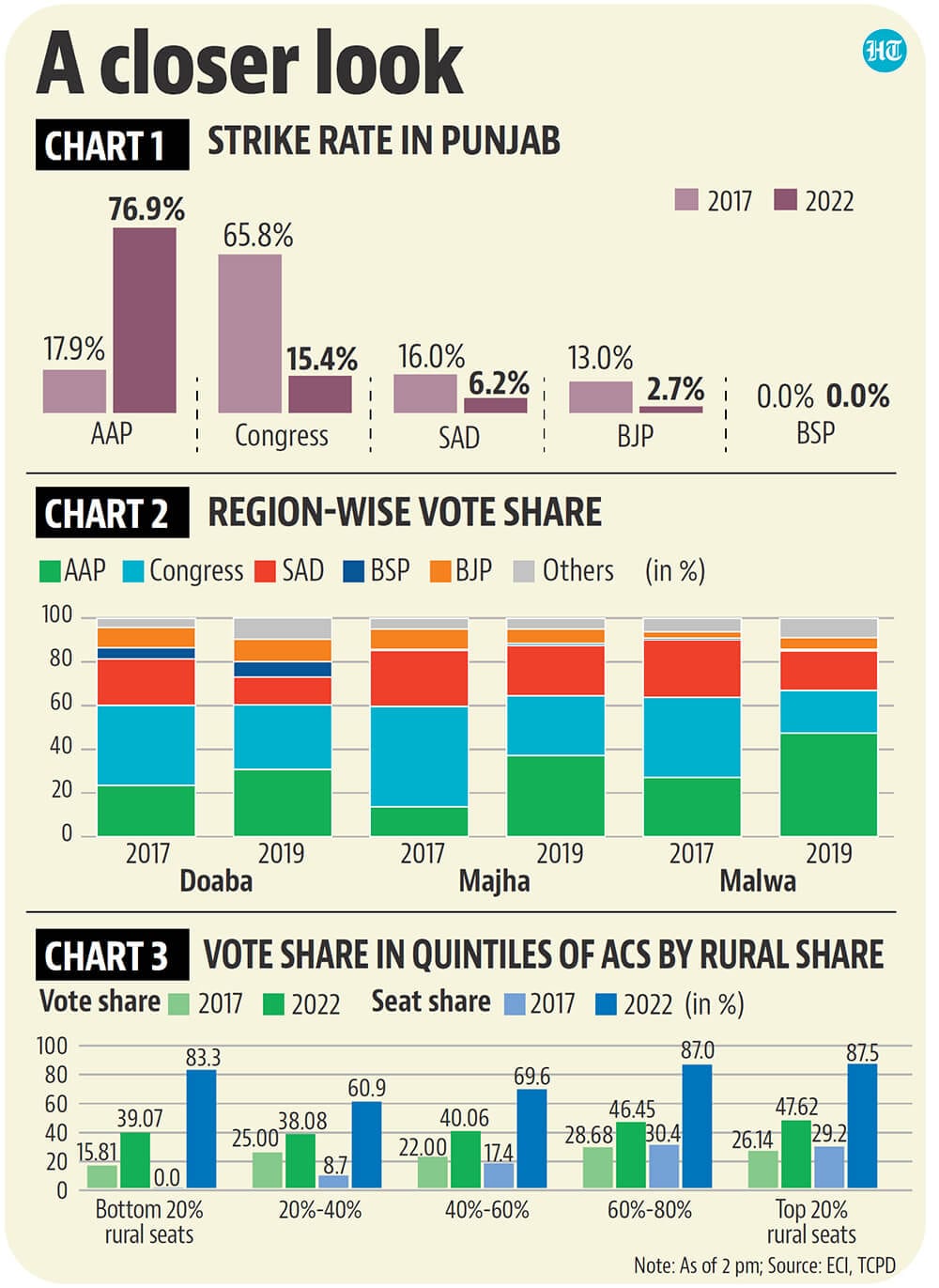
But the Congress’s defeat — across social segments, across the state’s diverse regions, across genders, as symbolised by the defeat of its top leaders including Sidhu and Channi — is only one part of the story from Punjab.
It is the Aam Aadmi Party (AAP)’s ability to win — across social segments, across regions, across genders, as symbolised by its unprecedented sweep — that constitutes an arguably even more significant part of the Punjab electoral story.
This is what the AAP did right.
For one, it was on the right side of public opinion. Arvind Kejriwal has been restrained in criticising Narendra Modi on the national stage on all major policy issues — especially those that could portray him as somehow being on the wrong side of “nationalist opinion”, except for the farm laws. Kejriwal ensured that he remained firmly committed to opposing the farm laws; the Delhi government, in its own way, supported farmer groups on the outskirts of the national capital during their long agitation; and when AAP went to campaign back in Punjab, to allay apprehensions that it was but the BJP’s B team, it could point to its role during the farm protests.
Second, AAP was on the right side of the politics of identity in Punjab. Unlike 2017, when Arvind Kejriwal let ambition get the better of his judgment and let it be known that he may be the CM if the party won the state, AAP recognised early on that declaring a Sikh would be CM was essential. This was a nod to Punjab’s unique history and social mosaic, and the need to give Sikh identity its legitimate political space at a time of heightened assertion. At the same time, AAP managed to retain the support of a large segment of Hindu voters in the state — who could see that the Congress was a sinking ship, the BJP was not in the game at all, and for whom, the Akalis, now contesting without their traditional ally, was not an option.
Three, AAP was on the right side of the politics of hope in a state that has known disenchantment in recent years. Punjab’s governance crisis is most acutely reflected in its unsustainable political economy of agriculture, massive unemployment, high rates of external migration, poor public finances, and the fact that one of the most prosperous and developed states of India has fallen behind its competitors in key economic metrics. AAP, by promising welfare packages, offered a ray of hope to the poor; by showcasing its Delhi model of health and educational achievements, it offered the promise of improved public service delivery; by portraying itself as a clean party in a polity marked by cronyism and corruption, it gave a sense of a break from the past; and by promising to be an effective regional voice for Punjab in Delhi, it tapped into the sub regional anxieties of a state which other regional forces had been tested and seen to have failed.
The victory in Punjab will change AAP — it will become a more serious contender on the national stage in terms of leading the opposition; it will have to contend with competing interests of Punjab and Delhi (Kejriwal can’t blame Punjab anymore for the spike in pollution in the capital every winter); and it will have to be a far more responsible actor given the national security imperatives associated with ruling a border state. But even as Punjab changes AAP, voters will wait to see whether AAP can change Punjab.


