
 E-Paper



How PM Modi transformed Gujarat and is now leading India's rise
After taking over as prime minister in 2014, Modi undertook the monumental task of rebuilding India from the ground up.


As Prime Minister Narendra Modi marks 23 years as head of government, his home state of Gujarat has been termed as a “beacon of transformation.”
Modi, who turned 74 last month, served 12 years as chief minister of Gujarat and now is in 11th year as the prime minister of India.
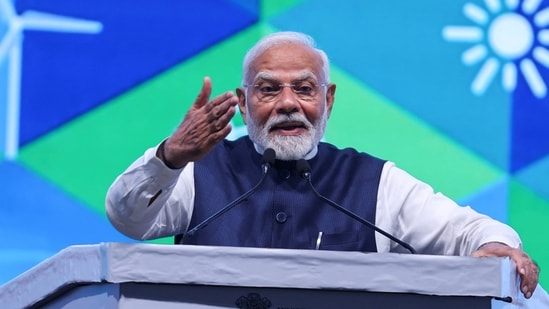
How Gujarat fared before Modi took over as CM?
In the mid-1980s, Gujarat witnessed three consecutive droughts from 1985 to 1987. Out of 18,000 villages, 11,000 had no access to drinking water. The state's economy had nearly collapsed. Agricultural distress paralysed rural livelihoods and the industries faced supply chain disruptions.
ALSO READ: Narendra Modi marks 23 years of leadership with focus on ‘Jan Bhagidari’
After taking over as the chief minister of Gujarat in 2001, Modi's first task was to tackle the state's severe water shortage and revive its crippled economy.
The then chief minister launched the ‘Sujalam Sufalam Yojana’, a groundbreaking initiative focused on water conservation and management. Under this scheme, an intricate network of canals, check dams, and reservoirs was constructed to meet the state’s water needs year-round.
The project not only replenished groundwater levels but also made Gujarat water surplus, turning the state's fortunes around. Moreover, Modi’s emphasis on decentralised governance empowered local communities to take ownership of water resources, laying the groundwork for long-term sustainability.
Another significant intervention was the Jyotigram Yojana, which provided 24-hour electricity to rural Gujarat. This transformed the agricultural sector, allowing farmers to access water pumps and modern machinery, while also fostering small-scale industries.
Narendra Modi’s leadership during this time not only resolved the state’s immediate water and energy crisis but also laid the foundation for Gujarat’s economic resurgence.
Modi’s tenure as CM of Gujarat left an indelible mark through ambitious projects that combined development with visionary governance.
Vibrant Gujarat Summit
The Vibrant Gujarat Summit was launched in 2003 and became a platform to attract global investments. Modi positioned Gujarat as an investor-friendly state, and by the time he left office, the summit had garnered billions in commitments, transforming the state into an industrial powerhouse.
Projects like the Sabarmati Riverfront turned neglected areas into flourishing public spaces, boosting both tourism and urban development. The riverfront not only enhanced the city’s aesthetic appeal but also rejuvenated the local economy by attracting businesses, events, and festivals.
2014: PM Modi undertook task of Rebuilding India
After taking over as prime minister in 2014, Modi undertook the monumental task of rebuilding India from the ground up.
One of his most far-reaching initiatives was the Digital India Mission, which aimed to transform India into a digitally empowered society. By focusing on expanding internet access, digital literacy, and online government services, Modi brought millions of citizens into the digital fold, making e-governance more accessible and transparent.
The Swachh Bharat Abhiyan revolutionised public health and sanitation across the country. This massive cleanliness drive made over 100 million toilets accessible, declaring villages open defecation free, improving overall health, and drastically reducing diseases related to poor sanitation.
Through the PM-Kisan Samman Nidhi, Modi directly addressed the plight of farmers by providing income support to 11 crore farmers. This was a game-changer for India’s agrarian community, alleviating debt pressures and enabling farmers to invest in better resources for their crops.
The PM Awas Yojana has built over 4 crore houses, providing millions of Indians with safe, affordable housing. Under this initiative, housing is no longer a distant dream for India’s poor, as the government’s focus on affordable and sustainable development has given them the means to own their homes.
Healthcare in India saw a revolutionary change with the introduction of Ayushman Bharat, the world’s largest government-funded healthcare program. Providing free health insurance to over 50 crore citizens, Ayushman Bharat has shielded millions of families from the crippling costs of medical treatments and surgeries, ensuring that healthcare is a fundamental right rather than a privilege.
It is for the time since independence that public spending on healthcare has exceeded out of pocket expenditure, indicating massive financial relief for millions of poor and middle class households.
With Make in India, Modi focused on transforming India into a global manufacturing hub, boosting local industries, and creating jobs. This initiative has revitalized sectors such as electronics, automobiles, and defence manufacturing, leading to an increase in exports and foreign investments.
Aligned with India's vision of 'Atmanirbhar Bharat,' Production Linked Incentive (PLI) Schemes for 14 key sectors have been launched with an investment of Rs. 1.97 lakh crore (over US$26 billion) to boost India's manufacturing capabilities and drive exports. Recently, India India's foreign exchange reserves have skyrocketed to an all-time high of $700 billion. In 2013-14, India’s foreign reserves stood at less than $300 billion.


