
 E-Paper



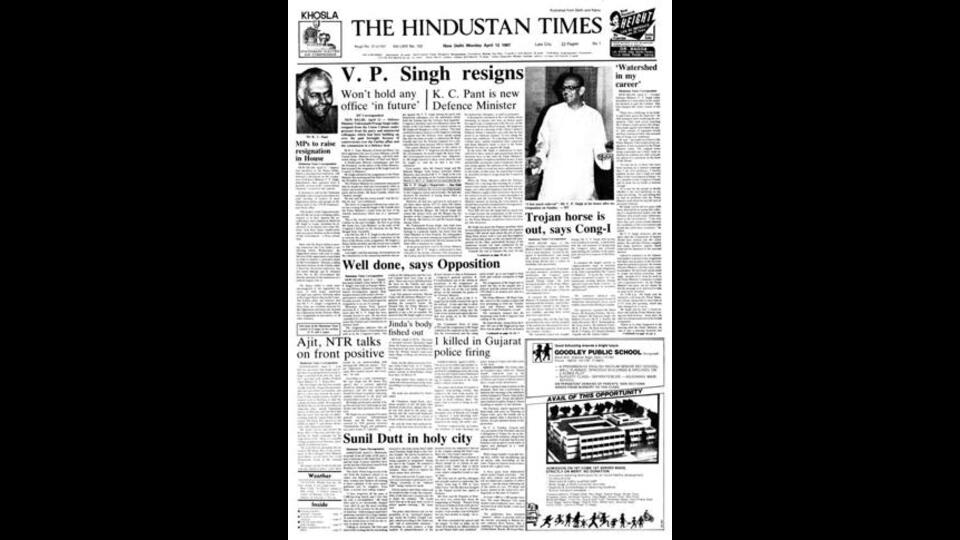
HT This Day: April 13, 1987 -- V. P. Singh resigns
Defence Minister Vishwanath Pratap Singh today resigned from the Union Cabinet under pressure from his party and ministerial colleagues which had been building up over the past fortnight because of controversies over the Fairfax affair and the commission in a Defence deal

 Prefer HTon Google


Defence Minister Vishwanath Pratap Singh today resigned from the Union Cabinet under pressure from his party and ministerial colleagues which had been building up over the past fortnight because of controversies over the Fairfax affair and the commission in a Defence deal.
Mr K. C. Pant. Minister of Steel and Mines, has been appointed the new Defence Minister and Mr Vasant Sathe, Minister of Energy, will hold additional charge of the Ministry of Steel and Mines.
A Rashtrapati Bhavan communiqué said that the President, on the advice of the Prime Minister, had accepted the resignation of Mr Singh from the Council of Ministers.
Mr Singh submitted his resignation to the Prime Minister this morning and the latter forwarded it to the President for acceptance.
The Defence Minister in a statement announced that he would not hold any Government office in future and would continue to serve the Congress-I party and its leader, Mr Rajiv Gandhi, which was “honour enough”.
He also said that his action would “nail the lie” that he was “over-ambitious”.
The letter of resignation followed an earlier letter last evening from Mr Singh to Mr Gandhi after the Prime Minister’s return from his tour of the Amethi constituency which was of a “personal” nature.
This is the second resignation from the Union Cabinet in the past fortnight, the first to go being Mr Asoke Sen, Law Minister, in the wake of the Congress-I debacle in the elections for the West Bengal State Assembly.
Like Mr Sen, Mr V. P. Singh too has decided not to exercise his option to make a statement on the floor of the House on his resignation. Mr Singh is a Rajya Sabha member and this forum was available to him tomorrow if he had decided to make a statement.
Last night’s and this morning’s developments are the culmination of the simmering mistrust and anger against Mr V. P. Singh among his party and ministerial colleagues over the disclosures about both the Fairfax and the Defence deal inquiries. Congress-1 members and even Ministers chose the forum of the Lok Sabba also to launch attacks on Mr Singh and disapprove of his conduct. They had attributed sinister motives to Mr Singh for ordering an inquiry into the Defence deal, openly saying that this was done in order to embarrass Mr Rajiv Gandhi who was the Defence Minister for a considerable time from January 1985 to January 1987.
One junior Minister had gone to the extent of saying that if Mr V. P. Singh was not thrown out of the Government, he would topple Mr Rajiv Gandhi’s Government in two months’ time. Apparently, Mr Singh referred to these views when he said he sought to “nail the lie that I am overambitious”.
Even earlier, after Mr Dinesh Singh and Mr Baliram Bhagat, both former External Affairs Ministers, had attacked Mr V. P. Singh in the Lok Sabba while speaking on the Fairfax discussion on March 31, Mr V. P. Singh had declared that he was to undergo the severest test of his loyalty to the Congress-I party and its leader. He had also declared his intention of laying down office as proof of his loyalty.
However, he had also said that he had gone to jail three times during 1977-79, when Mrs Indira Gandhi was out of power unlike Mr Dinesh Singh and Mr Baliram Bhagat. Mr Dinesh Singh had joined the Janata Party and Mr Bhagat was the member of the Congress-S party headed by Mr Y. B. Chavan, Mr Devraj Urs and Mr Swaran Singh among others.
Mr Vishwanath Pratap Singh, who hails from Manda in Allahabad district of Uttar Pradesh and belongs to a princely family, has been twice the Chief Minister of Uttar Pradesh. He relinquished office on one occasion owning up responsibility for not being able to control the dacoity menace in the State after a massacre by a gang.
In his personal letter sent to the Prime Minister last night, Mr V. P. Singh is understood to have referred to the hostile criticism of his decisions in the Fairfax and the Defence commission deal from his ministerial colleagues, as well as partymen.
Following his statement in the Lok Sabba about instituting an inquiry into how an Indian agent managed to get a commission of ₹30crore on the submarine deal from West Germany, Mr Singh was taken to task at a meeting of the Union Cabinet’s Political Affairs Committee and told that he had acted in an arbitrary manner, by not taking the leader into confidence. At a meeting of the Union Cabinet later, similar sentiments were expressed and many Ministers made it clear to the Prime Minister he must act against Mr Singh.
In his letter Mr Singh is understood to have referred to these matters and assured him that his decisions were in line with the Prime Minister’s crusade against corruption and black money. It was uncharitable on anyone’s part to insinuate that he was acting against the interests of the party or its leader. In order to avoid any more embarrassment to the leader on this score, he stated that it would be desirable for him to resign from the Council of Ministers.
When the Prime Minister called the Defence Minister for a meeting this morning he is understood to have made it known to him that he was not happy over what had happened and that the Defence Minister ought to have been more discreet in his action so as not to create a crisis atmosphere in the party and the Government. If the Defence Minister insisted on leaving the Government, he should then send him a formal letter of resignation. Mr Singh did that after the meeting.
Party MPs felt that Mr Singh had no option but to resign because his continuance in the Government would have been difficult. Had he not done so, the Prime Minister would have been forced to get him dismissed.
Mr Singh was given the Finance portfolio when he was inducted in the Union Cabinet once again in January 1985 and he went about the job of unearthing black money with a zeal and thoroughness that earned him praise on the one hand and antagonism on the other, particularly because of the numerous income tax raids conducted by his Directorate of Enforcement all over the country.
Towards the end of January this year, he was suddenly shifted to the Defence Ministry when the Indian and Pakistani armies were locked in an “eye ball to eye ball” confrontation on their borders. The Prime Minister himself was (be Defence Minister at that time but it was felt that a full-time Defence Minister was required in view of the tension on the borders.
Political observers and Opposition leaders by and large, however, interpreted this as a punishment for Mr Singh for having taken his job of unearthing black money and preventing Foreign Exchange Regulation Act (FERA) violations by Indian companies abroad “too seriously”, which was causing embarrassment to the Government.
However, the raids, the Fairfax disclosures and the arrest of Mr S. Gurumurthy of the Indian Express by the Central Bureau of investigation (CBI) each coming after the other in quick succession in the last six weeks or so, apparently sealed his fate. He came under attack from his party colleagues for the manner in which he reportedly appointed Fairfax Inc. for enquiring into FERA violations by some Indian companies.
The proverbial last straw on the camel’s back was the announcement, through a Press release on Thursday evening, of the institution of an enquiry into a Defence deal in which an Indian agent was to receive as much as ₹30 crore as commission. More offensive, according to his party and ministerial colleagues, was the statement about this enquiry made on the floor of the lak Sabha, in contravention of established norms and conventions.
Mr Singh has been the Deputy Minister and Minister of State in the Commerce Ministry before 1977. He was Minister of Commerce in 1980 but had gone to Uttar Pradesh in 1982 to head the government there. He was elected to the Rajya Sabha in 1983 from Uttar Pradesh and is now the Leader of the House. This office, however will go to another Cabinet Minister who is a Rajya Sabha member.


