E-Paper



India is essential interlocutor in resolving conflicts: Italy’s deputy prime minister Antonio Tajani
Tajani emphasised the need for an investment protection agreement between India and the EU, alongside the FTA

 Prefer HTon Google


Italy wants concrete initiatives to speed up work on the India-Middle East-Europe Economic Corridor (IMEC), such as a fast-track corridor for customs clearance and container tracking through digital procedures, Italian deputy prime minister and foreign minister Antonio Tajani said in an exclusive interview.
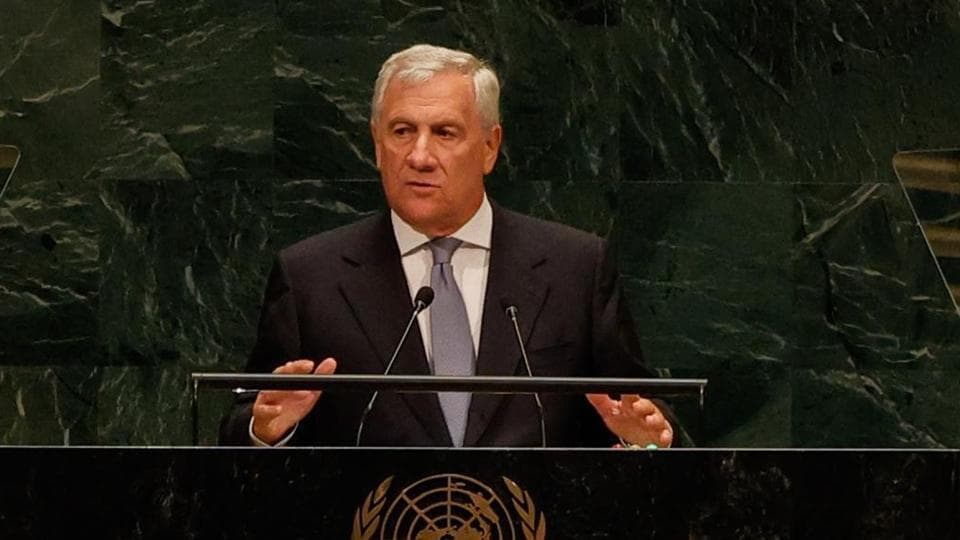
Speaking ahead of an India-Italy Business Forum he will co-chair with commerce minister Piyush Goyal in Rome on Wednesday, Tajani emphasised the need for an investment protection agreement between India and the EU, alongside the FTA to be signed in December. Tajani described India in the email interview as an essential interlocutor in addressing the conflicts in Ukraine and West Asia. Edited excerpts:
What opportunities does Italy expect the India-EU FTA, to be signed in December, to open up? How is Italy preparing to take advantage of the deal to boost trade and investment with India?
The EU-India FTA will be a game changer. The expected reduction in tariffs will open new opportunities in key sectors of bilateral trade with India: machinery, automotive components, pharmaceuticals and agri-food. Many Italian companies, particularly our SMEs, have high-quality technologies and solutions to offer. That makes Italy the second largest manufacturing powerhouse in Europe. India, for its part, is looking to strengthen its industrial base. There is an objective complementarity between our economies. We are determined to leverage it. My ministry has adopted a series of instruments to support Italian companies seeking to establish or expand their business in India – a €500 million financing line for market access and joint ventures, increased guarantees for Indian buyers of Italian products, business-matching platforms, a stronger presence at trade fairs across the country, targeted sectoral missions, and more. Around 1,000 Italian companies already operate in India. We aim to increase that number.
How important is it for India and the EU to conclude an investment protection agreement alongside the FTA?
More trade can be a driver for more investments. For Italy, India is not just a destination market for our exports. Rather, a priority industrial partner. The conclusion of an investment protection agreement could certainly help in this regard. It would constitute a necessary complement to the FTA; it would send a strong signal to investors about our commitment to providing a predictable, rules-based framework for cross-border investment between Europe and India, and to deepening our long-term economic partnership. Our goal is to build more resilient and diversified value chains.
What are the expected outcomes of the Business Forum you will co-chair with commerce minister Piyush Goyal?
We are bringing some of our most prominent business leaders to send them a clear message: Italy and India are privileged partners, particularly when it comes to trade and investment. Our bilateral trade exchange has doubled over the past 10 years. We must work together now to achieve the target of €20 billion in bilateral trade by 2029, set by our two governments last May. We stand alongside our companies to help turn opportunities into mutually beneficial industrial partnerships. We are placing a strong emphasis on innovation. Soon, we will open an Italian innovation centre in India. It will be a platform to enhance sustained growth for start-ups and innovative companies, from AI to agritech, biotech, and advanced materials. It will foster business, but also the fruitful exchange between our research clusters and universities.
What are Italy’s priorities for ties with India in 2027 and to deepen the bilateral strategic partnership?
Last May, we elevated Italy-India ties to a special strategic partnership. This is testimony to the strong political trust between our countries and broad convergence of our strategic interests. We have a roadmap, a Joint Action Plan for 2025-2029, which we are implementing and already delivering important milestones. Our cooperation spans a wide range of areas – from defence to space, from counter-terrorism to science and research, from education to professional mobility. A key dimension is people-to-people ties, and 2027 will be the Year of Culture and Tourism between Italy and India. We are working on an intense calendar of events, exhibitions and initiatives designed to bring our rich cultural heritages closer together. Art, architecture, design, cinema, fashion and much more. It will promote our territories and strengthen synergies between our creative industries. It is an investment in the future of our relationship: an opportunity to strengthen the ties between our societies and open up new avenues for cooperation.
How are the two sides taking forward the India-Middle East-Europe Economic Corridor (IMEC), and can this strategic initiative progress without resolving the West Asia conflict?
One of the lessons learned from the conflict in West Asia is the need to pursue the diversification of trade routes with even greater determination. In this spirit, we stand alongside India in advancing the vision of IMEC. The aim is to create a diversified network of corridors connecting India and Europe. Its promise is to reduce the risk of any single chokepoint being used as a source of leverage or coercion, as we have seen in the case of the Strait of Hormuz. This means developing infrastructure, undersea cables, and trade routes through which goods, data, people, and ideas can move. We want to start with concrete initiatives. One flagship initiative would be a fast-track corridor to speed up customs clearance and container tracking through digital procedures between our ports.
How do you assess the Russia-Ukraine conflict? What role can India play?
Italy is not at war with Russia, but we condemn Russia’s attacks against a free and democratic country. The law of force cannot prevail, even when disputes arise. Diplomacy must always take precedence. Italy’s position will remain unchanged – support for Kyiv, continued pressure on Moscow through sanctions, Euro-Atlantic unity. The peace we seek and are working for is a just peace. Only a just peace can last and safeguard Europe’s interests. But peace, for us, does not mean Ukraine’s surrender.
India can play a very important role in helping to find a political solution. We see New Delhi as an essential interlocutor in addressing crises that today are no longer merely regional, but global. I am referring to Ukraine, but also to the Gulf. We appreciated the Prime Minister’s recent assessment, calling for a shift from endless war to an end to all wars. India can play an ever greater role and contribute to international stability and security – priorities that Italy shares.