
 E-Paper





Follow the latest breaking news, major developments and agenda-setting stories from India and around the world with the newsdesk at Hindustan Times. Operating round the clock, the desk brings together experienced editors, reporters and correspondents to deliver fast, accurate and contextual reporting across subjects that influence public policy, governance, business, society and international affairs. The HT News Desk covers politics, elections, government policies, the economy, business and markets, science and technology, the environment, law and order, infrastructure, education, climate issues and geopolitics, while closely tracking developments across states, institutions and global capitals. The team also leads coverage of major breaking news events, policy announcements, court proceedings, natural disasters, public emergencies and significant international developments. Reports published by the newsdesk are based on information gathered from reporters on the ground, official statements, government agencies, court records, regulatory filings, recognised institutions and other authoritative sources. Stories undergo editorial scrutiny and verification processes to ensure accuracy, fairness and relevance, and are updated as events evolve and additional information becomes available. Whether covering a key political decision in New Delhi, an economic policy shift affecting millions, a landmark court ruling or a major global event, the HT News Desk aims to provide readers with reliable, fact-based journalism that delivers not only the latest developments but also the context and analysis needed to understand their wider implications.
$5 trillion economy possible due to efforts since Independence: Pranab Mukherjee
Delivering a lecture on ‘Furthering India’s Promise’, Mukherjee said various economic and social sectors are performing well because of the efforts of Indians since Independence.


Former president Pranab Mukherjee said on Thursday that India would become a USD 5 trillion economy by 2024 because of the strong foundation laid by previous governments.
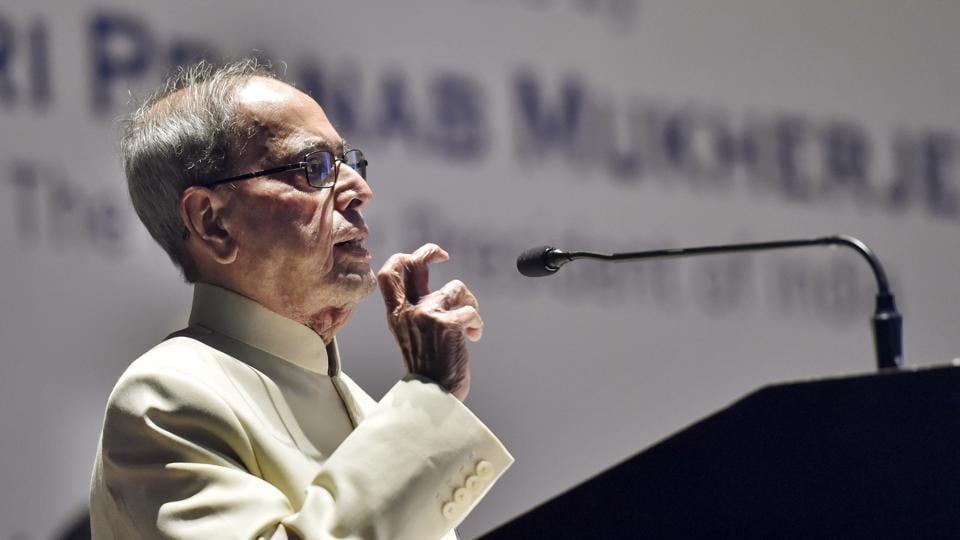
Delivering a lecture on ‘Furthering India’s Promise’, Mukherjee said various economic and social sectors are performing well because of the efforts of Indians since Independence.
He rued the fact that the Modi dispensation has not only scrapped five-year plans but also done away with the Planning Commission.
“The Finance Minister can say that India will become a USD 5 trillion economy by 2024 because of the strong foundation laid previously. The efforts were not put by Britishers but by Indians since Independence,” he said.
“These five-year plans built the vision for economy, health, education among others. The investment used to be made based on these plans,” he told at the lecture organised by Samruddha Bharat Foundation.
Mukherjee further said he agrees that non-Congress governemnts also played a vital role in development of the country but noted that to “exclude would be absolutely absurd”.
He said Mangalyaan has been made possible because “not by magic but by the sustained efforts on which the ground work has been done”.
He listed out various instances of exploitation by the Britishers and how India recuperated from it after the Independence.
“India has been physically conquered a number of times but not spiritually but I do believe that India has always risen out of it,” he said.
(This story has been published from a wire agency feed without modifications to the text. Only the headline has been changed.)


